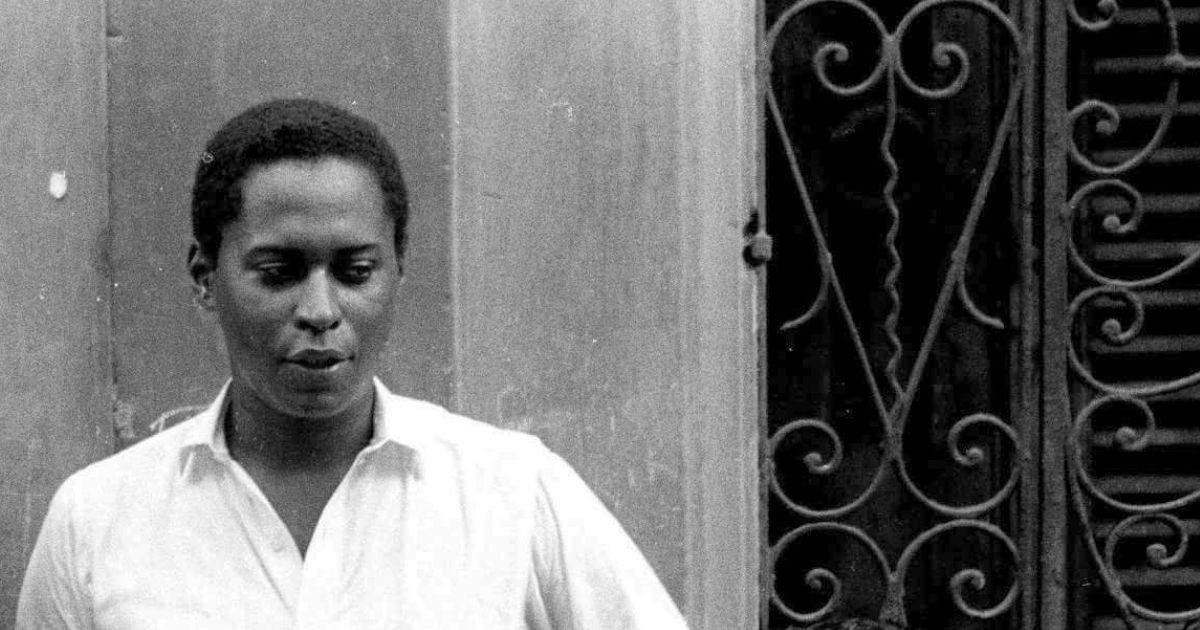
On Monday, October 26, the Institute of Hispanic-American Literature (ILH) at the University of Buenos Aires will host the screening of restored short films by Cuban filmmaker Nicolás Guillén Landrián. A victim of the Cuban regime, Guillén Landrián faced persecution, imprisonment, and psychiatric hospitalizations until he finally sought refuge in Miami.
The event is part of the La.R (Latinoamericanistas en Red) series, organized by the Caribbean Studies Group of the ILH. It is scheduled for 6:00 PM in the Ángel Rama Room, located at 25 de Mayo 221, 3rd floor, Buenos Aires.
Puerto Rican essayist and professor Julio Ramos will present the screening. The event will also feature a discussion with Cuban writer Marcial Gala, who has resided in Buenos Aires for several years.
Julio Ramos is a leading academic authority on Guillén Landrián's work. Together with Raydel Araoz, he co-directed the documentary "Returning to Havana with Guillén Landrián" (2013) and co-edited the book "Guillén Landrián or the Cinematic Disconcert," published by Almenara Editores in 2019.
Born on June 30, 1938, in Camagüey, and deceased in Miami on July 21, 2003, Nicolás Guillén Landrián was the nephew of Cuba's national poet Nicolás Guillén. He worked at the Cuban Institute of Cinematographic Art and Industry (ICAIC) between 1962 and 1972, where he created approximately twenty documentary shorts.
The Digital Encyclopedia of Cuban Audiovisuals describes him as "one of the most significant and irreverent documentarians in Latin American cinema." However, after being expelled from ICAIC in 1973 due to ideological reasons, he was largely forgotten. He faced imprisonment on several occasions, accused of 'dangerousness' and 'ideological diversionism,' and had multiple admissions to psychiatric hospitals.
One of his most famous works, Coffea Arábiga (1968), transformed a propagandistic commission about coffee cultivation in Havana's Cordón into an experimental montage. The documentary featured the song "The Fool on the Hill" by The Beatles during a sequence showing Fidel Castro ascending a podium. This association disturbed certain official viewers and contributed to the film's controversies and subsequent censorship.
Guillén Landrián himself documented the marginalization he experienced at ICAIC, stating, "I was humiliated and ostracized during my entire tenure at ICAIC, and my films were censored due to my social behavior."
After being expelled from ICAIC, he was confined to the Carbó-Serviá ward of Havana's Psychiatric Hospital—commonly known as Mazorra—at the State Security's request, where he underwent electroconvulsive treatments. He went into exile in 1989 and never returned to Cuba.
His filmography, sidelined for decades, began gaining visibility in the late 1990s. This resurgence accelerated in 2000 when "Ociel del Toa" (1965) and "Coffea Arábiga" (1968) were shown at the first ICAIC Young Audiovisual National Showcase in Havana. Subsequent editions of the event continued to revive his documentaries, introducing them to new generations of filmmakers.
Years later, restoration efforts allowed for the international circulation of his works, including shorts like "En un barrio viejo" (1963), "Ociel del Toa" (1965), "Los del baile" (1965), "Coffea Arábiga" (1968), and "Taller de Línea y 18" (1971), which were featured in festivals and international retrospectives.
However, this revival has not been without conflict. In December 2023, during the presentation of the documentary "Landrián"—directed by Ernesto Daranas—at the New Latin American Film Festival in Havana, Daranas publicly denounced Cuba's ongoing censorship: "The real issue has never been in our films, but in the reality they reflect. [...] That's why censorship persists. That's why dissent is criminalized."
Months later, in February 2025, Cuban journalist Yania Suárez was expelled from the Ludwig Foundation in Havana after questioning omissions regarding Guillén Landrián's potential ties with the Cuban Committee for Human Rights and his involvement in the First Exhibition of Dissident Art in 1988 during a debate on the same documentary.
Suárez accused the official "rescue" of the filmmaker of being orchestrated by ICAIC—the institution that once persecuted him—to align his legacy with the regime's narrative, erasing his dissident dimension.
This debate over the selective memory of the filmmaker might serve as the backdrop for the academic event in Buenos Aires, where his restored shorts will reach a Latin American audience more than two decades after his death.
Insight into Nicolás Guillén Landrián and His Cinematic Legacy
Who was Nicolás Guillén Landrián?
Nicolás Guillén Landrián was a Cuban filmmaker known for his influential yet controversial documentary shorts. Despite his artistic contributions, he faced severe persecution under the Cuban regime, which led to his eventual exile in Miami.
What is significant about his film "Coffea Arábiga"?
"Coffea Arábiga" is notable for transforming a propagandistic film about coffee cultivation into an experimental piece that included a sequence with Fidel Castro and a Beatles song, leading to its censorship and controversy.
How has his work been received over time?
Initially marginalized, Guillén Landrián's work began to gain recognition in the late 1990s, leading to international restoration and screenings, although not without ongoing controversies regarding censorship and narrative control by the Cuban regime.