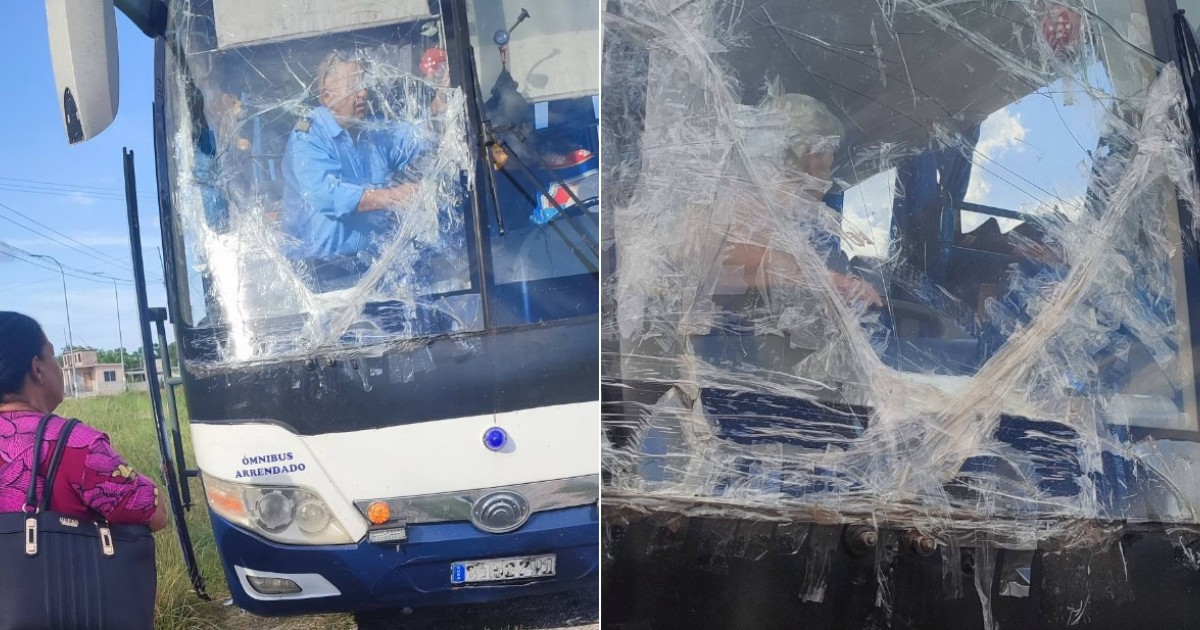
A traveler who purchased a ticket with Pedrocarr S.R.L.—a Cuban small and medium-sized enterprise (SME) specializing in interprovincial transportation—has taken to the Facebook group "Cubanos en Madrid" to report a harrowing 25-hour bus ride. The bus, which she boarded after paying 65 euros, had a windshield that was completely shattered and patched up with adhesive tape.
The photos shared by the passenger reveal the front of the bus marked with the sign "RENTED BUS" and display numerous radial and concentric cracks on the windshield. Pieces of laminated glass dangle precariously, with a central point of impact from which the fractures emanate, all while passengers are visibly seated inside the white bus.
A WhatsApp conversation with the company's contact further highlights the operational challenges faced by Pedrocarr at that time: "Good afternoon, currently we have no more vehicles available in the Bayamo or Santiago area. Let me see what other arrangements I can make. All buses are heading in the opposite direction."
The payment in euros is part of Pedrocarr's business model, which primarily targets the Cuban diaspora. They finance their family members' trips within the island through an online booking platform, where tickets are paid using international Visa or MasterCard credit cards.
In late 2025, the company was involved in violent incidents on the road: two of its buses were stoned within less than a week, one in Vado del Yeso—between Las Tunas and Bayamo—and the other in Contramaestre, Santiago de Cuba.
This complaint against Pedrocarr comes amid a structural crisis in Cuba's interprovincial transportation system: of the state's fleet of 558 buses, only 219 were operational as of December 2025—approximately 39%—while at least 320 are needed to maintain the national schedule.
Facing this collapse, the Ministry of Transport reduced the routes of National Buses starting in June 2026 to three weekly departures between Havana and provincial capitals, with just one weekly trip to Manzanillo and Baracoa.
In this gap, private companies like Pedrocarr—established in April 2022, headquartered in Las Tunas, and boasting a fleet of 34 buses as of February 2026, including those leased from the National Bus Company—have risen in prominence but have also accumulated complaints pointing to unacceptable safety conditions.
Cuban regulations mandate that vehicles must have windshields in good condition and with clear visibility, making the report of a bus completing a 25-hour trip with a cracked and tape-patched windshield particularly serious, especially with passengers on board.
Key Issues in Cuban Transportation
What are the operational challenges faced by Pedrocarr?
Pedrocarr has encountered issues with vehicle availability in specific regions, such as Bayamo and Santiago, with all buses reportedly traveling in opposite directions to demand.
Why does Pedrocarr charge in euros?
The company's business model targets the Cuban diaspora, allowing family members abroad to finance trips for relatives in Cuba through an online platform, using international Visa or MasterCard cards for payment.
What is the current state of Cuba's interprovincial transportation?
Cuba's interprovincial transportation is in crisis, with only 39% of the state fleet operational as of December 2025, far below the number needed to meet national scheduling demands.