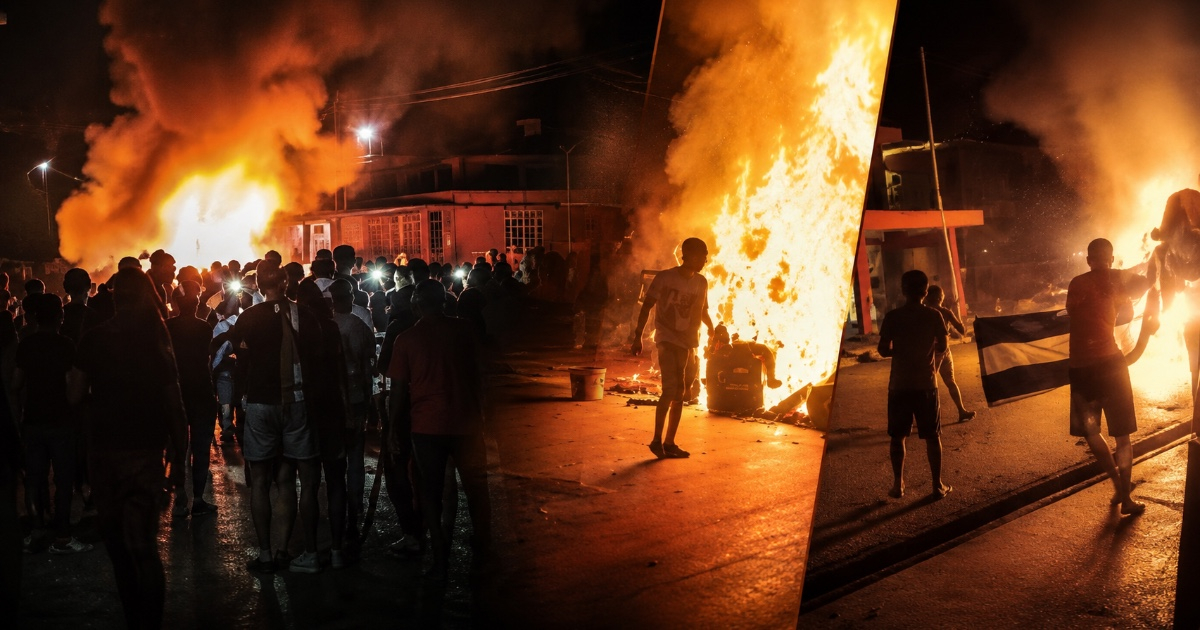
In response to the March 13 protests in Morón, the Provincial Prosecutor's Office in Ciego de Ávila is seeking lengthy prison sentences for 19 individuals, including minors. Some of these young people were underage when the events took place.
The charges stem from accusations of sedition related to anti-government demonstrations, where a large number of Morón residents voiced their frustration over persistent blackouts, food shortages, and harsh living conditions.
According to Martí Noticias, the prosecutor's requests range from seven to thirteen years of incarceration. Families of those accused argue against the charges, asserting that the authorities have not provided concrete evidence linking their children to any violent acts during the protest.
Among the accused, several youths have been held since March, while others, like teenager Jonathan David Muir Burgos, were later released but remain under judicial scrutiny.
These proposed sentences are not yet final court decisions. They represent preliminary conclusions by the prosecutor that will be subject to review during the trial process.
The Case of Extended Sentences for Blackout Protestors
The longest sentence proposed is for Hosuán Naranjo Chacón, with a request for 13 years. Meanwhile, 28-year-old Brian Pérez Muñoz and other adults face 12-year sentences.
Seventeen-year-old Christian de Jesús Crespo Álvarez is looking at eight years in prison, while other minors, including Jonathan David Muir Burgos, potentially face seven years. Muir's imprisonment in an adult facility has drawn criticism from international human rights organizations.
These prosecutorial demands come seven months after the protests, with many families still advocating for their relatives' release and challenging the use of sedition charges.
Mother Challenges Evidence Against Detained Son
Dayarmé Muñoz, the mother of Brian Pérez Muñoz, disputes the charges against her son, who remains detained since March. She told Martí Noticias that Brian joined the protest after incidents had already occurred at the Communist Party headquarters.
While acknowledging her son participated in the protest and voiced dissatisfaction, she denies any involvement in acts of vandalism, such as throwing stones or setting fires.
Brian was transferred to the maximum-security Canaleta prison about a month after his arrest, where he is still being held.
His mother claims that over the past seven months, authorities have dismissed four requests for a change in pretrial conditions and one formal complaint on his behalf.
Teen Faces Eight-Year Sentence Despite Negative Forensic Evidence
Christian de Jesús Crespo Álvarez, detained at 16, may be sentenced to eight years despite his mother's insistence that forensic tests did not link him to the protest damages. Marielkis Álvarez, his mother, disputes the evidence, stating fingerprint, footwear, and scent tests were all negative.
She also argues that the accusation relies on a video where her son's face is not visible. Investigators reportedly identified him based on height and a tattoo, which the family believes are insufficient for proving his involvement.
Christian's case has prompted public outcry, with reports of mistreatment and theft of his belongings during his detention at Canaleta.
Jonathan Muir's Continued Legal Battles Despite Release
Among those processed is Jonathan David Muir Burgos, initially detained on March 16 after a police summons with his father, pastor Elier Muir Ávila. He spent over three months in custody, much of it in an adult prison.
During his detention, concerns were raised about his health and living conditions. The Inter-American Commission on Human Rights granted him precautionary measures, citing threats to his life, personal integrity, and health.
Released on June 24, Jonathan still faces movement restrictions. Reports indicate he cannot leave home without court approval, except for work, study, or health reasons.
Background on the March 13 Morón Protests
The protests erupted over public dissatisfaction with persistent power outages, food scarcity, and worsening living conditions. That night, Morón residents took to the streets, banging pots and chanting slogans like "Freedom!" and "Homeland and Life."
Reports indicate the gathering grew to over 800 individuals, who first approached a National Revolutionary Police unit and then the Communist Party headquarters.
Footage from the protests showed people removing and burning items from party offices, as well as throwing stones and causing damage to doors and windows.
The Cuban government's initial response acknowledged the peaceful start of the protests but later condemned the incidents at the party headquarters as acts of vandalism.
FAQs on the Morón Protests Sentences
What are the charges faced by the protesters in Morón?
The protesters are primarily charged with sedition, a serious offense linked to their participation in anti-government demonstrations.
Why are the protesters in Morón facing such severe sentences?
The severe sentences are linked to the Cuban government's efforts to penalize dissent and deter future demonstrations against its policies.
What was the cause of the March 13 protests in Morón?
The protests were fueled by widespread discontent over ongoing blackouts, food shortages, and declining living standards in Cuba.
How have families of the accused responded to these charges?
Families have criticized the charges, arguing that there is insufficient evidence to prove their relatives' involvement in any crimes.