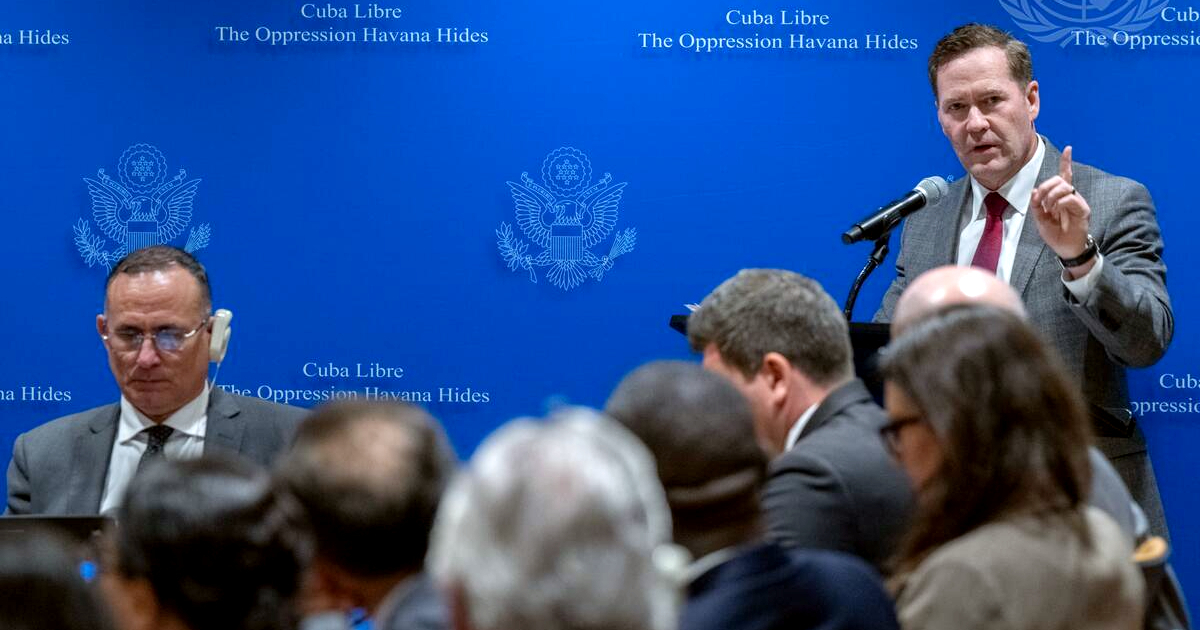
On Monday, the United States ramped up its diplomatic efforts to diminish global backing for Cuba's resolution against the embargo. This initiative took place at the United Nations headquarters in New York, bringing together former political prisoners, activists, and experts to spotlight the Cuban regime's role in the nation's ongoing crisis.
The event, titled "Cuba Libre: The Oppression Havana Hides," was led by U.S. Ambassador to the U.N., Mike Waltz. Notable speakers included José Daniel Ferrer, Luis Manuel Otero Alcántara, María Werlau, Emilio Morales, Republican Congresswoman Nicole Malliotakis, and Ukraine's diplomatic representative, Volodimir Pavlichenko.
With just over a week until the scheduled vote on October 27 and 28, Washington aims to shift the discussion from U.S. sanctions to Cuba's political repression, military control of the economy, and the government's accountability for the country's declining living conditions.
Waltz opened the gathering with a documentary highlighting the persecution of independent artists and challenged the narrative portraying the Cuban regime solely as a victim of U.S.-induced crisis. He also criticized the privileges enjoyed by Cuba's ruling elite while millions endure blackouts, food shortages, and a lack of medicines.
Voices of Former Political Prisoners
Opposition leader José Daniel Ferrer, who spent over 12 years in Cuban prisons, explained why he believes democratic governments should not support Havana's annual resolution. He argued that the regime uses these votes to mislead the public into thinking that the international community backs the Communist Party instead of those calling for freedom. For political prisoners, he emphasized, this message is particularly painful.
Ferrer also shared accounts of the torture and pressure he faced during incarceration and called for humanitarian aid to be delivered through independent entities. Meanwhile, artist Luis Manuel Otero Alcántara, recently exiled after five years in prison, condemned the criminalization of independent art and asserted Cubans' right to choose a different political path.
Researcher María Werlau highlighted the exploitation of healthcare professionals on international missions, while economist Emilio Morales pointed to GAESA as the center of the regime's economic and financial power. The Ukrainian representative further criticized the recruitment of Cuban citizens to fight for Russian forces, a topic previously addressed in U.S. diplomatic campaigns.
Impact of U.S. Diplomatic Pressure
This diplomatic push follows a significant setback for Cuba's resolution in October 2025, where it received 165 favorable votes compared to 187 in 2024. The number of opposing votes rose from two to seven, and abstentions increased from one to twelve. Argentina, Paraguay, Hungary, and Ukraine were among the nations that voted against it, while several European and Latin American governments chose to abstain.
In July 2026, Washington again applied pressure to prevent an extraordinary session on the embargo, which was eventually approved with 136 favorable votes, nine against, and 30 abstentions. Despite being a different vote, the outcome highlighted Havana's struggle to secure its traditional majority.
The Trump administration has intensified its efforts, with Secretary of State Marco Rubio directly discussing the issue with Salvadoran President Nayib Bukele. Germany is also reconsidering its longstanding support for the resolution.
Responses from Havana and Washington
The meeting sparked a strong reaction from Cuban diplomats. Permanent Representative to the U.N., Ernesto Soberón Guzmán, denounced it as a political maneuver against a sovereign state, while Foreign Minister Bruno Rodríguez Parrilla accused Rubio of exerting pressure and coercion on other governments. Cuban diplomats reportedly confronted activists, as noted by Ferrer, adding tension to the diplomatic standoff.
Congresswoman Malliotakis, whose family fled Cuba, urged the U.N. to hold Havana accountable for human rights abuses and questioned Cuba's repeated seat on the Human Rights Council. The U.S. aims to alter a vote that has, for over three decades, reflected the international community's opposition to the embargo. While many governments separate their stance on sanctions from their views on Cuba's political system, Washington argues that Havana exploits this support to maintain power and avoid reforms.
As the meeting concluded, Waltz urged delegations to remember the testimonies when voting. His call was clear: to reject Cuba's resolution or, at the very least, abstain.
The upcoming vote will reveal whether the U.S. diplomatic offensive can further erode support as seen in 2025, or if Havana can retain its international majority demanding an end to the embargo.
Common Questions About the U.S. and Cuba's U.N. Resolution
What was the purpose of the U.S. gathering at the United Nations?
The U.S. aimed to reduce international support for Cuba's anti-embargo resolution by highlighting the Cuban regime's responsibility for the island's crisis.
Who participated in the "Cuba Libre" event?
The event featured former political prisoners, activists, and experts, including José Daniel Ferrer, Luis Manuel Otero Alcántara, and Congresswoman Nicole Malliotakis.
How has the U.S. diplomatic strategy affected international voting on Cuba's resolution?
The U.S. strategy has led to fewer supportive votes for Cuba's resolution and increased opposition, with more countries abstaining from the vote.