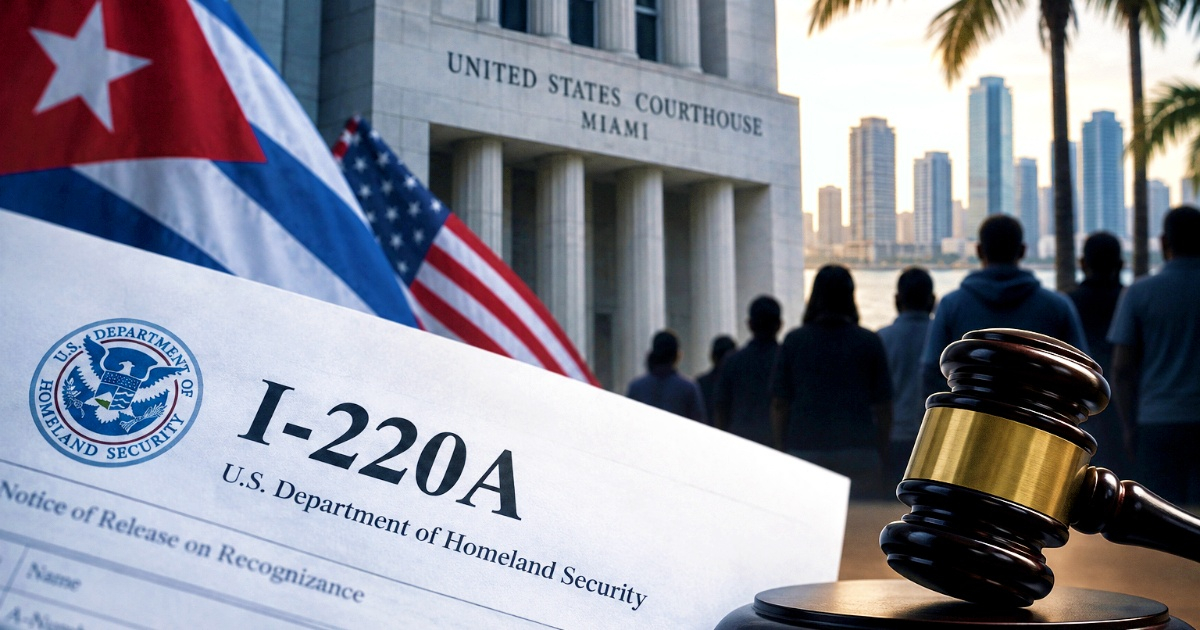
If you crossed the border and were released from immigration custody with a document labeled I-220A, you might have been told you "have parole" or, conversely, that the document "is useless." Both statements are inaccurate.
The I-220A is an Order of Release on Recognizance, which allows you to wait in freedom for your immigration process, albeit with conditions, and it is not equivalent to humanitarian parole.
The distinction is significant and not just a technicality.
Why the I-220A Falls Short for the Adjustment Act
The Cuban Adjustment Act requires individuals to have been "inspected and admitted or paroled" into the United States. The Board of Immigration Appeals (BIA) has ruled that release on recognizance does not meet this requirement.
Thus, many Cubans with an I-220A do not qualify for residency through this pathway with that document alone, although they may apply if they meet the criteria through other means.
What Exactly is the I-220A?
The I-220A is an ICE (Immigration and Customs Enforcement) form titled "Order of Release on Recognizance." According to the official model published by ICE, the release is granted "in accordance with section 236 of the Immigration and Nationality Act (INA)," which governs the arrest and detention of aliens while their case is decided.
Practically, this means the government released you from detention in exchange for your promise to meet certain conditions, such as:
- Attending all hearings or interviews when instructed by ICE.
- Submitting to deportation if so ordered.
- Enrolling in and complying with an Alternatives to Detention program if applicable.
- Not changing your residence without prior written permission from the designated officer.
- Not violating local, state, or federal laws.
- Collaborating with ICE to obtain travel documents if necessary.
In essence, the I-220A does not grant you any immigration status. It allows you to remain free while your case, typically before an immigration court, is ongoing.
Distinguishing Between I-220A, I-220B, and Parole
Though they can be easily confused, these three documents signify different situations for individuals in the United States without residency:
- I-220A (Order of Release on Recognizance): Issued under section 236 of the INA for those whose process has not concluded.
- I-220B (Order of Supervision): According to ICE's official form, given to individuals who have a final deportation order that hasn't been executed within the legal timeframe. It requires, among other things, reporting to ICE when requested and notifying any change of address or employment 48 hours in advance.
- Humanitarian Parole: Granted under section 212(d)(5) of the INA, it permits entry or stay in the country for humanitarian reasons or public benefit, typically recorded on the I-94 form.
The USCIS Policy Manual lists the I-94 among valid proofs of inspection, admission, or parole for status adjustment requests.
The Current State of the Legal Battle
The debate continues in federal courts. The BIA's decision in "Matter of Cabrera-Fernández," published on September 11, 2023, concluded that release on recognizance under section 236 is legally distinct from humanitarian parole under section 212(d)(5).
Consequently, applicants released in this manner "are not eligible" to adjust their status under the Cuban Adjustment Act. The BIA upheld this position in "Matter of Roque-Izada," dated June 20, 2025, rejecting the closure of a deportation case based solely on the potential future grant of parole by USCIS.
While federal courts remain divided on the issue, the Eleventh Circuit Court of Appeals, covering Florida, recently overturned BIA decisions in two Cuban Adjustment cases, sending them back for further review. This ruling did not declare the I-220A as parole nor grant residency to anyone, merely instructing the BIA to reevaluate those cases.
In Miami, lawsuits from Cubans with I-220A are ongoing, with the government requesting the dismissal of one such case, and no substantive decision has been reached.
Be wary of anyone promising to "convert" your I-220A into parole for a fee.
Your Responsibilities with an I-220A
Though the document does not confer status, failing to comply with its conditions can severely worsen your situation. Key obligations include:
- Attending all ICE appointments and court hearings. Appearing when summoned is the primary condition of the form.
- Obtaining permission before relocating. The form requires written authorization from the officer before changing residence, along with separate obligations to notify your new address to USCIS and the immigration court where applicable, within the applicable deadlines.
- Following your court case. With your A-number (the alien number on your documents), you can check dates and status in the EOIR's case information system, which oversees immigration courts.
- Complying with the Alternatives to Detention program if enrolled.
Next Steps
Review what document you have. Check the title of the paper you received upon release and consult your I-94 on the official CBP site. If you have an I-94 with parole, your situation may differ from someone with an I-220A.
Gather copies of everything: I-220A, citations, court notifications, ICE visit receipts, and any applications filed, such as asylum or work permits.
Consult with an attorney or accredited representative. Every case is unique, with Cubans holding I-220A having varied statuses, such as pending asylum applications, deportation orders, or BIA appeals. Legal advice can provide clarity on these distinctions.
Stay informed about the Cuban Adjustment Act requirements in our step-by-step guide, to know what might be required if your circumstances change.
Follow reliable sources for judicial updates. A favorable ruling in a specific case does not automatically apply to all Cubans with I-220A.
Legal Disclaimer: This article provides general information for informational purposes only and does not constitute legal advice. U.S. immigration laws and policies frequently change. To assess your specific circumstances, consult with a licensed immigration attorney or a representative accredited by the Department of Justice.
Frequently Asked Questions About I-220A and Cuban Adjustment Act
What is the difference between I-220A and humanitarian parole?
I-220A is an order of release on recognizance allowing you to wait for your immigration process in freedom with conditions, issued under section 236 of the INA. Humanitarian parole, on the other hand, is granted under section 212(d)(5) of the INA for humanitarian reasons or public benefit, typically documented on the I-94 form.
Can I adjust my status under the Cuban Adjustment Act with an I-220A?
No, having an I-220A alone does not qualify you for status adjustment under the Cuban Adjustment Act. However, you may apply if you meet the criteria through other means.
What should I do if I have an I-220A?
Review your documents, consult with an immigration attorney or accredited representative for advice specific to your situation, and ensure compliance with all conditions outlined in your I-220A to avoid worsening your immigration status.