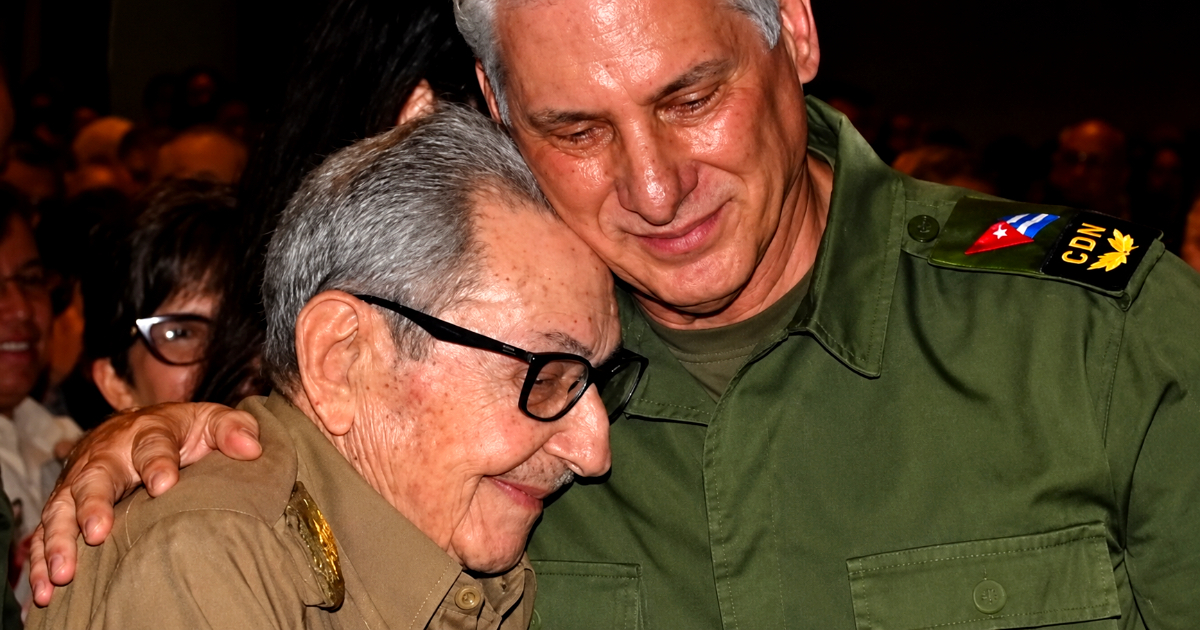
On Monday, Miguel Díaz-Canel took to Facebook to express his support for Raúl Castro, shortly after Florida's Attorney General James Uthmeier announced a state arrest warrant without bail for the 95-year-old former Cuban leader. Castro faces accusations of conspiracy to commit first-degree murder.
The Cuban president described this measure as "reprehensible," dismissing it as a "pathetic Miami circus with electoral overtones" that, according to him, "lacks, and will always lack, any legal or practical sense."
Furthermore, Díaz-Canel called it a "legally dressed maneuver orchestrated by anti-Cuban politicians," deserving of "our firm condemnation."
The regime's response was coordinated across its leadership. Foreign Minister Bruno Rodríguez Parrilla denounced the action on social media platform X, labeling Cuban-American politicians as "parasites" who "deceive and defraud their followers."
Similarly, Deputy Foreign Minister Carlos Fernández de Cossío criticized it as a "legally disguised maneuver" linked to what he called a "spectacle staged at the UN by the U.S. representative."
The state order, signed by Judge Ariana Fajardo Orshan, head of Florida's Eleventh Judicial Circuit, stands apart from the federal charges filed on May 20 by the Department of Justice. These charges accuse Castro and five other former Cuban military officers of seven counts related to the February 24, 1996, shootdown of two Brothers to the Rescue planes, resulting in the deaths of four men whose bodies were never recovered.
Uthmeier emphasized a significant distinction from the federal process: no U.S. president can pardon state crimes in Florida. "If a communist sympathizer were to return to the White House, they cannot pardon, commute, or grant immunity to these dictators from our state proceedings," he warned.
He also noted that Castro could not travel to any country with U.S. extradition agreements without risking arrest, "not even for medical treatment."
This is not the first instance of such a response from the regime. Following the federal charges in May, their propaganda machine quickly mobilized: Prime Minister Manuel Marrero Cruz called it a "farce," and both the Council of State and the National Assembly issued formal condemnations. The regime even organized a demonstration outside the U.S. Embassy in Havana.
Raúl's daughter, Mariela Castro Espín, led the protest with defiant statements like, "no one is going to kidnap him" and "they said they were coming today; here we are waiting." Despite her bold words, Raúl Castro did not appear publicly, leading to ridicule on social media.
The Florida Attorney General's office has indicated that the investigation remains open, with the potential for additional charges against others involved in the downing of the planes.
Key Questions on Raúl Castro's Arrest Warrant
Why was an arrest warrant issued for Raúl Castro in Florida?
Raúl Castro faces charges of conspiracy to commit first-degree murder, linked to the 1996 shootdown of two Brothers to the Rescue planes.
What is the significance of the state charges compared to federal charges?
State charges in Florida cannot be pardoned by a U.S. president, unlike federal offenses, adding a layer of legal complexity for those accused.
Can Raúl Castro travel internationally despite the warrant?
Castro risks arrest if he travels to countries with extradition agreements with the U.S., limiting his international movements.