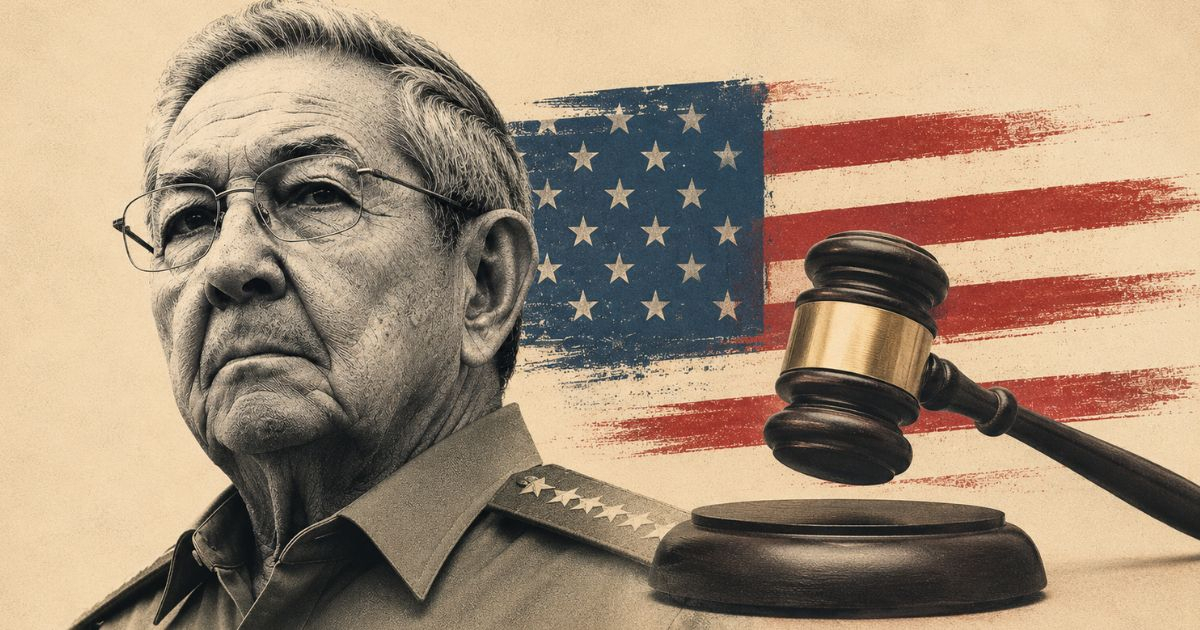
On Monday, Florida's Attorney General issued a warning that new charges could be filed in the ongoing investigation against Raúl Castro for his alleged involvement in the downing of two Brothers to the Rescue planes on February 24, 1996, over international waters, resulting in the deaths of four men.
The warning was included in an official statement released by Attorney General James Uthmeier, announcing a state arrest warrant for dictator Raúl Modesto Castro Ruz on a charge of conspiracy to commit first-degree murder.
The Attorney General's office emphasized that the case remains active and further charges could be forthcoming.
Currently, the arrest warrant includes a state charge of conspiracy to commit first-degree murder, in accordance with sections 777.04(3) and 782.04(1)(a)1 of the Florida Statutes. This offense is classified as a first-degree felony, and the court has issued the warrant without bail.
The document was signed by Ariana Fajardo Orshan, the presiding judge of the Eleventh Judicial Circuit of Florida.
Uthmeier made the announcement during a press conference held at Florida International University (FIU) College of Law. According to Local 10, the Attorney General was unequivocal in his remarks regarding the 1996 attack.
"This was not an accident; it was murder," Uthmeier declared.
The victims, Carlos Costa, Pablo Morales, Mario de la Peña, and Armando Alejandre Jr., were traveling in two civilian aircraft belonging to Brothers to the Rescue, an organization founded in Miami in 1991 to locate and assist Cuban migrants at sea.
De la Peña was 24 years old, Costa and Morales were 29, and Alejandre was 45 when the planes were shot down.
Continuing the Pursuit of Justice
In his official statement, Uthmeier directly accused Raúl Castro of ordering the attack.
"Raúl Castro ordered the cold-blooded murder of four Floridians, and Florida will never cease to seek accountability for that communist conspiracy," the Attorney General stated, according to a translation of his words.
He further alleged that Cuban intelligence agents operated within Florida communities, sending information to Havana that helped target the civilian pilots with MiG fighter jets.
"Thirty years later, we continue to fight for justice for Carlos Costa, Pablo Morales, Mario de la Peña, and Armando Alejandre Jr.," he added.
This new legal action results from an investigation that Uthmeier reopened in 2025, involving the Office of Statewide Prosecution (OSP) and the Florida Department of Law Enforcement (FDLE).
According to the affidavit outlined by the Attorney General's office, Raúl Castro, the then Minister of the Revolutionary Armed Forces (MINFAR) and First Vice President of Cuba, was reportedly a key figure in the decision-making chain that authorized the planes' downing.
The affidavit also highlights Cuban Intelligence Directorate agents, part of the so-called Wasp Network, who operated in Miami-Dade and Monroe counties. They infiltrated Brothers to the Rescue, gathering and relaying information about their flight plans and supporting Operation Scorpion, linked to preparing for the attack.
On February 24, 1996, three unarmed civilian Cessna planes took off from Opa-locka Airport in Miami-Dade. After crossing south of the 24th parallel, outside Cuban territorial waters, two of the aircraft were destroyed by MiG jets using air-to-air missiles, resulting in the deaths of their four occupants. The state statement maintains that the planes were moving away from Cuba and received no warnings before the attack, despite maintaining contact with Havana's air traffic control.
Federal and State Legal Proceedings
One of the central elements of the state proceedings is the alleged participation of intelligence agents from Florida territory. According to the Attorney General, the affidavit identifies activities related to gathering and transmitting flight information, as well as intelligence directives, occurring within the Eleventh Judicial Circuit (Miami-Dade) and the Sixteenth Judicial Circuit (Monroe).
The Office of Statewide Prosecution will handle jurisdiction over the alleged organized criminal conspiracy spanning both judicial circuits.
Michael Stein, special agent in charge of the FDLE, emphasized that the agency has taken the lead in the investigation and that the passage of time does not lessen their commitment to resolving the case. "The pursuit of justice is undeterred by the passage of time," Stein stated in the official release.
This state warrant follows five months after the United States Department of Justice announced an expanded federal indictment against Raúl Castro and five other individuals for their alleged roles in the same events.
On May 20, 2026, the federal prosecutor's office for the Southern District of Florida reported seven charges: one for conspiracy to kill U.S. citizens, two for aircraft destruction, and four for murder. Among those accused in the federal proceedings, along with Castro, are Lorenzo Alberto Pérez-Pérez, Emilio José Palacio Blanco, José Fidel Gual Barzaga, Raúl Simanca Cárdenas, and Luis Raúl González-Pardo Rodríguez.
The federal indictment identifies four victims, three of whom were U.S. citizens, while Pablo Morales held legal residency in the United States.
Federal Prosecutor Jason A. Reding Quiñones endorsed Florida's actions announced on Monday and supported the possibility of conducting parallel state and federal proceedings.
"Our historic federal indictment laid the groundwork, and James and his team have now taken the crucial step of bringing charges under Florida law," Reding Quiñones stated. He indicated that federal authorities will continue to use available legal avenues to attempt to hold those responsible for the aircraft downing accountable.
Rosie Cordero-Stutz, Miami-Dade Sheriff, also participated in the announcement, recalling the families' pain over the past three decades. "For thirty years, their families and our Cuban-American community have borne this deep loss and refused to allow the pursuit of justice to fade," she said.
Cordero-Stutz regarded the state warrant as a significant step in efforts to demand accountability for the deaths of the four Brothers to the Rescue members.
The signing of the arrest warrant against Raúl Castro by a Miami judge, separate from the federal process, was confirmed on Monday. It was also reported that Florida would seek extradition if he were detained outside the state, following judicial procedures.
The state warrant does not imply Castro's arrest or constitute a judicial declaration of guilt. The charges detail the conduct attributed to him by the Attorney General, which must be proven in court.
The investigation remains open. While no specific new charges have been announced, Florida's Attorney General has explicitly left the possibility of additional charges open in a case that continues to be active both at the state and federal levels, three decades after the downing.
Frequently Asked Questions about the Raúl Castro Case
What are the current charges against Raúl Castro in Florida?
Raúl Castro currently faces a state charge of conspiracy to commit first-degree murder under sections 777.04(3) and 782.04(1)(a)1 of the Florida Statutes.
Who were the victims in the 1996 attack?
The victims were Carlos Costa, Pablo Morales, Mario de la Peña, and Armando Alejandre Jr., members of Brothers to the Rescue.
What is Brothers to the Rescue?
Brothers to the Rescue is an organization founded in Miami in 1991 to locate and assist Cuban migrants in danger at sea.
Is the investigation into the 1996 attack still open?
Yes, the investigation remains open, and the Florida Attorney General's office has stated that additional charges could be filed as the case progresses.