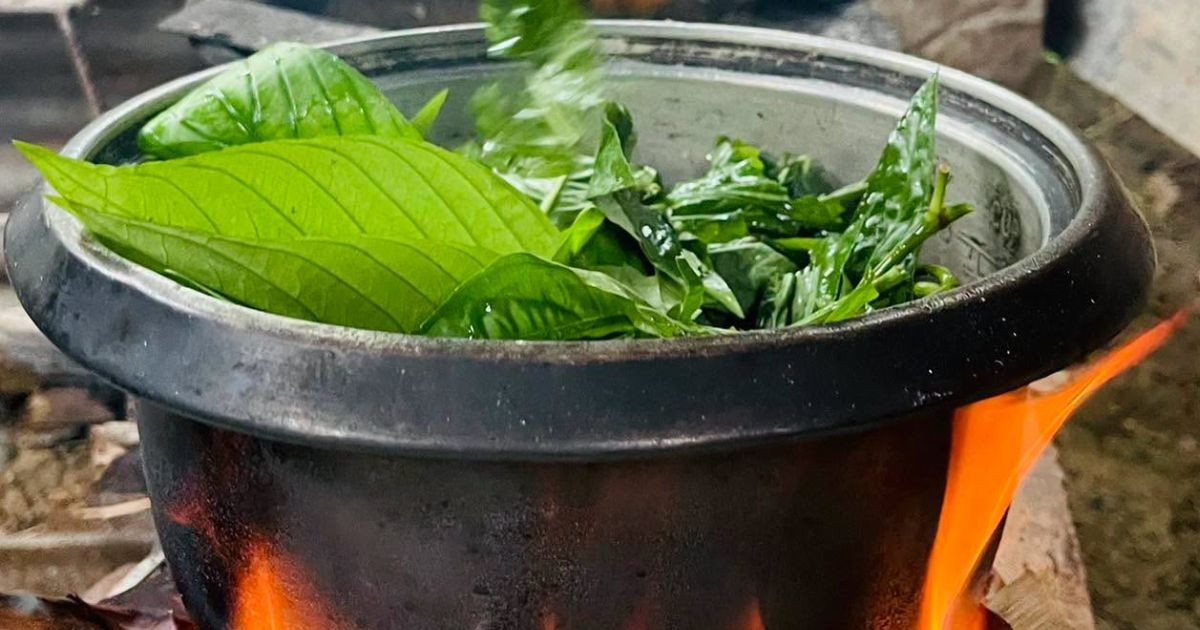
An elderly woman stands before a makeshift wood-fired stove in her backyard, cooking pieces of a wild plant known as "God's Fingernail" to treat illnesses she cannot afford to medicate. This poignant scene, shared by Cuban playwright Irán Capote on Sunday, encapsulates the harsh reality he found upon visiting his grandmother in El Jíbaro, a rural community in San Juan y Martínez, Pinar del Río.
Capote recounted his visit on Facebook after four months without seeing his family, bringing "a few things that barely fit in a cubalse bag." However, what he discovered was far from comforting: they had been without electricity for over four days, lacked running water for more than 40 days, the local store was closed, and medicines were beyond the reach of any farmer in the area.
"In El Jíbaro, San Juan y Martínez, my grandmother, who is neither a witch nor knows about witchcraft, throws into the blackened pot, due to the burning wood, pieces of a shrub she deems blessed to heal an endless list of ailments," Capote wrote. The plant referred to as "God's Fingernail" by the elderly woman has become the sole therapeutic option available. "The name of the shrub seems too ironic," Capote noted.
The family relied on a small energy accumulator without solar panels, charged during the one and a half hours of daily electricity, but this routine was disrupted. Amidst the smoke from the stove, the grandmother repeatedly laments, "things are really bad, and medicine costs an arm and a leg."
The power outage Capote describes is not an isolated incident. Some circuits in Pinar del Río experienced over 90 consecutive hours without electricity during the week, as acknowledged by the provincial first secretary of the Communist Party. Since more than 80% of Cuban water systems depend on the National Electric System, each blackout results in water cuts: 52 out of 177 water supply sources in the province were out of service during those days.
"There’s been no water for over 40 days. How ironic!" wrote the playwright, who had spent many days in the city carrying water in five-liter jugs. Residents of El Jíbaro address the water shortage by collecting rainwater in vessels placed under roof gutters. While recent rains quenched their thirst, they also brought mud, worsening the scene of neglect.
"People in the neighborhood already wear on their faces, bodies, and voices the pain of a country that has abandoned them," Capote observed. When neighbors asked about the city, he replied, "almost the same as the countryside, though maybe slightly better." Their response was unanimous: "There’s no bottom to this. We need to leave for anywhere. There’s no prosperity."
The energy and water crisis is compounded by a collapsed distribution system. The neighborhood store remains closed, and bread hasn’t been sold in a long time. Tobacco farmers await overdue payments for past harvests while accruing debt to purchase "the most expensive rice bag, the most expensive sugar bag, and whatever else they can find."
The recourse to medicinal plants as a substitute for pharmaceuticals is not unique to Capote's grandmother. A digital survey conducted by CubaData for Diario de Cuba from February 23 to March 13, 2026, revealed that about 91% of participants reported experiencing some difficulty obtaining medications.
The regime itself has encouraged the cultivation of plants like aloe vera, linden, peppermint, and plantain in response to chronic pharmacy shortages. Capote's grandmother's "God's Fingernail" is yet another element of a survival strategy that the State has normalized through neglect.
Capote concluded his account with a challenging statement: "The level of degradation, misery, and sorrow among our farmers is painful. If anyone doubts it, go there, deep into the countryside… and prove me wrong."
Until that happens, his grandmother will continue to cling, as lamented by her grandson, "not to the hand, but to the God's Fingernail."
Understanding the Struggles of Cuban Farmers
What is "God's Fingernail"?
"God's Fingernail" is a wild plant used by some rural Cubans as a home remedy due to the lack of access to conventional medicines.
Why are Cuban farmers resorting to using wild plants?
Farmers are turning to wild plants because of severe shortages of medicine and other essential supplies, exacerbated by the economic and infrastructural collapse in Cuba.
How are power outages impacting daily life in rural Cuba?
Frequent power outages disrupt essential services like water supply and the ability to store or prepare food, severely affecting the quality of life in rural areas.