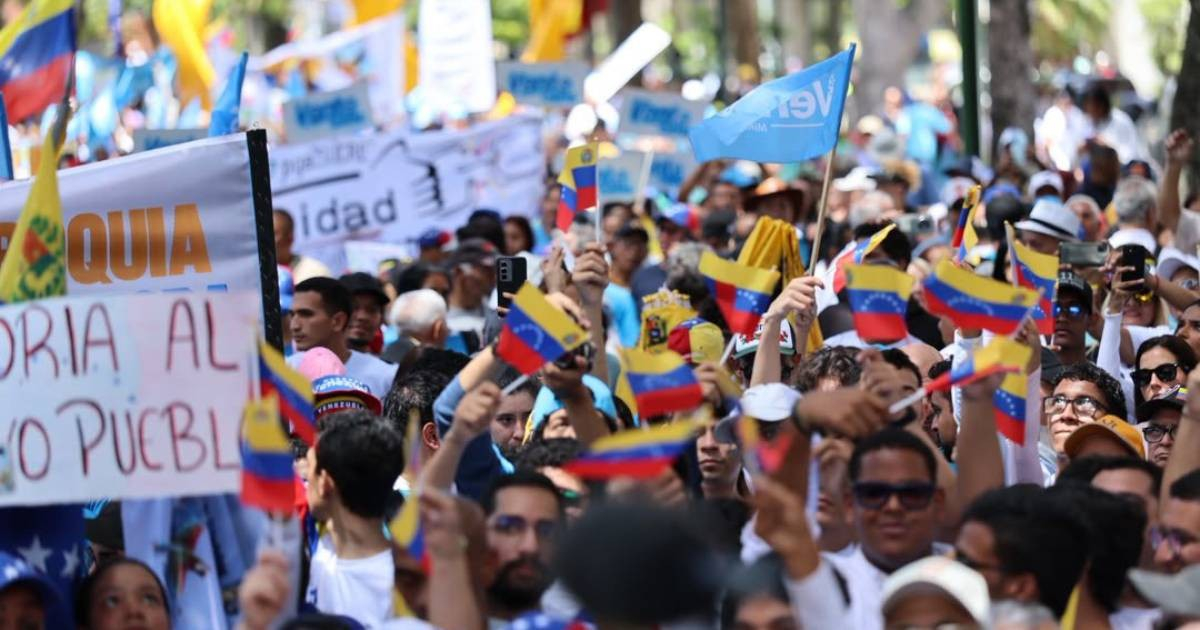
The Democratic Unity Platform (PUD), Venezuela's primary opposition alliance, unveiled the "National Agreement for the Recovery of the Republic" this past Sunday. This 14-point roadmap underscores the leadership of María Corina Machado and sets the stage for a democratic transition in the nation.
Biagio Pilieri, a leader of the Convergencia party and a former political prisoner, publicly read the document on behalf of the opposition coalition. Pilieri highlighted the core of the proposal: "A peaceful, orderly, and sustainable transition for Venezuela, grounded in establishing conditions for effective negotiation and the holding of free, competitive, and verifiable elections, with a focus on presidential elections."
The agreement explicitly acknowledges the leadership of Machado and presidential candidate Edmundo González Urrutia in the fight for Venezuela's freedom and democracy.
The proposal also demands the "immediate release of all political prisoners," who number 322 according to the Penal Forum, as well as the "respect and recognition of the National Assembly elected in 2015" and the "restoration of constitutional guarantees."
Additional points in the document call for "an end to political persecution" and the "safe return of Venezuelans in exile," including Machado herself, who has reported at least seven unsuccessful attempts to return to Venezuela since late June.
The agreement also enshrines democratic alternation and bans indefinite re-election in executive positions. It promotes the effective separation of government, state, and political parties, and calls for the lifting of political disqualifications, with the restoration of party names, symbols, and electoral cards.
The PUD has invited all political, social, and economic sectors to join in building this agreement, aiming to achieve "the institutional, economic, and social reconstruction of the country" and "the reunification of the Venezuelan family."
This agreement was presented amidst tensions within the opposition. Since August, a faction led by Dinorah Figuera, president of the National Assembly elected in 2015, has been engaged in formal dialogue with the chavismo, represented by Jorge Rodríguez, with support from Washington.
The third round of these negotiations began in Caracas on October 14, just four days before the PUD introduced its own roadmap.
Neither Machado nor González Urrutia are directly involved in these talks. On October 16, Machado publicly accused Washington of excluding her from discussions between Delcy Rodríguez's government and opposition sectors.
Secretary of State Marco Rubio met with Figuera in Washington on October 9, expressing U.S. support for the dialogue process, in which the PUD is not directly participating.
In this context, the "National Agreement" acts as a significant political statement: the PUD seeks to establish its own agenda and reinforce that any resolution must be through "the sovereign will of the people, expressed via free elections."
Machado has endorsed July 24, 2027—Simón Bolívar's birthday—as a potential date for presidential elections, a proposal championed by U.S. Senator Bernie Moreno, while Rodríguez's government has promised elections without providing a concrete timeline.
Key Questions on Venezuela's Transition Plan
What is the main goal of the National Agreement proposed by the PUD?
The main goal is to establish a peaceful, orderly, and sustainable transition for Venezuela, focusing on effective negotiations and free, verifiable elections.
What are some key demands of the PUD's proposal?
Key demands include the immediate release of all political prisoners, respect for the National Assembly elected in 2015, ending political persecution, and restoring constitutional guarantees.
How does the PUD's roadmap differ from other opposition dialogues?
The PUD's roadmap is independent of the formal dialogue led by Dinorah Figuera and aims to assert its own political agenda, emphasizing elections as a means to resolve Venezuela's issues.