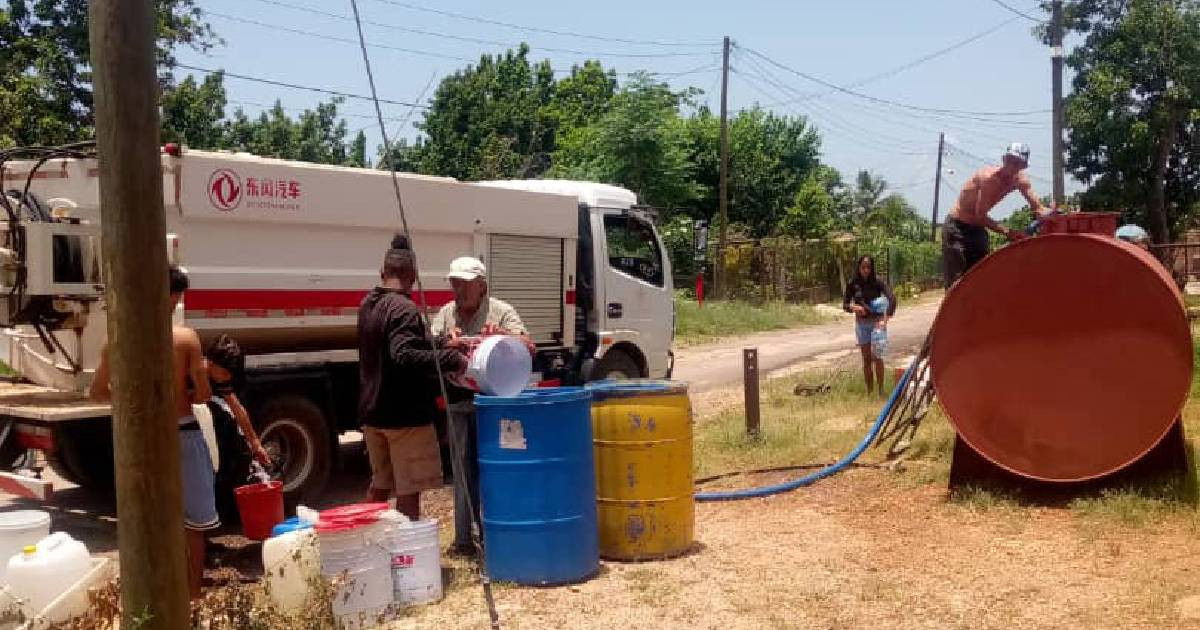
Approximately one-third of the residents in Artemisa municipality, who rely on the water distribution network, are currently without access to water, according to a report released on Wednesday by the official newspaper El Artemiseño, which described the situation as "extremely challenging."
The crisis stems from a combination of broken motors at several water supply sources and a shortage of electricity, affecting various areas within the municipality simultaneously.
The report notes that the pumping equipment from Las Cañas and the Recompensa community has been sent to workshops in San Cristóbal for repairs.
Meanwhile, in the El Corojal area, the machinery's pumping unit suffered more severe damage — it was burned out — and has been dispatched to the workshop in San José de las Lajas, Mayabeque. The repair schedule is determined by national priorities and is beyond the control of the Artemisa Provincial Aqueduct and Sewer Company.
In the same El Corojal zone, the Incubadora motor remains out of order because its transformer was destroyed; the solution is in the hands of the Artemisa Electric Company.
In Los Mongolos, the Drilling Company is working on fixing the motor of the oldest well. Although a new well was constructed nearby, it failed to provide sufficient water flow.
Additionally, wells one and three in Waterloo have encountered issues. The first experienced theft of dielectric oil from its transformers, causing equipment damage.
New transformers have been installed to resume pumping, but the Municipal Assembly of People's Power has warned that substantial distribution levels are only achievable when both Waterloo sources operate simultaneously under the protection of the 1500 electrical circuit for at least 12 consecutive hours.
The series of breakdowns is exacerbated by a fuel shortage, hindering the transportation of water trucks to neighborhoods without water. Pablo Francisco San Crespo, director of the Aqueduct and Sewer Company of the so-called Villa Roja, stated that tanker distribution is reserved for essential facilities.
"Due to the fuel shortage, it is currently impossible to deliver water by trucks to affected residential areas. However, we ensure an organized service to prioritized education and public health centers located in the municipal seat, in coordination with their respective administrative units: the Adrián Sansaricq and Tomás Romay polyclinics, the Elderly Home, the Maternity Home, daycare centers, and other educational institutions," he explained.
In July, official data indicated that power outages and deteriorating pumping equipment left around 225,000 people, approximately 65% of the population in the western province, without regular water service.
The crisis in Artemisa is part of a nationwide water collapse. In early October, hydraulic sector authorities acknowledged that 2.7 million Cubans, nearly 35% of those served by networks, had partially or completely lost access to potable water, a figure nearly identical to that in May.
Since 87% of the country's aqueducts rely on the National Electrical System, each blackout results in a simultaneous water outage for hundreds of thousands of people.
Understanding Artemisa's Water Supply Crisis
What is causing the water crisis in Artemisa?
The water crisis in Artemisa is primarily due to faulty motors at water supply sources and a shortage of electricity, which affects the municipality's ability to distribute water effectively.
How are repairs being managed in Artemisa?
Repairs in Artemisa are being coordinated by sending damaged equipment to workshops in San Cristóbal and San José de las Lajas. However, repair schedules are dictated by national priorities, limiting local control.
What areas are prioritized for water distribution in Artemisa?
In Artemisa, water distribution is prioritized for essential facilities such as education and public health centers, including polyclinics, homes for the elderly, maternity homes, and daycare centers.