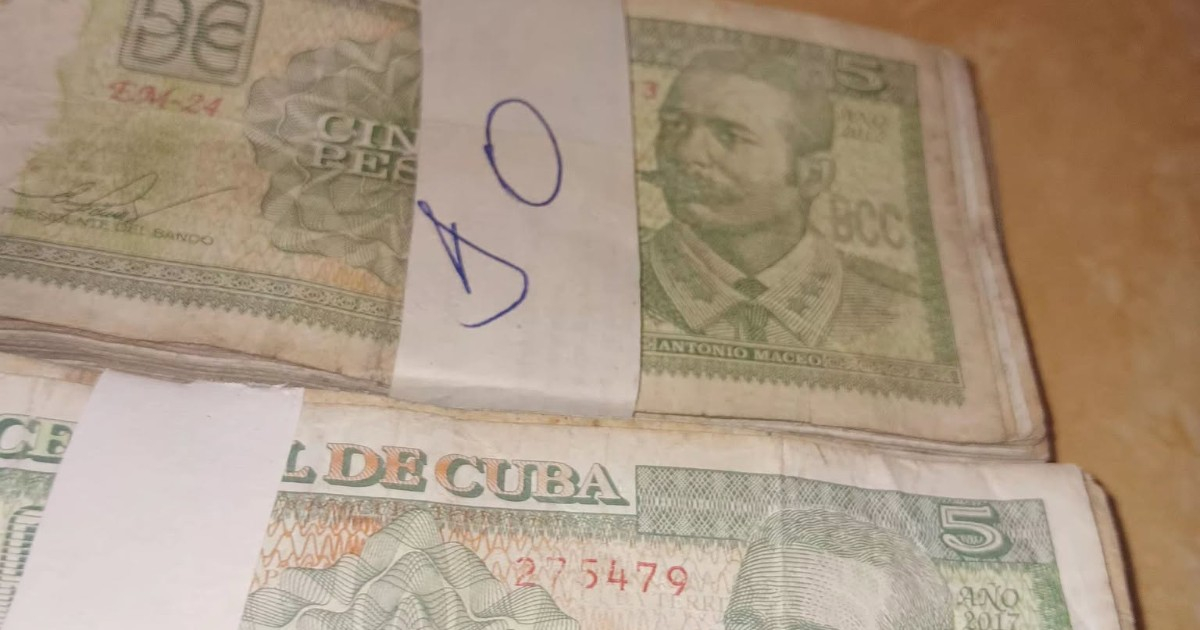
A Cuban woman found herself with a thousand pesos in five-peso bills—a total of two hundred of the smallest denomination in circulation—but faced rejection when attempting to spend them, as businesses, small enterprises, and individuals refused to accept the notes.
A photo of two stacks of five-peso Cuban bills, featuring Antonio Maceo and issued in 2017, posted in the Facebook group "El toque en Cuba," sparked a wave of reactions that highlighted widespread frustration across the island.
"My neighbor picked up her monthly payment at the bank, receiving 1,000 pesos in five-peso bills. When she tried to buy two pounds of sugar priced at 480, she was told those bills wouldn't be accepted," shared Mary López Hernández on social media.
The poster also questioned when the government would address such injustices, like the one affecting her neighbor.
Social media comments reflect a growing sense of indignation. "It seems that's all the bank has for pensioners... The high-denomination bills are kept away... Sad for my country, sad for our elders," commented another user.
Another user highlighted the banking system's inconsistency: "It's unbelievable: small enterprises deposit at the bank in any denomination, yet refuse to accept the same when given back. Banks distribute what they receive; they bring backpacks full of five and ten-peso bills. It's legal tender; no private business or small enterprise can refuse it."
The rejection chain goes higher: "Now even small enterprises won't take 50-peso bills. What a situation we're in. Help me think this through," another comment summarized.
Some directly blame the regime: "Tell your neighbor to start protesting at the bank, which does whatever it wants with your money. But of course, it's easier to complain about individuals than to confront the government," wrote a user.
Another was even more blunt: "We don't matter to them. If there's supposedly 20,000 in cash, which average Cuban earns that?"
This is not an isolated incident. Since late 2024, and increasingly throughout 2026, private businesses and small entrepreneurs across Cuba have rejected one, five, ten, twenty, and even fifty-peso bills, despite all having legal tender status.
The elderly and pensioners are the most affected, receiving their payments in cash and in whatever denominations the bank has available.
A documented case illustrates the scale of the issue: Arturo Chang, a 74-year-old retiree from Santa Clara, tried to buy bread using 100 five-peso bills given by the bank as part of his monthly pension of 3,653 pesos, but the store refused the payment.
The Banco de Crédito y Comercio (BANDEC) in Ciego de Ávila termed this practice a "flagrant violation of citizens' rights" and warned in August that no establishment can reject low-denomination bills or dictate how a customer pays.
However, these warnings have not led to any tangible penalties. In early October, a small enterprise restricted payments to 500 pesos in fifty-peso bills when a customer tried to purchase rice, demonstrating that rejection is extending even to higher denominations.
The root of the problem is structural. Cuba is enduring a severe cash shortage: more than 50% of Havana's ATMs ceased functioning in 2026, and Granma Province admitted it lacked cash to pay pensions to over 111,000 retirees.
State banks distribute what they have, predominantly low-denomination bills, while higher-value notes do not reach the neediest sectors.
In September 2026, the Cuban Central Bank introduced 10,000 and 20,000 peso bills, the highest denominations in the country's history. Yet, these new bills do not reach pensioners, who continue to receive bundles of small bills that they cannot spend.
Over 1.7 million Cuban retirees rely on bank-disbursed pensions, many of which are less than 10 dollars a month at the informal exchange rate, and they bear the brunt of a monetary crisis that the regime has failed to resolve.
Understanding Cuba's Cash Crisis
Why are Cuban businesses rejecting low-denomination bills?
Cuban businesses are rejecting low-denomination bills due to a structural cash shortage and the inconvenience of handling large volumes of small bills. Despite being legal tender, the distribution of higher-denomination bills is limited, forcing businesses to refuse smaller notes.
What measures are being taken to address the cash shortage in Cuba?
The Cuban Central Bank has issued higher-denomination bills, such as the 10,000 and 20,000 pesos, as a measure to alleviate the cash shortage. However, these bills have not effectively trickled down to pensioners and vulnerable groups.
How are pensioners in Cuba affected by the cash crisis?
Pensioners in Cuba are significantly affected as they rely on cash payments in low-denomination bills, which are often refused by businesses. This situation exacerbates their financial instability, as they struggle to spend their pensions effectively.