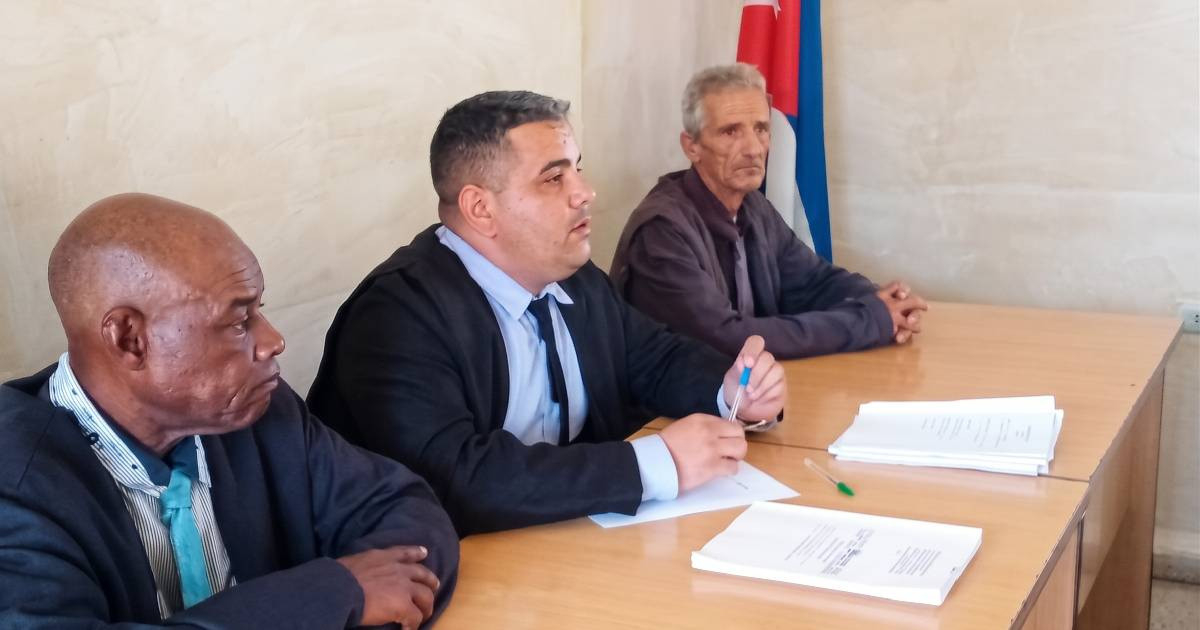
The People's Municipal Court of Jimaguayú conducted a session at the Open Penitentiary Facility of Camagüey, deviating from its usual location, to try six inmates for escape and related offenses, as reported on Saturday by the provincial station Radio Cadena Agramonte.
The decision to hold the trial within the confines of the prison was justified by authorities due to the "high incidence and severity of inmate or detainee escapes," outlined in article 206 of Law No. 151, the current Penal Code.
The imposed sentences ranged from 10 months to three years of imprisonment. Additionally, the court ordered restrictions on rights and prohibited the convicted from leaving the national territory, as stipulated by Cuban law.
The court further rescinded the penitentiary privileges of those convicted and mandated their transfer to more stringent facilities, implying harsher detention conditions for the sanctioned individuals.
The media portrayed the judicial action as an institutional response to the serious nature of the escapes, emphasizing that the process was conducted in a public and oral trial, ensuring due process.
However, the official report did not detail the escape circumstances, when they occurred, or the other associated crimes for which the inmates were prosecuted.
Such practices are not unprecedented in Cuba. In June, authorities militarized a prison in Las Tunas to try political prisoners within the El Típico prison itself, with restricted access for families and observers.
This case emerges amidst a severe decline in the Cuban penitentiary system. Cubalex recorded 762 incidents against incarcerated individuals in the first half of the year, including 104 punitive transfers, 85 isolations in punishment cells, and 77 hunger strikes.
A recent report documented four deaths and 79 rights violations in Cuban prisons in October alone, with Camagüey being a focal point, particularly in the Kilo 7 and Kilo 8 prisons.
The Cuban Observatory for Human Rights filed a formal complaint with the Provincial Prosecutor's Office of Camagüey regarding irregularities in the case of journalist Henry Constantín, detained at Kilo 7 prison since September 16.
In the Agramontine region, escapes from open facilities have recent precedents. In December 2025, an inmate fled from the La Empresita Open Unit and was recaptured thanks to local residents' alerts, resulting in the loss of prison privileges as well.
Prisoners Defenders reported 1,372 political prisoners in Cuba as of October 1, marking a historic high under the Cuban dictatorship, highlighting the intensification of the penitentiary system amidst an unprecedented wave of repression.
Understanding the Legal and Human Rights Issues in Cuban Prisons
What led to the trial of the six inmates in Camagüey?
The six inmates were tried for escape and related offenses, with the trial held inside the prison to address the severity and frequency of such incidents.
How does the Cuban legal system handle prisoner escapes?
In Cuba, prisoner escapes are dealt with under article 206 of Law No. 151, leading to sentences ranging from several months to years and additional penalties like travel bans.
What were the conditions of the trial for the six prisoners?
The trial was conducted as a public and oral proceeding within the prison, purportedly ensuring due process, though lacking detailed information on the escapes.
What is the state of the Cuban prison system?
The Cuban prison system is facing severe deterioration, with numerous incidents of human rights violations, punitive transfers, and other abuses documented by organizations like Cubalex.