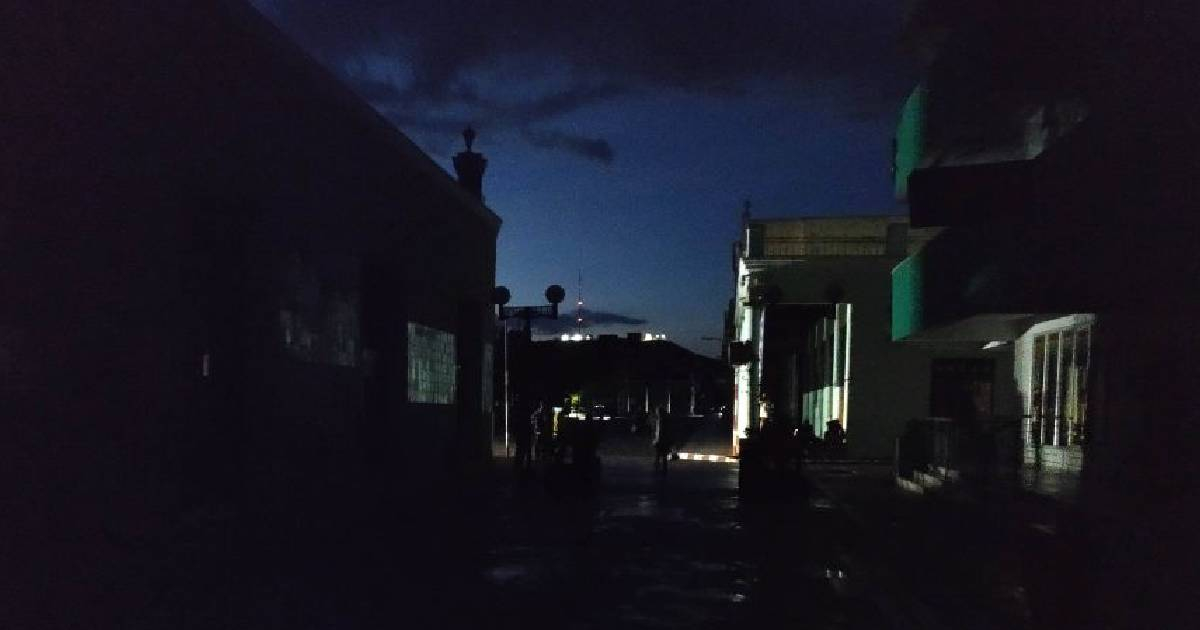
The Holguín Power Company announced on its Facebook page this Saturday that it is halting the 12-hour circuit rotation in the city due to the notorious "complex situation of the National Electric System."
This decision excludes circuits 1, 2, 19, 20, and 21, which supply electricity to the Lenin Hospital Express, the largest medical facility in the province. For the rest of the residents, the company vaguely promised to resume rotations "once the Base Generation of the System recovers," without specifying any dates or times, ending the announcement with the customary apology: "We apologize for any inconvenience caused."
Social media users responded swiftly and critically. "When did the other circuits ever have a fixed 12-hour rotation? They provided electricity whenever they could or wanted," one user commented. Another was succinct, "Too good to be true, it didn't last long." A third user added with sarcasm, "A 12-hour rotation must be a joke."
The sharpest irony came from those who never experienced the so-called rotation. "Is there any rotation for the forgotten municipalities, or do we continue every 30 hours? I'm talking about Sagua de Tánamo," one person questioned. From Mayarí, another noted that power cuts there already lasted 27 hours, and with the rotation suspension, "it might now be weekly." The question that best captured the collective sentiment was the shortest: "What rotation?"
As of the morning of Saturday, October 17, the National Electric System (SEN) had a mere 758 MW available against a demand of 2,250 MW, with a reported deficit of 1,493 MW, according to the Electric Union's report at 6:00 a.m. For peak hours, a shortfall of 2,042 MW and an impact of up to 2,072 MW were anticipated.
In Holguín, the served demand was just 50 MW, while records from the provincial Electric Company at 8:44 a.m. indicated that the Banes 2 circuit, Tanganica branch, had been without power for 43 hours and 15 minutes. Other circuits like Guerrita and Ocujal experienced outages of 39 hours and 35 minutes and 39 hours and 18 minutes, respectively.
This breakdown is due to specific, accumulated causes. The day before, unit 1 of the Ernesto Guevara de la Serna thermoelectric plant in Santa Cruz del Norte (Mayabeque) suffered a fire, further reducing national availability. Additionally, the Lidio Ramón Pérez de Felton thermoelectric plant in Mayarí went offline on Friday. The Antonio Guiteras thermoelectric plant, the country's largest, has failed at least 17 times so far in 2026.
This suspension is not an isolated incident but rather the latest chapter in an ongoing crisis throughout the year. Cuba has experienced eight total disconnections from the SEN in 2026, the most recent on September 18.
The frustration is palpable. This Saturday, residents of Santa Rita in Jiguaní (Granma) took to the streets shouting "We want power!" in front of a police patrol that failed to disperse them.
One user predicted the outcome with bitter foresight: "When the SEN completely collapses, which isn't far off, the NTV will say we're fortunate because we have the moon at night and the sun during the day."
Understanding the Electric Crisis in Holguín
Why did the Holguín Power Company suspend the circuit rotation?
The Holguín Power Company suspended the circuit rotation due to the "complex situation of the National Electric System," which has been a recurring issue in Cuba.
Which circuits are exempt from this suspension?
Circuits 1, 2, 19, 20, and 21, which serve the Lenin Hospital Express, are exempt from the suspension.
What is the public's reaction to the suspension?
The public reacted critically and skeptically on social media, questioning the reality of the supposed 12-hour rotation and expressing frustration over prolonged outages.
What are the current electricity demand and availability in Cuba?
As of the latest report, Cuba's National Electric System had an availability of 758 MW against a demand of 2,250 MW, leading to significant shortages and outages.