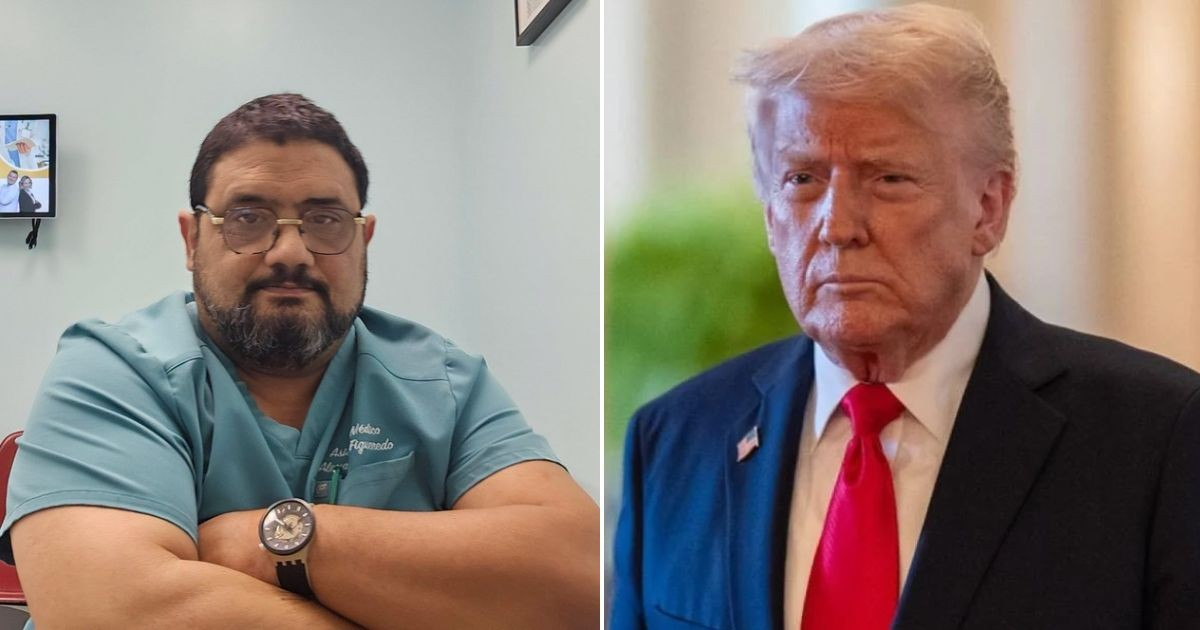
Dr. Alexander Jesús Figueredo Izaguirre, a Cuban physician residing in Houston, Texas, has made a public appeal to President Donald Trump and Secretary of State Marco Rubio. He urged them to leverage the expertise of exiled Cuban healthcare professionals in the U.S. to contribute to a newly announced medical recruitment initiative for the Caribbean.
In a letter shared on Facebook, Figueredo expressed support for the $61.5 million U.S. initiative aimed at direct hiring of healthcare workers. However, he emphasized an opportunity that Washington should not overlook: the Cuban doctors already residing in the United States who are unable to practice their profession.
"The doctors are already here. We just need the chance to be doctors again," Figueredo wrote, suggesting that Caribbean governments could directly hire these professionals with full salaries, transparent contracts, and without the intervention of Cuban authorities.
Responses to Figueredo's Proposal
Figueredo’s proposal sparked varied reactions. While he received encouragement and shared experiences from professionals working outside their field, criticisms also emerged. These included concerns about the necessity of revalidating medical degrees in the U.S., political debates, and even personal attacks.
The announcement of the $61.5 million U.S. program to aid Caribbean nations in hiring healthcare personnel was met with hopeful anticipation. Known as ASPIRE (Americas Strategic Partnership for Regional Independent Health Excellence), the initiative aims to foster more autonomous regional healthcare systems through transparent contracts and direct payments to workers.
However, the funding is pending approval from the U.S. Congress, meaning the announced funds are not yet available.
Barriers to Practicing Medicine in the U.S.
Figueredo's letter raises an important question: "Where will these doctors come from?" He suggests that part of the solution lies with Cuban professionals who immigrated to the U.S. after years of working in hospitals and international medical missions.
"Here in the U.S., we are thousands of Cuban doctors who crossed jungles and borders to escape the regime you aim to dismantle," he stated.
He painted a vivid picture of the current situation: experienced clinicians now working in various non-medical jobs, such as cleaning floors and delivering packages. "I take blood pressure in a Texas clinic. In Cuba, I signed off on treatments. This is the real picture of Cuban doctors in exile," he lamented.
Figueredo clarified that he isn’t seeking a U.S. medical license through his letter. Instead, he advocates for Caribbean nations to employ Cuban professionals residing in America, under the terms and conditions set by the respective authorities.
An Alternative to Cuban-Controlled Medical Missions
Having participated in Cuban medical missions, Figueredo argues that direct contracts would allow professionals to receive their full salaries and work without the constraints imposed by the Cuban government.
"Let the Caribbean hire free doctors directly, with their full pay in their pockets, under transparent contracts, and your supervision. No intermediaries in Havana. No 70% retention. No passports locked away. No fear," he asserted.
Figueredo believes that Caribbean countries could benefit from professionals already familiar with the region's healthcare needs, but through individual labor agreements. This model could also decrease the revenue the Cuban government earns from international medical service agreements.
The conditions of Cuban medical missions have faced criticism from former participants and human rights organizations. The U.S. State Department’s 2024 Trafficking in Persons Report highlighted coercive practices, mobility restrictions, and withheld salaries in Cuba’s worker export programs. Havana denies these exploitation claims, presenting its medical brigades as international cooperation efforts.
In September, U.S. officials heard testimony from a former member of a Cuban medical mission and reiterated their opposition to agreements that economically benefit the Cuban state from healthcare professionals’ labor.
Debate Over Returning to Medical Practice
Figueredo's publication sparked a debate about the real prospects for Cuban-trained doctors to practice medicine again after emigrating. Critics pointed out that U.S. medical practice requires accreditation and licensing, regardless of where one studied.
"You must revalidate your medical degree as required by the country's law. Every nation demands the same before allowing legal medical practice," a commenter noted.
Another criticized the futility of writing letters to Washington: "Instead of wasting time on useless letters that no one reads... start studying and revalidating your medical degree, as many Cuban doctors have done since 1959 while also working in other jobs."
The critique highlights a significant point: possessing a Cuban medical degree doesn’t automatically authorize one to practice in the U.S. Foreign-trained professionals must complete certification processes, evaluations, clinical training, and meet state licensing requirements.
Nevertheless, Figueredo’s proposal doesn’t seek to waive these U.S. requirements. Instead, it suggests Caribbean countries hire exiled Cuban professionals through direct agreements under the destination countries’ applicable regulations.
Some responses suggested this alternative: "Why not write to the health secretary of a Caribbean country and offer your résumé? They might accept."
Others acknowledged that while revalidation can be challenging and costly, it’s not impossible. One commenter recalled many foreign doctors completing the process after years of study and sacrifice.
Criticisms weren’t limited to professional requirements. Some questioned Washington’s motives and the role of Cuban doctors in the political conflict between the two countries.
"The issue isn’t the doctors’ well-being; it’s about harming the Cuban government," one user asserted.
Another viewed the U.S. initiative as primarily politically motivated: "They aren’t interested in Cuban doctors; it’s more a political than social issue."
A third reaction doubted the guarantees professionals would receive under the new program and questioned the trust in the Trump administration.
Some comments were outright hostile toward Figueredo for emigrating and criticizing the Cuban regime.
"Keep cleaning floors. Didn’t you want the North? Well, deal with it," one participant wrote.
Another labeled him a "traitor" for studying medicine in Cuba before moving to the U.S.
In response to an attack focused on his writing style, Figueredo replied:
"Look, friend: what matters isn’t my writing but the idea. There are thousands of Cuban-trained doctors doing other jobs in this country. Spelling doesn’t heal patients; doctors do. Have a good day."
In another reply, Figueredo defended his background and rejected that his academic training obligates him to support the Cuban government.
"I trained in Cuba and served in missions. I left on my own and work humbly here. If you have arguments against the proposal, I’m listening," he stated.
Doctors, Caregivers, and Workers in Other Sectors: Personal Testimonies
Amidst the criticisms, numerous users shared personal or family experiences echoing Figueredo’s concerns.
A woman recounted that her daughter, a Cuban doctor, currently works as a caregiver in the U.S. but isn’t practicing medicine.
Another person claimed to know a doctor earning a living through home maintenance jobs, while a commenter mentioned a Cuban professional delivering for a restaurant.
"My niece, a specialist, works as a shelf stocker at Walmart," another user commented.
A physician with over 30 years of experience and nine years in a Venezuelan mission before emigrating also shared his story.
"Yes, I know one: myself," he remarked in response to Figueredo’s query about Cuban professionals currently engaged in other jobs.
A woman described a particularly long journey: she’s been in the U.S. for 12 years, invested thousands of dollars in certifications and further studies, but didn’t find the expected opportunities in the healthcare sector.
"I fought hard until I got tired," she said, explaining that she ended up working as a caregiver and in other roles.
Among the comments were also voices advocating for better labor conditions for doctors in Cuba and questioning whether exiled professionals would be willing to move to remote Caribbean areas where Cuban brigades have served for decades.
The Challenge for Cuban Doctors to Practice in the U.S.
The hurdles to re-entering the medical profession in the U.S. are not new.
In May 2026, over 300 Cuban doctors were identified as facing immigration uncertainty, hindering their employment access and professional advancement, according to a report by Telemundo 51.
The group was part of a network of approximately 1,500 foreign doctors organized to tackle revalidation requirements and other barriers to practicing in the U.S.
Some had entered through immigration mechanisms like humanitarian parole, CBP One, or I-220A documents, facing additional challenges related to their legal status.
In July 2024, another Cuban doctor publicly sought a job opportunity in the U.S. healthcare sector, despite having professional experience and a medical assistant credential.
Figueredo himself has previously shared his adaptation journey in the U.S.
In September 2022, shortly after emigrating, he recounted earning $200 from a moving job while preparing to work in healthcare.
Months later, he shared his initial professional progress in Houston and his intention to continue studying to practice medicine.
In March 2025, he publicly discussed his U.S. situation again, working with a clinic and continuing to prepare for credential recognition.
The new letter revives that concern but transforms it into a proposal directed at Washington: utilize the experience of exiled Cuban doctors to meet Caribbean healthcare needs through direct contracts.
FAQs about Cuban Doctors in the U.S.
Why can't Cuban doctors practice in the U.S. immediately?
Cuban doctors must go through a process of revalidation, which includes certification, evaluation, clinical training, and meeting state licensing requirements to practice in the U.S.
What is the ASPIRE program?
ASPIRE (Americas Strategic Partnership for Regional Independent Health Excellence) is a $61.5 million U.S. initiative to help Caribbean nations hire healthcare workers directly, avoiding state intermediaries.
What are Figueredo's main arguments for hiring Cuban doctors?
Figueredo argues that Caribbean countries could benefit from hiring Cuban doctors already in the U.S., offering them direct contracts and full salaries without Cuban government intervention.
What challenges do Cuban doctors face in the U.S.?
Cuban doctors in the U.S. face challenges like immigration uncertainty, the costly and lengthy revalidation process, and often working in non-medical jobs while trying to re-enter the healthcare field.