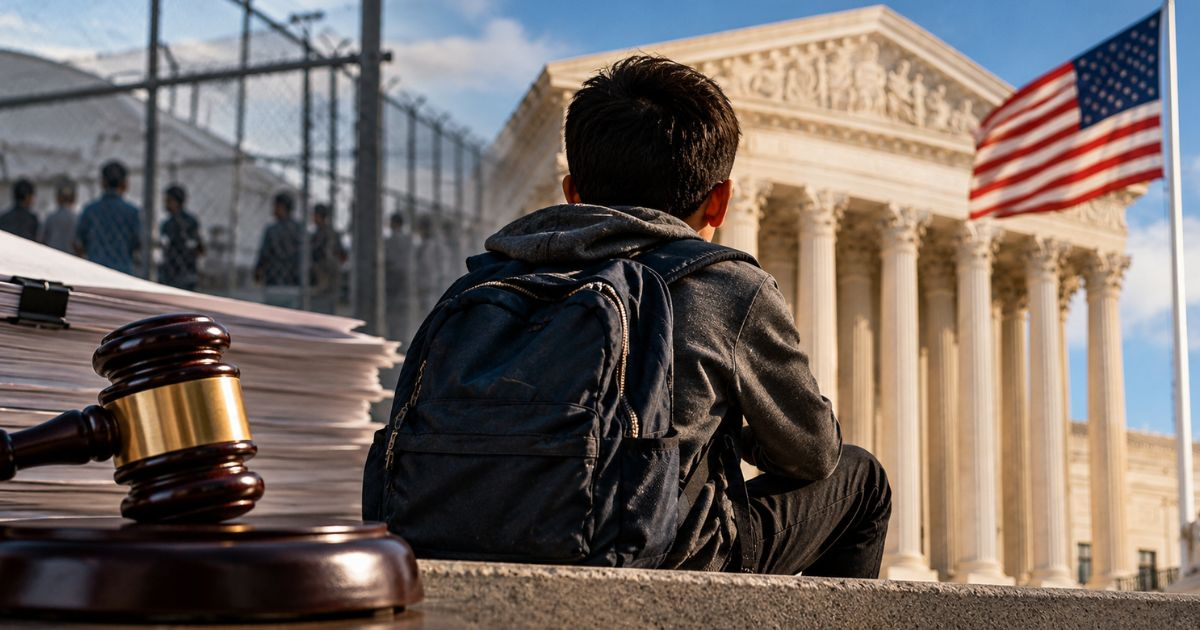
A coalition of six organizations dedicated to providing legal aid to migrant minors has filed a federal lawsuit against the Trump administration. Their goal is to stop the expedited asylum and deportation processes imposed on children who arrive alone in the United States, arguing that these new government policies hinder proper preparation of their protection requests.
The lawsuit, known as The Door v. Edlow, was filed on October 15 in the U.S. District Court for the Southern Division of Maryland, as announced by the National Center for Youth Law.
Filed under case number 8:26-cv-04326-DLB, the legal action challenges a series of measures that the plaintiffs claim are eroding procedural safeguards for foreign minors seeking refuge in the U.S.
Questioning the Federal Measures
According to details released by the National Immigration Law Center (NILC), the organizations argue that various federal agencies have altered child protection procedures in ways that obstruct minors' access to asylum and a fair evaluation of their cases.
Filing this lawsuit does not imply that a court has deemed these practices illegal or that expedited procedures have been halted. The case remains active, and its outcome will depend on judicial decisions made during the process.
What Practices Are Being Challenged?
The plaintiffs criticize federal authorities for imposing preparation deadlines and appearance conditions that they believe are incompatible with the needs of children and teenagers facing immigration proceedings without their parents or guardians.
In a statement issued on October 15, NILC outlined several contested practices:
- Requiring some minors to submit asylum applications within weeks of their arrival in the U.S.
- Providing asylum interview notifications with very little notice, sometimes less than 24 hours, according to the organizations.
- Changing interview locations or formats with minimal notice.
- Mandating frequent court appearances for immigration hearings.
- Setting accelerated conclusion targets for cases involving minors in immigration custody.
The plaintiffs argue that these conditions can prevent minors from gathering documents, presenting evidence, consulting with their attorneys, and adequately explaining the circumstances that led them to flee their countries.
Organizations Behind the Lawsuit
Six entities committed to defending and representing immigrants, especially minors, have brought the lawsuit:
- Amica Center for Immigrant Rights, an advocate for immigrant rights.
- The Door, providing legal and support services to youth.
- Florence Immigrant and Refugee Rights Project (FIRRP), offering legal aid to immigrants and refugees.
- Galveston-Houston Immigrant Representation Project (GHIRP), focused on immigration legal representation.
- Immigrant Defenders Law Center (ImmDef), specializing in immigration defense.
- Jewish Family and Community Services Pittsburgh (JFCS Pittsburgh), providing community services and immigrant assistance.
These entities are represented by the National Immigration Law Center, the Center for Gender and Refugee Studies, the National Center for Youth Law, and the Trial Impact Project.
Special Protections for Unaccompanied Minors
U.S. law provides specific protections for foreign minors who arrive without a parent or legal guardian to care for them. These safeguards are designed to acknowledge that a child does not face immigration proceedings under the same conditions as an adult, particularly when they must explain situations of violence, persecution, threats, or other risks that could justify an asylum request.
The organizations argue that new federal practices contradict established congressional guarantees and violate due process rights. They invoke laws such as the Trafficking Victims Protection Reauthorization Act, the Immigration and Nationality Act, the Administrative Procedure Act, and the Fifth Amendment of the U.S. Constitution.
The court will need to determine if the challenged measures comply with these laws and what judicial remedies, if any, are appropriate.
Potential Impact of the Lawsuit
The organizations aim to secure judicial intervention to prevent the application of practices they claim deprive minors of adequate time and opportunity to prepare their protection requests.
If the court grants the requested measures, certain administrative actions could be restricted or altered. However, this outcome is not guaranteed, and the filing of the lawsuit alone does not automatically change individual asylum cases.
The lawsuit does not equate to a blanket approval of protection requests nor does it eliminate the possibility of deportation for minors whose cases are processed by immigration authorities. The specific impact of any decision will depend on its content and the groups or procedures the court decides to include.
Impact on Cuban Families in the U.S.
This case is significant for Cuban families monitoring changes in U.S. immigration procedures, especially those with minors who arrived without parents or guardians seeking humanitarian protection.
However, there is no evidence that Cuban minors are among the plaintiffs, nor does the lawsuit automatically grant protection to children of that nationality. The case's importance lies in its challenge to federal practices related to unaccompanied minors, regardless of whether their countries of origin are Cuba or others.
For any individual case, the consequences will depend on the minor's immigration status, the stage of their proceedings, and the decisions made by the relevant authorities.
Recent Changes in Handling Migrant Minors
This legal controversy arises amid a backdrop of changes in how the U.S. government handles issues related to foreign minors. On October 8, it was announced that the Trump administration would assign federal attorneys to work on cases involving migrant children through a new structure within the Department of Health and Human Services (HHS).
That measure pertains to the organization of the government's legal services and is distinct from the lawsuit filed in Maryland, which challenges the acceleration of asylum and deportation proceedings.
Additionally, a recent report on the arrest of minors by U.S. Immigration and Customs Enforcement (ICE) has again drawn public attention to the plight of children affected by U.S. immigration policies.
That report addresses arrest statistics and does not constitute a procedural precedent or a resolution related to The Door v. Edlow.
Currently, the new development is the initiation of a federal lawsuit seeking judicial review of the speed at which certain cases involving unaccompanied minors are processed. The plaintiffs argue that the quest for faster procedures should not deprive children of a genuine opportunity to seek protection.
The National Center for Youth Law's litigation record maintains the case as active, which does not imply a favorable ruling has been issued for the plaintiffs.
Understanding the Legal Challenge for Unaccompanied Minors
What is the main objective of the lawsuit?
The lawsuit seeks to halt the expedited asylum and deportation processes for unaccompanied minors, arguing that these policies prevent adequate preparation for their protection requests.
Who are the organizations involved in the lawsuit?
The lawsuit is filed by six organizations, including Amica Center for Immigrant Rights, The Door, Florence Immigrant and Refugee Rights Project, Galveston-Houston Immigrant Representation Project, Immigrant Defenders Law Center, and Jewish Family and Community Services Pittsburgh.
What are the specific practices being challenged in the lawsuit?
The lawsuit challenges practices such as requiring quick submission of asylum applications, providing short notice for interviews, frequent court appearances, and setting fast-track targets for case resolutions.
How might this lawsuit affect Cuban families in the U.S.?
While the lawsuit does not specifically involve Cuban minors, it is of interest to Cuban families tracking changes in U.S. immigration procedures, especially those with unaccompanied minors seeking protection.