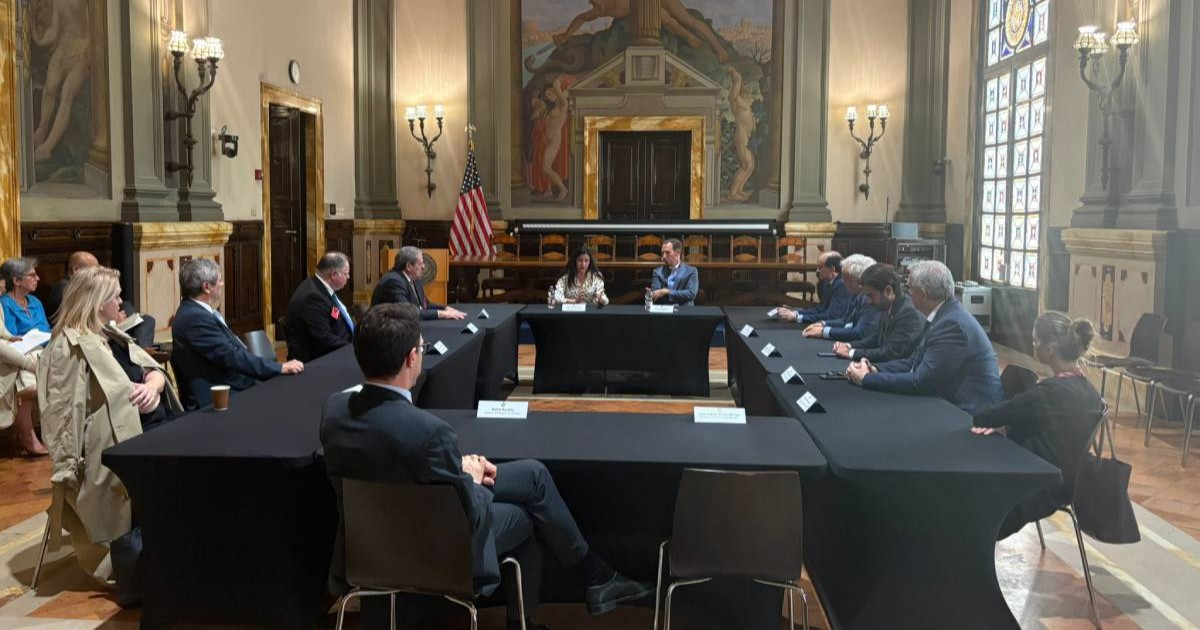
The United States Embassy to the Holy See hosted Rosa María Payá on Thursday in a formal diplomatic meeting in Rome, reiterating its commitment to supporting the Cuban people's quest for freedom and fundamental rights.
The diplomatic mission shared a statement on its official Twitter account, describing it as an "honor" to receive the Cuban activist and hear the story of her father, Oswaldo Payá Sardiñas. He was portrayed as "a man of deep Catholic faith" who championed free expression, fair elections, and the release of political prisoners in Cuba.
"Today, Rosa María continues that legacy. We remain dedicated to standing with the Cuban people in their pursuit of freedom and fundamental liberties," the embassy emphasized, highlighting that "faith and the defense of human dignity go hand in hand."
A Symbolic Meeting in Rome
The encounter in Rome carries particular symbolic weight: Oswaldo Payá was the founder of the Christian Liberation Movement (MCL) and the Varela Project, peaceful opposition initiatives inspired by Catholic principles that gathered over 11,000 signatures demanding democratic reforms in Cuba. The Church served as a central support space for his activism for decades.
This visit comes during a week of significant international activity for Rosa María Payá. On Friday, she was awarded the 13th FAES Freedom Award in Madrid, shared with Yulia Navalnaya, widow of Russian dissident Alexei Navalny, and Iranian activist Masih Alinejad. This recognition places Cuban civic resistance on the same symbolic level as Russian and Iranian efforts in the European context.
In Madrid, Payá delivered a message of hope: "Cuba is closer to freedom than many imagine."
International Pressure Intensifies
Founder of Cuba Decide and commissioner of the Inter-American Commission on Human Rights for the 2026-2029 period —the first person of Cuban descent to join that body— Payá has ramped up her diplomatic pressure on the Cuban regime in recent months.
In September, she accused Cuban Foreign Minister Bruno Rodríguez of having "blood-stained" hands with crimes against humanity, responding to a meeting between the minister and UN High Commissioner Volker Türk.
The international context places maximum pressure on Havana. Twelve days before the United Nations General Assembly vote on the annual resolution calling for the end of the U.S. embargo on Cuba —scheduled for October 28— a coalition of over 1,000 opposition groups has urged democracies to vote against or abstain. Prisoners Defenders recorded 1,351 political prisoners in Cuba as of the end of September, including 40 detained as minors.
Unresolved Tragedy
The death of Oswaldo Payá in July 2012, alongside activist Harold Cepero, remains an unresolved issue. In June 2023, the Inter-American Commission on Human Rights concluded there were "serious and sufficient indications" of direct involvement by Cuban state agents in both deaths, attributing international responsibility to the Cuban state.
Payá announced in Madrid that the plan derived from the Liberation Agreement for Cuba —signed in Miami in March 2026 and ratified in Madrid in May— will be presented during the XXX Ibero-American Summit on November 3, 2026.
Key Insights into U.S.-Cuba Relations and Activism
What was the purpose of Rosa María Payá's meeting at the U.S. Embassy to the Holy See?
The meeting aimed to reaffirm the U.S. support for the Cuban people's pursuit of freedom and fundamental rights, continuing the legacy of Oswaldo Payá.
What initiatives did Oswaldo Payá lead in Cuba?
Oswaldo Payá founded the Christian Liberation Movement and the Varela Project, which were peaceful opposition efforts inspired by Catholic principles, advocating for democratic reforms in Cuba.
How is the international pressure affecting Cuba?
International pressure is mounting as a coalition of opposition groups urges democracies to vote against or abstain from the UN resolution on lifting the U.S. embargo, highlighting Cuba's human rights abuses.