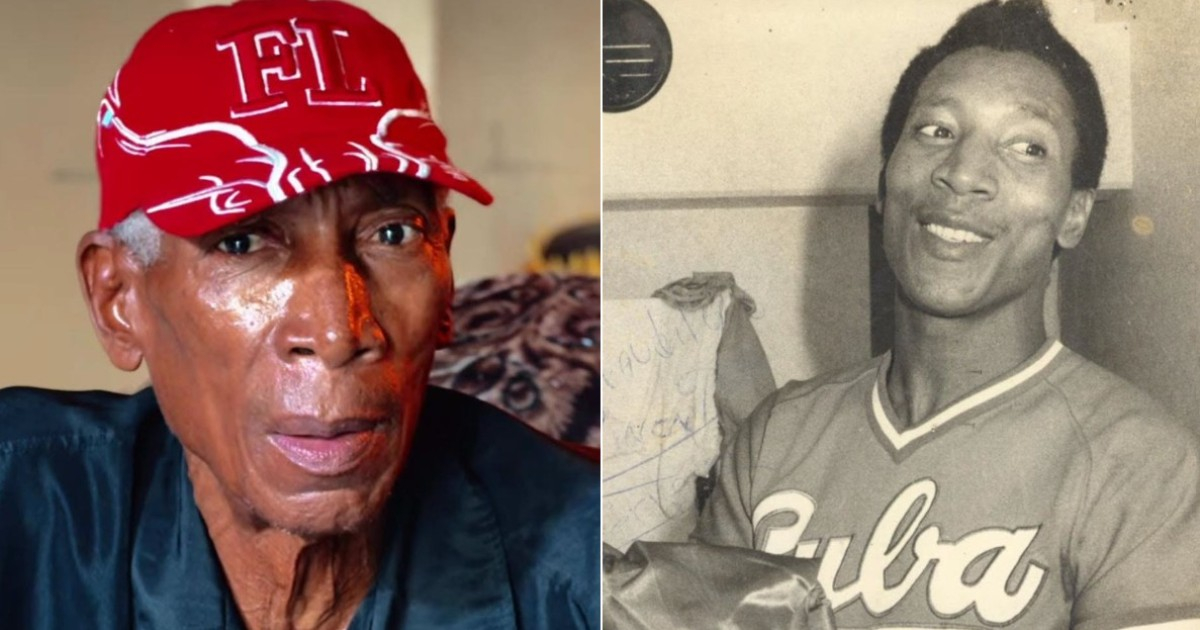
Considered one of Cuba's greatest pitchers, Braudilio Vinent has publicly highlighted the dire conditions he faces in his senior years. At over 70, he struggles without financial support and finds it challenging to access basic necessities.
"I sacrificed for the Revolution, and now I've been forgotten," lamented the former baseball star from Santiago, known as "El Meteoro de La Maya," in a statement shared on the Facebook page La Tijera.
Visibly upset, Vinent shared, "I'm over 70 now, just an old man, yet Braudilio Vinent is forgotten."
The Hardship Behind the Glory
His words paint a picture of daily hardship that starkly contrasts with his extraordinary sports career. "It's tough to have to go out and struggle for a little rice because there's no support for the sports heroes," he said.
Vinent warned that if his situation remains unchanged, he would remove the pictures, diplomas, and medals from his walls that testify to his career. However, he clarified that he does not intend to sell them to make ends meet: "Principles aren't for sale."
An Unmatched Career on the Mound
Born on July 10, 1947, in Songo-La Maya, Santiago de Cuba, Vinent's 20-season career in the National Series left a legacy few can match, with 221 wins, 2,134 strikeouts, 63 shutouts, and 265 complete games, boasting an earned run average of 2.42.
He was the first modern Cuban pitcher to achieve 200 wins on May 16, 1976, and the first to reach 2,000 strikeouts in 1986.
With the national team, Vinent claimed six world championships (1972, 1973, 1976, 1978, 1980, and 1984), four Pan American gold medals, and two Intercontinental Cups. His contribution to Cuban baseball was recognized in 2014 when he was inducted into the Cuban Baseball Hall of Fame in a ceremony at the Mártires de Barbados stadium in Bayamo.
A Widespread Issue of Neglect
Vinent's situation is not unique. Recently, numerous complaints have unveiled the systematic neglect that retired Cuban sports figures endure.
Grandmaster Lázaro Bruzón criticized the regime for discarding retired athletes after years of service: "They were useful numbers as long as we produced results. Once retired, their value to the system ended. That's how this system operates: it recycles people, drains their spirit, and discards those who no longer fit its narrative."
Former world boxing champion Bernardo Comas, suffering from senile dementia at 65, is under his mother's care in a leaky Camagüey home, surviving on a meager pension of just 8,000 Cuban pesos monthly.
The wife of Olympic champion Andrés Aldama publicly pleaded for help due to the neglect her family faces in Matanzas, where the former boxer, afflicted with dementia and diabetes, lacks medication and support from INDER.
Other cases include former boxer Gaspar Casamayor, seen begging in Santiago de Cuba, and baseball player Víctor Tornés, reported abandoned in Bayamo after suffering a stroke.
Last year, Wilmer Lewis Calvo, the national commissioner for Athlete Care at INDER, denied claims on the Roundtable program that sports heroes were neglected, asserting that support structures exist. However, evidence from various provinces contradicts this assertion.
Understanding the Plight of Retired Cuban Athletes
How has Braudilio Vinent contributed to Cuban baseball?
Braudilio Vinent is renowned for his impressive career in Cuban baseball, achieving 221 wins, 2,134 strikeouts, and numerous accolades with the national team, including six world championships and four Pan American gold medals.
What challenges do retired athletes in Cuba face?
Retired athletes in Cuba often struggle with neglect and lack of financial support, facing difficulties in accessing basic necessities and receiving adequate healthcare, as evidenced by numerous public complaints.
What is the Cuban regime's stance on supporting retired sports figures?
The Cuban regime, as stated by officials like Wilmer Lewis Calvo, claims that support structures are in place for retired athletes, though many accounts and evidence from various provinces suggest otherwise.