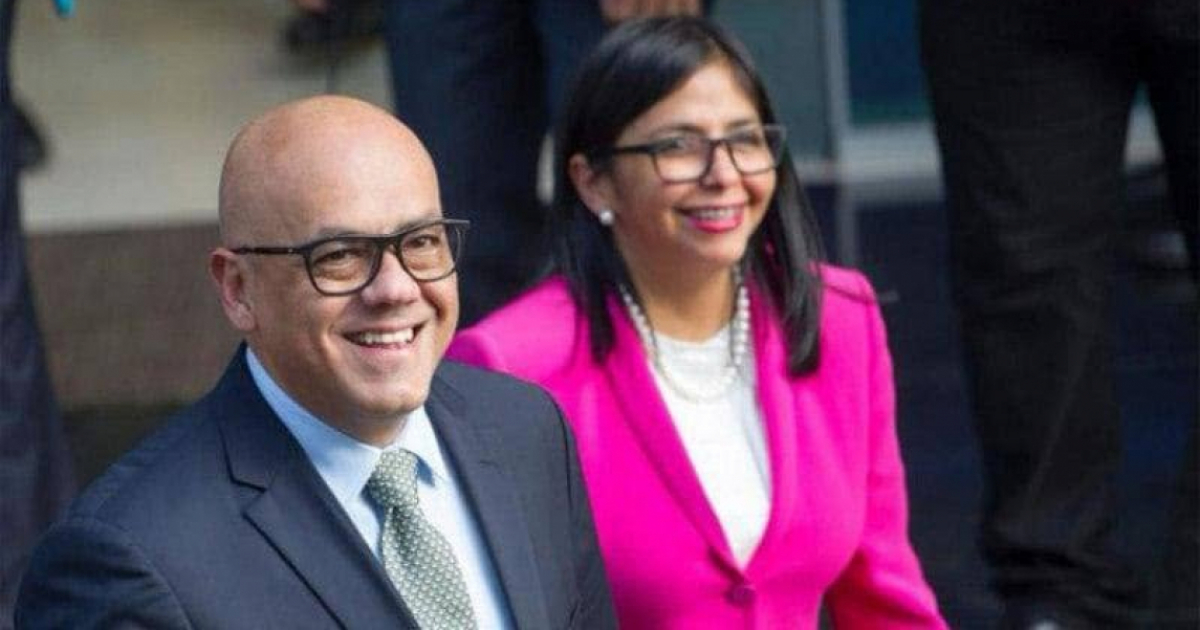
The U.S. Department of the Treasury has officially removed Jorge Rodríguez, the President of Venezuela's National Assembly, from its list of Specially Designated Nationals, effectively lifting the sanctions imposed on him. Jorge is the brother of Delcy Rodríguez, the interim president, and both siblings are influential figures in the ongoing transition dialogue.
This decision, announced by the Office of Foreign Assets Control (OFAC), took Rodríguez's name off the registry in all five variations it appeared under, without providing any public reasoning for this action.
Jorge Rodríguez was originally placed on the sanctions list in September 2018, alongside his sister Delcy, First Lady Cilia Flores, and then Defense Minister Vladimir Padrino López. This was part of a strategic move targeting Nicolás Maduro's inner circle.
The lifting of restrictions on Jorge completes the unblocking of the Rodríguez siblings, who currently hold significant power in Venezuela's executive and legislative branches. Delcy was removed from the OFAC list on April 1 of this year, just three months following Maduro's apprehension.
Jorge Rodríguez plays a pivotal role in the transition dialogue promoted by Washington between the Chavista regime and an opposition faction led by Dinorah Figuera. This process was officially launched in August at the La Carlota airbase in Caracas, resulting in a joint declaration outlining plans to renew the Supreme Court and establish a monitoring mechanism.
The decision reflects a rapid normalization of relations between Washington and Caracas that began after Maduro's capture on January 3, 2026. Since then, the Trump administration has formally acknowledged Delcy Rodríguez as the head of state, re-established diplomatic ties with Venezuela—severed since 2019—and in August, announced a historic oil agreement granting U.S. companies access to 17 fields with reserves estimated at 65 billion barrels, alongside an anticipated investment exceeding $100 billion.
In addition, the Trump administration has eased sanctions related to Venezuela's oil and mining operations, marking a significant shift from the maximum pressure policy previously maintained against the Chavista government.
However, this normalization process has not favored the entire Venezuelan opposition. María Corina Machado, Nobel Peace Prize laureate in 2025 and a leading figure of the opposition not involved in the dialogue, remains in Panama. She alleges that Chavista authorities have obstructed her return to Venezuela, with at least seven failed attempts documented by the end of September.
Machado is not participating in the negotiations led by Jorge Rodríguez for the Chavistas, and her effective exclusion from the process remains a major friction point in Venezuelan politics at this time.
The dialogue between the Chavista regime and the opposition continues, with Jorge Rodríguez as a key negotiator, now free from the sanctions constraints imposed by the U.S. Treasury for the past eight years.
Understanding the U.S. Policy on Venezuela
Why did the U.S. lift sanctions on Jorge Rodríguez?
The U.S. Treasury's Office of Foreign Assets Control removed Jorge Rodríguez from its sanctions list, though no public explanation was provided for this decision. It aligns with a broader effort to normalize relations with Venezuela.
What role does Jorge Rodríguez play in Venezuela's transition dialogue?
Jorge Rodríguez is a central figure in the transition dialogue between the Chavista regime and an opposition faction. This dialogue aims to address political reforms, including the renewal of the Supreme Court.
How has the U.S. policy towards Venezuela changed recently?
The Trump administration has shifted its approach by recognizing Delcy Rodríguez as Venezuela's head of state, re-establishing diplomatic relations, and easing sanctions, particularly those related to oil and mining operations.