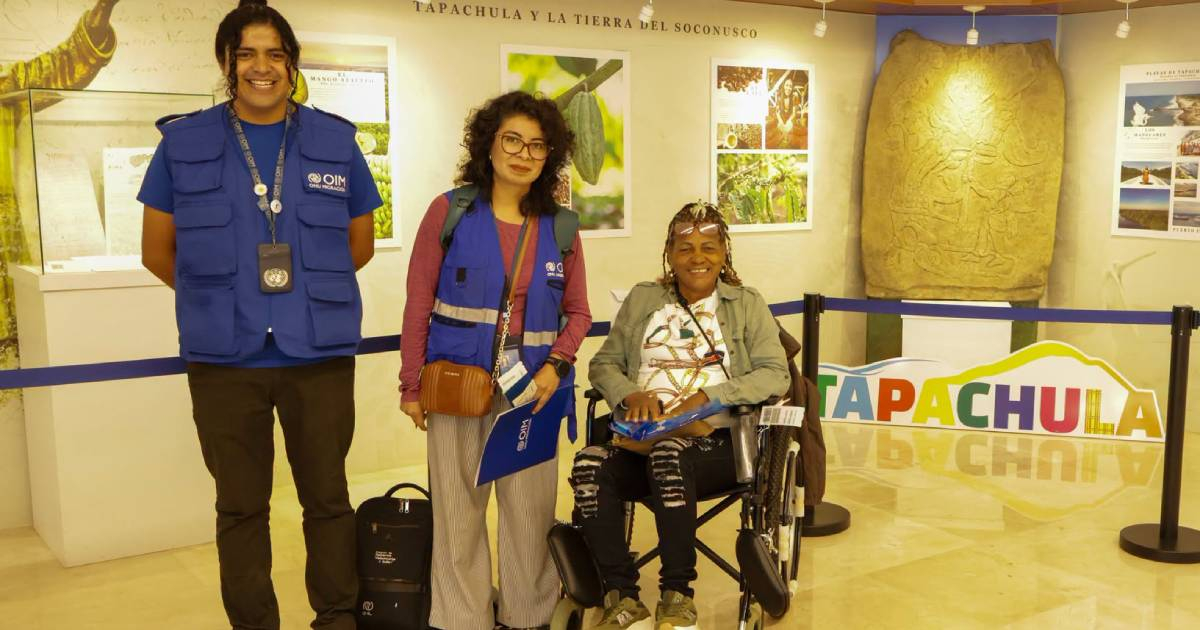
The International Organization for Migration (IOM) played a crucial role in helping a Cuban woman, who faced challenges with mobility and speech, return from Tapachula, Mexico, to her homeland. The journey was facilitated with medical accompaniment and a wheelchair generously provided by the International Red Cross.
The IOM in Mexico highlighted the case of this migrant, whose journey home necessitated specialized care, close supervision, and a protocol for individuals facing medical issues. "Her return required not only coordination but also special care and close support throughout the entire process," the organization shared in a Facebook post, including photos of the woman preparing for her journey.
Assisted Voluntary Return Program
Through the Assisted Voluntary Return (AVR) Program, the IOM organized her transportation, ensuring she traveled safely and with dignity to Cuba by providing a medical escort. The operation was further supported by the Regional Delegation for Mexico of the International Committee of the Red Cross (ICRC), which donated a wheelchair.
"We are grateful to the ICRC Regional Delegation in Mexico for their invaluable collaboration and efforts to make this return possible," the IOM stated.
The organization did not specify the exact health issue the Cuban woman encountered, how long she had been in Mexico, or the exact date of her return. Additionally, no details were provided about her current health condition.
Migrant Support Amidst Uncertainty
Assisted voluntary return is a support mechanism for migrants choosing to return to their home countries, offering logistical and administrative assistance, and when necessary, medical support.
As reported by the Mexican newspaper Diario del Sur in March 2026, the IOM had facilitated the voluntary return of 435 migrants of various nationalities from Mexico between October 2025 and mid-March of the current year. Among them, 31 individuals returned to Cuba from the country.
This case unfolds amid uncertainty for many Cubans remaining in Mexico. In Tapachula, a city near the Guatemalan border, Cuban migrants have reported economic hardships, difficulties regularizing their status, and obstacles in continuing their journey toward the United States.
While the IOM did not disclose the circumstances leading to this woman's migration, her story underscores one of the vulnerable situations migrants can face: experiencing health issues far from home and requiring specialized assistance to return.
FAQs on Cuban Migration and Health Assistance
What is the Assisted Voluntary Return (AVR) Program?
The AVR Program is a mechanism that supports migrants who choose to return to their home countries by providing logistical, administrative, and sometimes medical assistance.
How many Cuban migrants have returned from Mexico with the help of the IOM?
As of mid-March 2026, the IOM had assisted 31 Cuban migrants in voluntarily returning from Mexico.