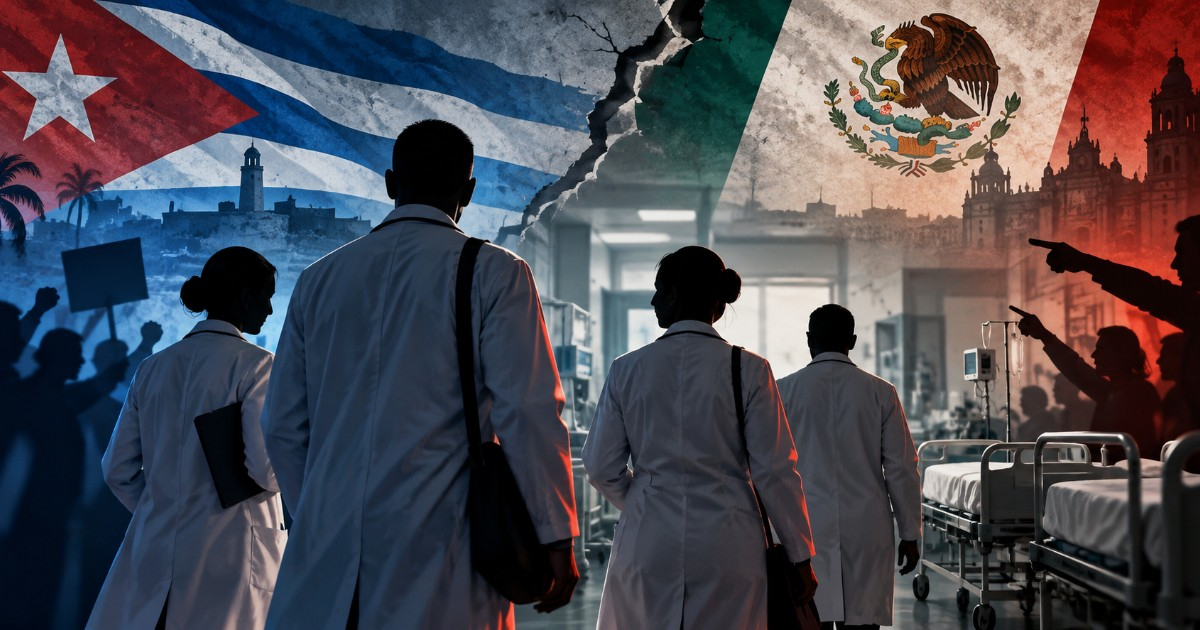
The hiring of Cuban doctors has reignited political tensions in Mexico as the opposition National Action Party (PAN) criticizes Claudia Sheinbaum's administration for prioritizing Caribbean island professionals over local doctors and nurses, who have been protesting against poor working conditions and the shortcomings of the public health system.
Federico Döring, the PAN's deputy coordinator in the Chamber of Deputies, called for the resignation of Zoé Robledo, director of the Mexican Social Security Institute (IMSS), and urged the Mexican president to overhaul the organization's leadership, according to Latinus.
In an interview, Döring questioned the government's priorities, contrasting the support for Cuban doctors with Mexican healthcare workers' complaints about medication shortages, labor issues, and benefit cuts.
"Madam President, I wish you cared for Mexican doctors and nurses working at the IMSS as much as you do for Cuban doctors," stated Döring. "They deserve at least a fraction of the budget, affection, and recognition given to the Cubans."
The deputy was even more pointed in his criticism of the perceived disparity in treatment: "Why is it that you have only hugs for the Cuban doctors, President, but only blows for the Mexican doctors and nurses at the IMSS?"
These remarks come amid escalating tensions between Social Security workers and their management, with protests starting October 8 and a nationwide megamarch planned for Tuesday, the 13th.
Employees have voiced grievances over labor and financial issues, while public discourse on the healthcare system also highlights drug shortages and hospital deficiencies.
Döring pointed out that medical staff feel undermined by the current IMSS leadership and the lack of union support. "There is the issue of the eleven babies who have died in the past month, and this crisis where doctors and nurses feel sabotaged by the current IMSS leadership and lack of union support," he asserted.
For the opposition leader, replacing Zoé Robledo is essential to resolving the conflict. He urged Sheinbaum to consider making a change. "If you truly want to resolve this conflict, you need to change the interlocutors," he declared.
This criticism is particularly significant because Zoé Robledo has been a staunch advocate for medical cooperation agreements between Mexico and Cuba.
Under his leadership, Mexican authorities have pushed for the inclusion of Cuban specialists in public hospitals, particularly in areas where the government claims it is challenging to fill positions with local staff.
In April 2024, the IMSS announced efforts to expand healthcare cooperation with Cuba, aiming for 1,200 Cuban specialists in units and hospitals across 23 Mexican states.
Hiring these professionals remains one of the most visible cooperation policies between the two governments, though it has faced criticism over costs, working conditions, and resources directed to Cuban authorities.
In March 2026, Sheinbaum confirmed her commitment to the agreement with Havana despite U.S. pressures and the cancellation of similar programs in other countries.
She defended the usefulness of Cuban specialists in expanding healthcare, particularly in remote areas lacking enough Mexican specialists.
Her administration also denied allegations of irregularities in the program. In March, the Mexican Embassy in the United States stated that the agreements do not exploit Cuban doctors and that the healthcare cooperation respects labor rights.
Mexican authorities contend that the program addresses medical coverage needs and that foreign professionals receive suitable conditions to perform their duties.
However, the terms of employment and remuneration for Cuban brigade members remain contentious.
In early October, three Cuban doctors working in Mexico reported not being paid for over two months, with no clear answers on when pending payments would occur.
One doctor claimed delays affected both funds channeled through Banjército and those from Banco del Bienestar, also mentioning that mission members were forbidden from publicly complaining.
Questions About Cuban Doctors in Mexico
Why is the hiring of Cuban doctors controversial in Mexico?
The hiring of Cuban doctors is controversial because it is seen as prioritizing foreign professionals over Mexican doctors and nurses, who are protesting poor working conditions and resource shortages. Critics also question the financial and labor implications of these agreements.
What actions have been taken by Mexican healthcare workers in response to the situation?
Mexican healthcare workers have initiated protests and organized a nationwide megamarch to express dissatisfaction with labor conditions and the healthcare system's state. They are demanding better support and resources.
How has the Mexican government responded to the allegations of irregularities in the medical cooperation program?
The Mexican government has denied any irregularities, stating that the cooperation respects labor rights and that the program addresses the need for medical coverage in underserved areas. They argue that foreign professionals receive appropriate conditions for their work.