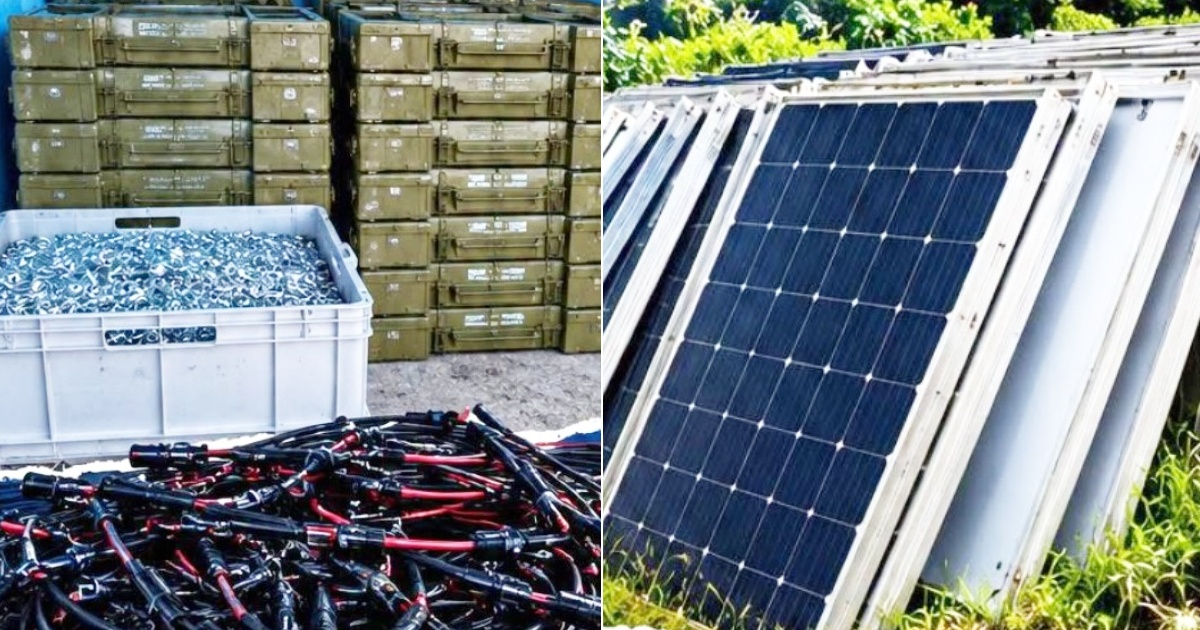
In a significant bust, Guantánamo authorities have retrieved close to 50 stolen solar panels from Santa Teresa 4 solar park. The recovery occurred during a search of a residence in the municipality.
The discovery, publicized by the pro-government Facebook page "Guantánamo y su Verdad," has caused a stir throughout the province due to the scale of the theft and the involvement of park employees among those arrested.
The sheer volume of equipment found in a single location was striking.
"It wasn't just one or two!" the post emphasized, detailing how boxes of screws, washers, cables, and connectors were seized alongside the panels—essentially everything needed to assemble and operate a complete photovoltaic system.
Investigations have revealed that these panels were stolen with the intent to sell them on the black market, according to the source.
More Than Just Solar Panels Stolen
The theft extended beyond the panels themselves. Authorities are also probing the disappearance of around 700 meters of cables from the facility, although the extent of recovered material remains unspecified.
Among those detained, whose numbers were not disclosed by the official source, are employees of the solar park, indicating an inside job.
The case is not being treated as mere theft: "Several individuals, including park workers, remain in custody. The case is being processed as an act of sabotage," the publication reported.
This classification carries severe legal repercussions.
Under Article 125 of the Cuban Penal Code, sabotage against the electrical system results in sentences ranging from seven to 15 years, escalating to 10 to 30 years, life imprisonment, or even the death penalty if severe consequences are proven.
The Cuban regime has toughened penalties for electrical sabotage specifically to curb a surge in thefts that have persisted in recent months.
Failed Preventative Measures
One of the most unsettling aspects of the case is its timing: mere days before the theft, management and workers at the park participated in awareness sessions with the Ministry of the Interior, Electric Company representatives, and the Prosecutor's Office.
The official publication couldn't resist a bit of self-criticism: "Prevention cannot stop at a mere discussion."
This phrase encapsulates the sentiment shared by many citizens in comments: that an informational meeting is no substitute for effective resource control and daily vigilance over facilities.
Public Outrage and Questions of Complicity
The reaction on social media was one of intense outrage. Comments like "The full weight of the law should fall," "Zero tolerance for crime," and "It's unforgivable, it's sabotage and must be severely punished" were prevalent.
However, alongside support for police actions, uncomfortable questions arose.
"So many panels couldn't have been stolen by just one thief," "That many panels can't be stolen overnight," and "There was a lack of control, prevention, and oversight of state and public resources," were pointed out by other users, demanding that the investigation also encompass those responsible for their safekeeping.
A Widespread Issue Across Cuba
Between 2025 and mid-2026, the Attorney General's Office acknowledged over 460 criminal investigations related to offenses against the National Electric System.
In Pinar del Río, a man received a 12-year sentence for stealing screws from a photovoltaic park. In Matanzas, three individuals were apprehended for the theft of 28 solar panels intended for water pumping.
In response, authorities in Las Tunas have started employing an invisible chemical marking method detectable with ultraviolet light to identify those handling the panels, and the Electric Company in Havana has resorted to chemical traps in substations to catch dielectric oil thieves.
What's at Stake
Guantánamo faces particular vulnerability: it relies on a single 110 kV transmission line from Santiago de Cuba, whose failure left the entire province without power in June 2026, with outages lasting up to 33 consecutive hours in some areas.
The solar parks contributed approximately 32 MW during daylight hours, a critical source for a population all too familiar with the consequences of power outages.
"Every panel counts! As does every cable, connector, and component enabling electricity generation. Protecting them is essential to safeguarding a service we all need," concluded the publication that exposed the case.
Key Questions About Solar Panel Theft in Cuba
What penalties are involved in solar panel theft in Cuba?
Under the Cuban Penal Code, sabotage against the electrical system can lead to sentences ranging from seven to 15 years, with the possibility of life imprisonment or death penalty if severe consequences are proven.
How are authorities in Cuba responding to the thefts?
Authorities have begun employing invisible chemical marking detectable with ultraviolet light to identify those handling stolen panels. Additionally, they are using chemical traps in substations to catch thieves.
Why is Guantánamo particularly vulnerable to power outages?
Guantánamo relies on a single 110 kV transmission line from Santiago de Cuba. Any failure in this line can result in extensive power outages, as seen in June 2026 when the province experienced outages lasting up to 33 hours.