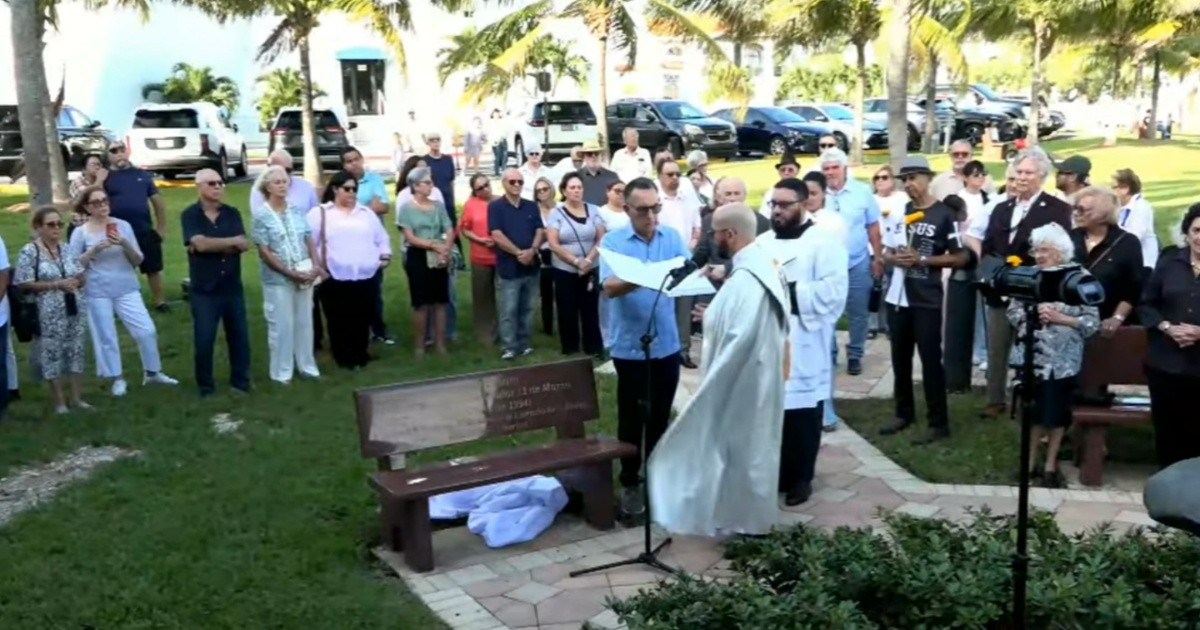
A commemorative bench was unveiled this past Saturday along the seawall of the National Shrine of Our Lady of Charity in Miami, serving as a lasting tribute to the 37 victims of the "13 de Marzo" tugboat tragedy and to all Cubans who have lost their lives in the Florida Straits.
The event, organized by the Foundation for Pan-American Democracy, Patria de Martí, and The CubanAmerican Voice, gathered members of the Cuban exile community for a solemn ceremony that blended historical reflection, religious symbolism, and community actions by the Biscayne Bay.
Radio Martí journalist José Luis Ramos read aloud the names and ages of each of the 37 victims, which included 10 children, and asked for a moment of silence to honor all Cubans who have perished at sea. Omar Vento provided a historical overview of the event, sourced from Jorge García's book on the sinking, outlining the timeline from planning to the tragic attack.
Communicator Ninoska Pérez Castellón recounted how the initial news of the disaster reached Miami and its profound impact on the exile community. Meanwhile, Julio M. Shiling, director of Patria de Martí, connected the date — the 158th anniversary of the Cry of Yara — with the duty to preserve historical memory. "The Cry of Yara defines us as Cubans, and we are also defined by the victims of the 13 de Marzo Tugboat; it is part of our identity," he remarked.
Rosa María Payá, executive director of the Foundation for Pan-American Democracy and a commissioner of the IACHR, expressed gratitude to the survivors and their families "for the courage they had from the very beginning to denounce such a heinous crime." She read words written by her late father, opposition leader Oswaldo Payá Sardiñas, after visiting the survivors in July 1994. In his text, Payá described how "women with children in their arms pleaded for mercy, but their captors responded by aiming powerful water cannons at them."
Father Ángel Andrés González blessed the bench with words that encapsulated the monument's significance: "With this bench's blessing, we dedicate a place to memory, silence, prayer, and hope. Those who sit here will gaze upon the sea, the same sea once viewed by so many Cubans dreaming of freedom."
In a symbolic gesture, attendees placed two bouquets of 19 sunflowers each — totaling 37 flowers for the tugboat victims and an additional flower for all rafters lost at sea — next to the seawall before moving them inside the shrine for a requiem mass.
The bench marks the second such monument at the shrine in 2026: earlier in February, another bench was unveiled in honor of Oswaldo Payá Sardiñas, bearing the inscription "The only choice for the people is freedom."
The "13 de Marzo" tugboat set sail from Havana's port in the early hours of July 13, 1994, with 68 individuals seeking to escape to the United States. Survivors consistently testified that Cuban state vessels systematically rammed the tugboat and used high-pressure water hoses until it sank approximately seven miles off the Havana coast. The IACHR labeled the incident as an intentional attack in its Report No. 47/96; however, the Cuban regime has consistently maintained it was a maritime accident. The case remains unresolved over 32 years later.
"May we soon be able to say, in Cuba and in exile, never again," wrote Oswaldo Payá in 1994. His words, read during the unveiling of the new bench, concluded a ceremony that the Cuban exile community transformed into an act of living memory.
Remembering the "13 de Marzo" Tugboat Tragedy
What is the significance of the "13 de Marzo" tugboat tragedy?
The "13 de Marzo" tugboat tragedy is a symbol of the Cuban struggle for freedom and the human cost of fleeing oppressive regimes. It highlights the dangers faced by those who attempt to escape the island and serves as a reminder of the oppressive actions of the Cuban government.
Why was a bench unveiled in Miami to honor the victims?
The bench in Miami serves as a permanent memorial to the 37 victims of the "13 de Marzo" tugboat tragedy and all Cubans who have died trying to reach freedom. It is a place for reflection, memory, and hope, honoring the lives lost in pursuit of liberty.