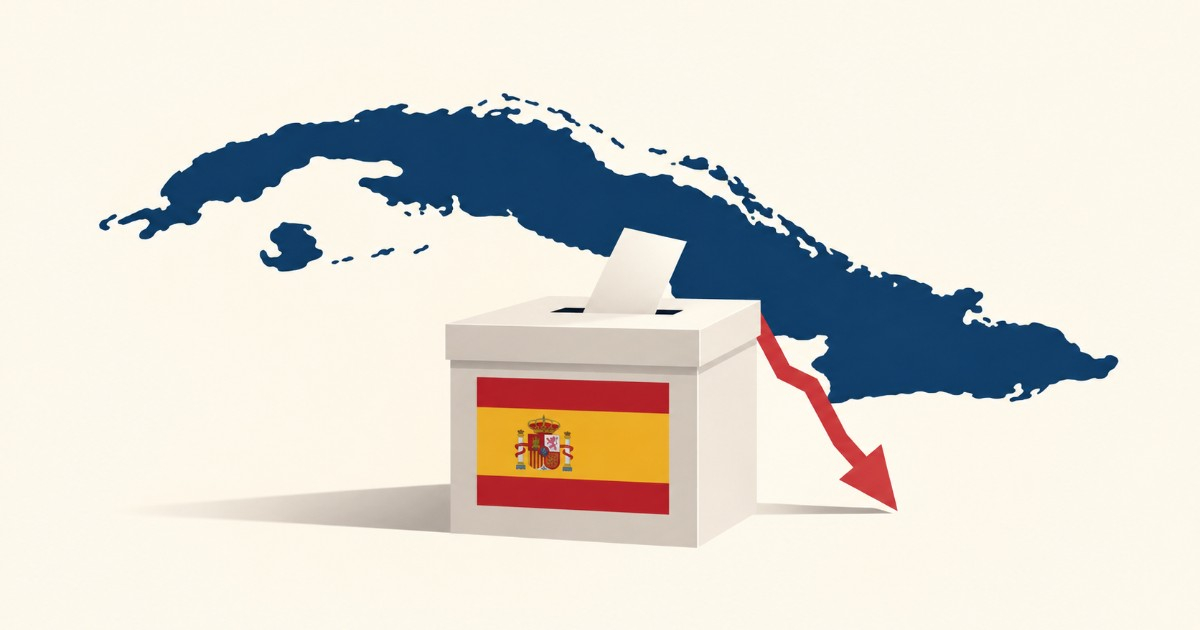
The count of Spanish citizens registered as voters residing in Cuba fell by 1,018 during September 2026, decreasing from 169,038 to 168,020, according to data from the Electoral Census Office (OCE) reported by El Español on Sunday.
This decline sharply contrasts with the global trend of the Electoral Census of Absent Residents (CERA), where the number of Spaniards registered abroad rose by 15,141 in the same month, reaching a total of 2,762,829, as per the newspaper's findings.
Understanding Cuba's Position in the Global Context
Despite this reduction, Cuba remains the fifth country with the highest number of Spaniards registered to vote from abroad, following Argentina, France, the United States, and Mexico. The decrease noted in September pertains specifically to the consular district of Havana.
This downward trend occurs after years of growth in this registry on the island. According to data collected by El Español, during the 2023 general elections, there were 152,796 Spanish voters residing in Cuba. Even after the September drop, the current total exceeds that figure by 15,224. The publication notes, however, that a significant portion of the increase was concentrated in 2023 and 2024, with growth slowing down in subsequent years.
Factors Behind the Decrease in Spanish Voter Registration
Why is there a decline in the number of voters in Cuba? Diplomatic sources consulted by El Español suggest that some Cuban nationals who acquired Spanish citizenship may have moved to live in Spain or another country. When individuals change their habitual residence and update their registration, they may transition from being listed in the Cuban census to that of the new location.
However, a decrease of 1,018 registrations does not necessarily equate to 1,018 emigrants or imply that these individuals have lost their Spanish nationality. The National Institute of Statistics (INE) clarifies that the census is updated monthly with information from consulates, municipalities, civil registries, and accepted claims. The decrease in numbers alone does not provide insight into the specific reasons for the change.
The Role of the Memory Law in Nationality Applications
The evolution of CERA is noteworthy due to nationality applications under the Democratic Memory Law, also known as the Grandchildren's Law. However, obtaining Spanish nationality and being registered as a resident voter abroad are different scenarios: census changes do not reflect how many nationalities have been granted.
Details on the November Electoral Census
In its official statement on October 9, the INE counted 169,290 resident voters in Cuba for the general elections on November 29, out of a total of 2,769,645 abroad. This electoral count should not be confused with the 168,020 registered in the September monthly update cited by El Español, as they are compiled using different census references and procedures.
The INE's guide for these elections highlights that the applicable census for voting closed with reference to August 1, 2026, without prejudice to any claims that may be upheld.
Spanish citizens residing in Cuba will have the opportunity to check and contest their census data from October 12 to 19, inclusive, through the channels provided by the INE and consular offices. The overseas vote will be conducted without the need for a prior request for electoral documentation, following the procedures established for these elections.
Key Insights into Spanish Voter Registration in Cuba
What caused the drop in Spanish voter registration in Cuba in September 2026?
The decline is attributed to some Cuban nationals who obtained Spanish citizenship choosing to relocate to Spain or another country, updating their registration accordingly.
How does Cuba rank globally in terms of Spanish voter registration abroad?
Cuba ranks fifth globally for the number of Spaniards registered to vote from abroad, following Argentina, France, the United States, and Mexico.
Does the decrease in registrations indicate a loss of Spanish nationality?
No, a reduction in registrations does not necessarily mean a loss of nationality. The census updates reflect changes in residence rather than nationality status.