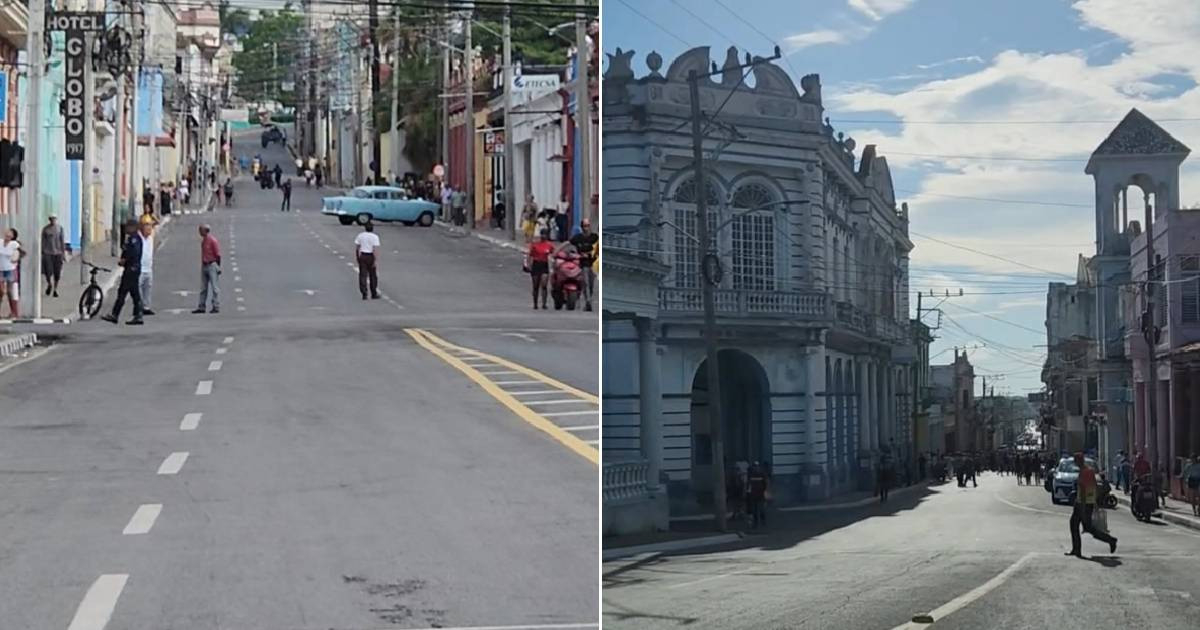
The persistent lack of potable water for more than 50 days on Main Street in the heart of Pinar del Río has prompted playwright Irán Capote to propose a controversial solution. He suggests handing over the water service to a private entity, citing the inefficiency of state management. This crisis has forced families to ration even the most basic necessities.
Capote expressed his disbelief on Facebook, stating, "It’s hard to fathom that in the main street of a city, we’ve been without a reliable water supply for over 50 days. I’m talking about the very center of town, not some outlying area. This is about Main Street."
As a theater director and screenwriter, Capote shared his daily struggle. His household of three relies on just two five-liter gallons of water per person each day. One is allocated for basic hygiene, cooking, and dishwashing, while the other is reserved for drinking, making coffee, and emergencies.
"Carrying around two empty jugs to fill wherever I can find water is now part of my daily routine. The trick is not to frequent the same places too often, so as not to overburden those who help," he explained.
Hope Amid Crisis: A Positive Encounter
A surprising encounter during one of his water-seeking journeys inspired Capote's proposal. He noticed the line for tricycles was unusually short due to the return of the urban bus Route 6, a service revived in late September through a collaboration between the Pinar del Río Transport Group and the private enterprise On Bazar, with a fare set at 15 pesos.
This experience led Capote to suggest that a similar model could be applied to the water service. "I was thrilled because I have faith that someday they might even hand over the water supply to a private enterprise, or even to someone with a knack for business," he wrote ironically.
Capote criticized the Pinar del Río Water and Sewage Company for focusing on political slogans rather than addressing the prolonged water shortage that residents have been complaining about.
"Water Company! Just give up already, my dear, we need water, not patriotic posts. Learn from the Transport folks, come on…," he concluded.
Community Voices: Frustration and Calls for Change
Comments on Capote's post painted a broader picture of the impacts. One resident noted that Cuarteles Street had been without service for nearly two months, while another mentioned that the area near the pediatric hospital had gone 75 days without water since July 25.
A resident from Retiro Street echoed the sentiment for privatization, saying, "Maybe a private company could provide water, because nothing state-run works."
Others questioned the priorities of the water company, recalling a post showing workers engaged in beautification projects under the banner of "Social Responsibility," which seemed out of touch with the urgent needs of the residents.
"I didn’t know whether to laugh or cry. We live—or perhaps die—on political fanfare and appearances alone," one user lamented.
The shared complaints underscore the daily struggles faced by various neighborhoods in Pinar del Río due to the supply shortage.
Capote's proposal, delivered with dark humor, challenges the state's ability to provide essential services and calls for accountability in a situation that, according to residents, has dragged on for weeks.
In September, the provincial Communist Party acknowledged the recurring complaints about water, despite over 100 million pesos spent on investments that have failed to solve the problem.
By the end of September, 159,171 residents in the province were affected, with the capital receiving only 50% of the scheduled pumping time, according to the official newspaper Granma.
Weeks earlier, authorities admitted that 2.7 million Cubans had their access to potable water partially or fully disrupted, with around 85% of pumping stations reliant on the National Electric System, meaning each power outage directly halts water supply.
Pinar del Río is also dealing with three active outbreaks of hepatitis A, a public health issue that authorities have yet to control, despite advising residents to manually chlorinate their water.
Frequently Asked Questions About Pinar del Río's Water Crisis
What has led to the prolonged water shortage in Pinar del Río?
The persistent water shortage in Pinar del Río is attributed to inefficient state management and infrastructure issues, compounded by a reliance on an unstable National Electric System to power pumping stations.
How are residents coping with the water crisis?
Residents are rationing their water supply, using limited amounts for basic needs, and often resorting to collecting water from various locations as part of their daily routine.
What solutions have been proposed to address the water shortage?
Proposals include privatizing the water service to improve efficiency and reliability, drawing inspiration from successful private-public partnerships in the transportation sector.