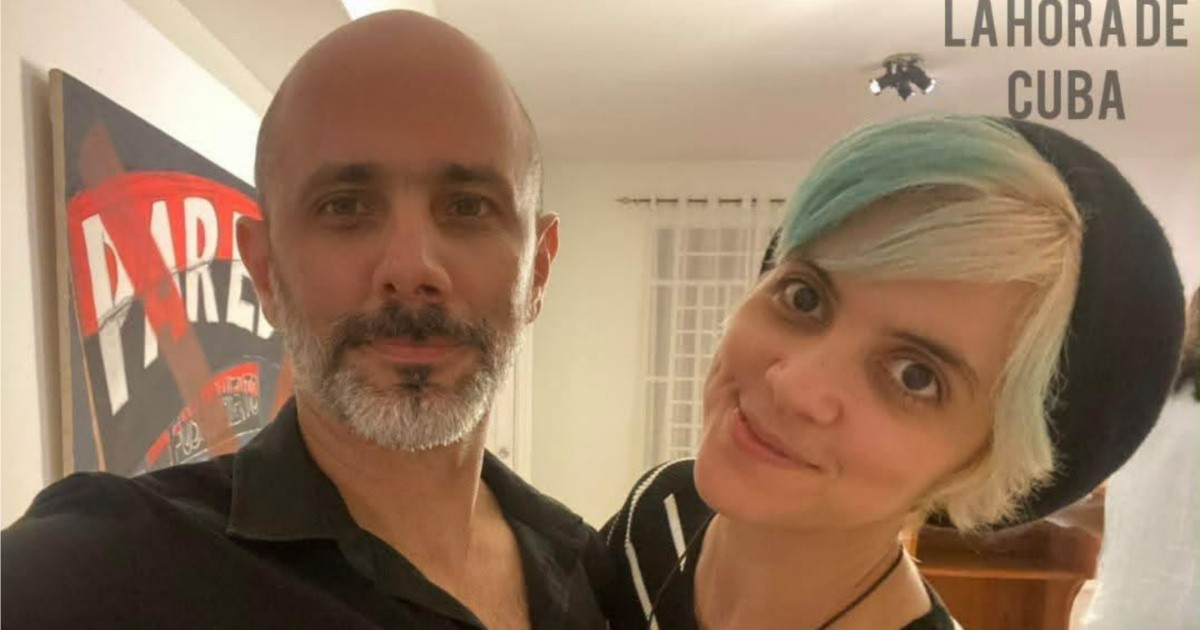
Alejandra García, a journalist and partner of the director of La Hora de Cuba, revealed on Saturday that State Security agents subjected her to an interrogation on Friday following her second scheduled visit to Henry Constantín at the maximum-security Kilo 7 prison, located in the Albaisa neighborhood of Camagüey.
García shared details of the incident on social media through the independent media outlet, recounting how after her farewell to Constantín, two agents named Felipe and Frank detained her for what they termed a "friendly dialogue."
"They called it a 'friendly dialogue.' For me, it was an interrogation," García wrote.
The visit took place in a separate office from noon until two in the afternoon, always under the supervision of an officer. García was able to deliver belongings, food, and drinks to Constantín, who gave her a rose. She described him as calm, in good health, and confident that Cuba will one day be free.
The pressure began upon her departure. The agents employed what García identified as the classic good cop, bad cop routine, with threats thinly veiled in cordiality.
"Threats, or warnings as they might call them, were not missing in this 'friendly conversation': that they could help me, that I didn't have to go through this, that the process could be shorter, that I wouldn't want my people to suffer, that I wouldn't want anything to happen to me that might worry or destabilize Henry," she reported.
The agents also inquired about her sister abroad, her grandmother, her mother, and her father. "They only missed mentioning my dog and cats. Everyone is fine, agents. Thanks for the 'concern,'" García replied sarcastically in her account.
At the end of the encounter, agent Frank presented her with an ultimatum: "It was in my hands to choose the easy or the hard way." García responded without hesitation: "I looked him in the eye and replied: Henry remains steadfast. And I stand firm with him."
The journalist dismissed any justification for what occurred: "It was a family visit. I didn't commit any crime; I just went to see my partner, whom they unjustly keep imprisoned." She was unequivocal in defining her experience: "This was not a meeting, it should be named for what it is: harassment and intimidation. It's a control mechanism and a twisted game applied to independent journalists, activists, influencers, and civil society members."
García noted that harassment is not new for the La Hora de Cuba team. Deputy Director Iris Mariño, writers, and contributors have faced summonses, detentions, and interrogations over the years. "The names and settings change, but the script remains the same," she wrote.
Constantín has been incarcerated since September 16, charged with "disobedience" for allegedly missing a migration summons, a charge both he and García deny. He was transferred without notice to Kilo 7 on September 24. Reporters Without Borders has documented this as at least his nineteenth detention related to journalism, in a country ranked 160 out of 180 in the global press freedom index.
"They fabricated a crime against Henry and built everything on lies," García concluded, ending her denunciation with a declaration of purpose: "I have the mission to communicate, and I will do so."
Understanding the Situation of Henry Constantín and Press Freedom in Cuba
Who is Henry Constantín?
Henry Constantín is the director of the independent media outlet La Hora de Cuba, known for its critical stance against the Cuban government. He has been detained multiple times due to his journalistic activities.
What challenges do independent journalists face in Cuba?
Independent journalists in Cuba often face harassment, detentions, and interrogations by State Security. The government uses intimidation tactics to suppress dissent and maintain control over the media narrative.
Why was Henry Constantín detained?
Henry Constantín was detained on charges of "disobedience" for allegedly missing a migration summons, a charge he and his partner Alejandra García dispute as fabricated and unjust.