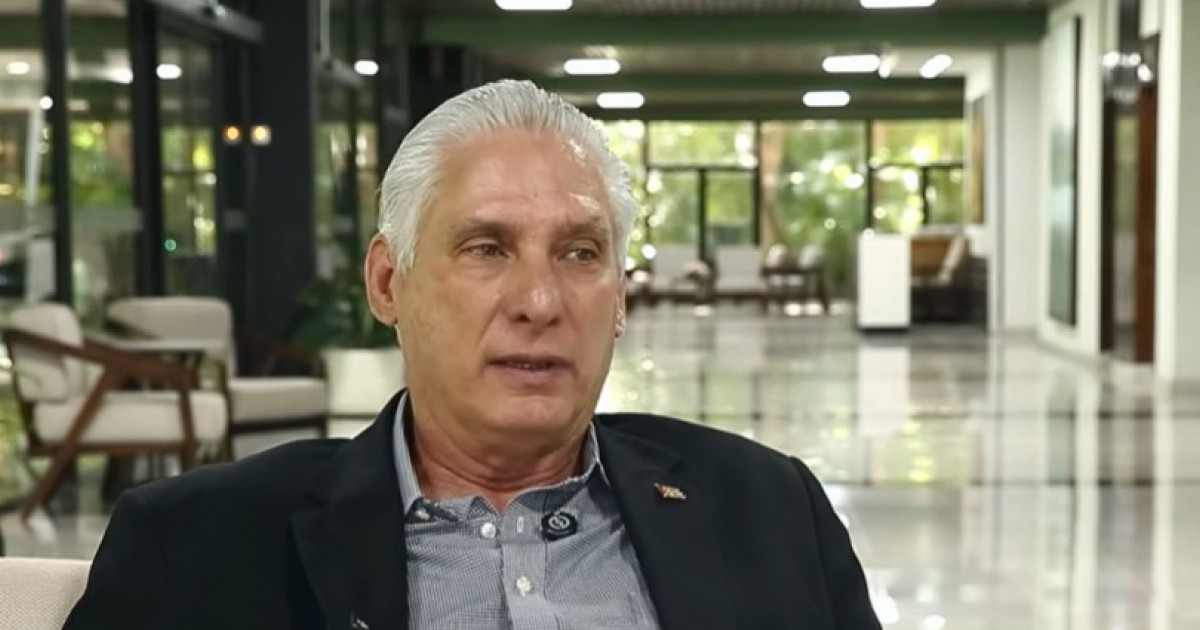
Amidst one of Cuba's most severe energy crises in recent history, Miguel Díaz-Canel voiced his "strong confidence" in the officials of the Ministry of Energy and Mines (MINEM), asserting that the nation is undergoing an "energy transition" of an impressive scale not yet fully realized.
"We indeed trust in the professional abilities, political commitment, and the responsible approach taken by the ministry's staff," the leader stated in a video shared on social media following his two-day visit to the ministry and three key enterprises in the sector.
These remarks, made on Thursday during his visit, starkly contrast with the harsh reality faced by millions of Cubans. On that very day, the actual maximum impact on the system reached 1,886 MW. For Saturday—marking the 158th anniversary of the Cry of Yara—the Electric Union forecasted a deficit of up to 1,680 MW during peak hours, with only 1,250 MW available against a demand of 2,900 MW.
Ironically, on the same day Díaz-Canel praised his officials, a fault in the 220 kV Nuevitas-Las Tunas line caused a partial system blackout in the eastern part of the country, leaving Las Tunas, Holguín, Granma, Santiago de Cuba, and Guantánamo without power for over two hours.
The pattern over recent months has been devastating: between September 3 and October 2, 23 out of 28 days experienced maximum disruptions exceeding 2,000 MW, according to the Electric Union's own data.
The National Electroenergetic System suffered eight total collapses during 2026, with the latest occurring on September 18, requiring approximately 32 hours for recovery.
In some areas like Mayarí, blackouts have persisted for over 60 consecutive days, while residents of Puerto Esperanza in Pinar del Río get barely two hours of electricity daily.
Díaz-Canel highlighted progress in renewable energy: by 2025, over 1,000 MW of solar photovoltaic capacity was installed, with 144 solar parks in operation, and renewable energy's share reportedly increased from 3% to 10% in one year.
Nevertheless, solar power does not meet nighttime demand or compensate for the collapse of thermal generation, which has suffered from years of neglect and chronic fuel shortages.
In July, Minister Vicente de la O Levy acknowledged the "long road ahead" and the lack of resources to quickly stabilize the grid, admitting that some communities endured up to 105 consecutive days without electricity.
This isn't the first time the leader has resorted to institutional praise amid a worsening crisis. In July, Díaz-Canel suggested "better organization" of blackouts instead of offering structural solutions, and in August, he promised "equity" in their distribution.
On this occasion, beyond expressing his confidence in the ministry, Díaz-Canel urged the officials to change: "The first thing that needs an energy transformation is this ministry," he declared, an implicit acknowledgment that something is amiss within the institution that has overseen the island's worst energy crisis in recent memory as Cuba finds itself in darkness on October 10.
Understanding Cuba's Energy Crisis
What is causing the severe power outages in Cuba?
The power outages are primarily due to the collapse of thermal generation systems, exacerbated by years of inadequate maintenance and chronic fuel shortages.
How is Cuba addressing its energy challenges?
Cuba is attempting to tackle its energy issues by investing in renewable sources, such as solar power, although these efforts have not yet met the nighttime demand or fully compensated for the loss in thermal generation capacity.
What progress has Cuba made in renewable energy?
As of 2025, Cuba has installed over 1,000 MW of solar photovoltaic capacity, with 144 solar parks in operation, and has increased the share of renewable energy from 3% to 10% in one year.