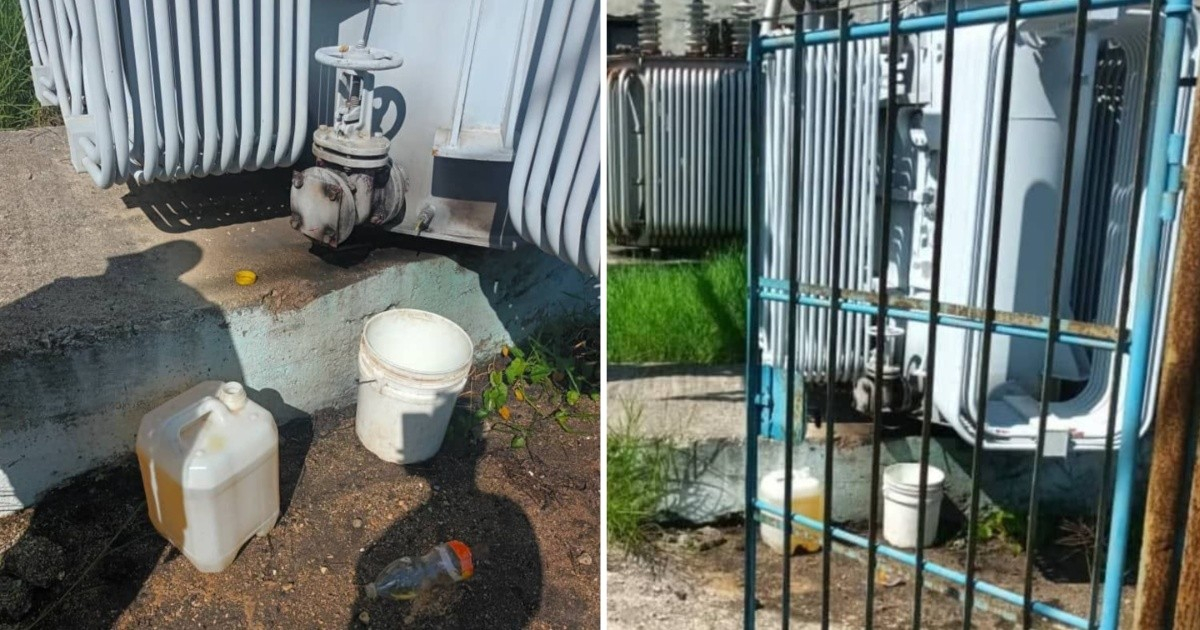
Cuban authorities successfully intercepted an attempted theft of dielectric oil at the Cuban Bronze substation in the Havana municipality of Guanabacoa this past Friday, as announced by the Havana Electric Company on its Facebook page.
The Havana Electric Company (EELH) assured that the transformer remained undamaged and that the individuals involved in the attempted theft were apprehended by security forces.
This incident was described by the company as a testament to "the effectiveness of the organizational and technical measures implemented by the Havana Electric Company in conjunction with enforcement agencies."
This positive outcome comes just ten days after EELH revealed the installation of chemical traps in its substations. These traps use an invisible substance detectable under ultraviolet light to identify individuals attempting to siphon the oil. The Guanabacoa case marks the first publicly known success of these measures in Havana.
The theft of dielectric oil poses a significant threat to Cuba's electrical infrastructure. This oil is crucial for cooling and insulating transformers; its removal results in overheating, short circuits, and irreversible damage to the equipment.
On the black market, it is resold as a substitute fuel for tractors and agricultural machinery, fetching prices between 500 and over 1,000 Cuban pesos per liter.
The extent of this issue was highlighted in July 2026 when Energy and Mines Minister Vicente de la O Levy admitted to the National Assembly that such thefts occur "daily" and the amount stolen is nearly equivalent to the country's production during the same period.
From 2025 through the first half of 2026, authorities launched over 460 criminal investigations related to offenses against the National Electric System, with more than 300 linked to dielectric oil theft across all 15 provinces and 97 municipalities in the country.
Courts have imposed severe sentences in response. In early October, seven individuals received prison terms ranging from 12 to 15 years for stealing 1,248 liters of oil from the Moa Nueva substation in Holguín, an act that destroyed the transformer and left more than 6,000 homes without power.
On the same date, four men were sentenced to 15 to 20 years for extracting oil from Havana's Dairy Complex, causing losses exceeding 10 million pesos and disrupting the production of food staples.
Despite the intensifying penalties, thefts persist. In Holguín, the provincial electric company's distribution director, Fabián Vega Genicio, reported 65 incidents compromising the electrical system by the end of October, compared to 42 in the same period of 2025. Of these, 36 were related to dielectric oil thefts, up from just four in the previous year.
Under Cuban Penal Code, following Supreme People's Court Ruling 475/2025, these thefts can be classified as sabotage, with sentences ranging from seven years to life imprisonment or even the death penalty in aggravated cases.
Understanding the Dielectric Oil Theft Crisis in Cuba
What measures are being taken to prevent dielectric oil theft in Cuba?
The Havana Electric Company has implemented chemical traps in its substations, which use an invisible substance detectable under ultraviolet light to catch oil thieves.
Why is dielectric oil theft a significant issue for Cuba's electrical system?
Dielectric oil is essential for cooling and insulating transformers. Its theft leads to overheating, short circuits, and irreversible damage to the equipment, threatening the stability of the country's electrical infrastructure.
How has the Cuban government responded to the theft of dielectric oil?
The government has launched numerous criminal investigations and imposed severe sentences, ranging from long-term imprisonment to potential life sentences or the death penalty for aggravated cases.