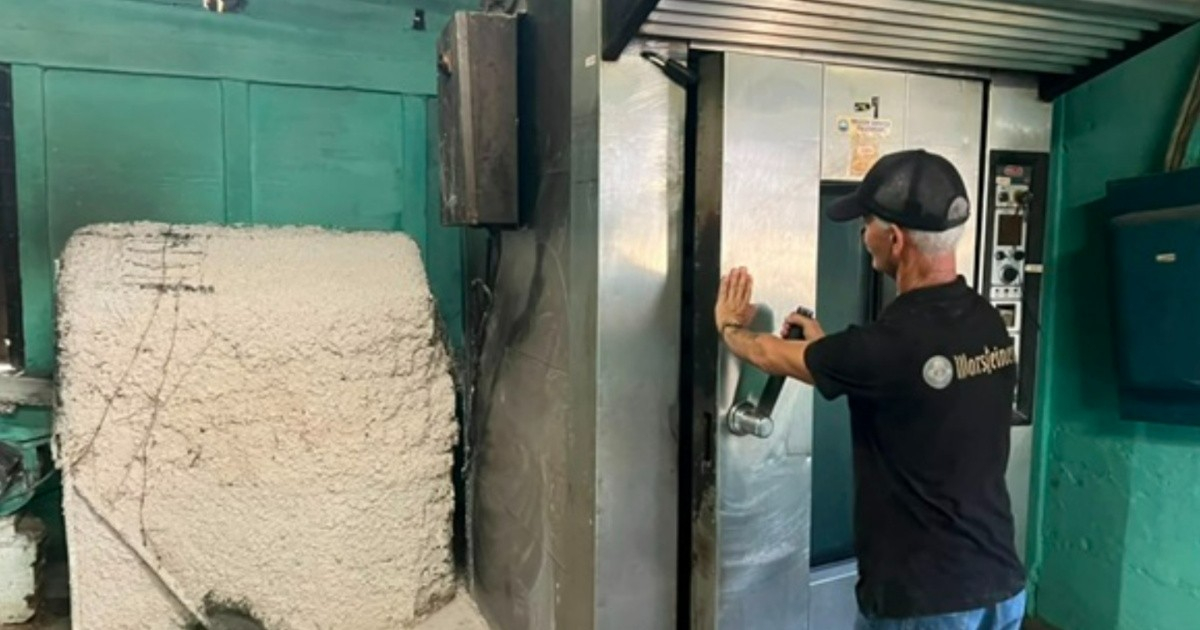
On Saturday, the state-run media outlet Cubadebate highlighted what it termed an "innovation" but is actually a survival strategy amid Cuba's energy collapse: a bakery in the municipality of San Cristóbal, Artemisa, has swapped diesel for marabú—a pervasive plant—to continue baking bread amidst a severe fuel shortage.
This bakery, located in the José Martí community near the old sugar mill of the same name, has crafted an outdoor makeshift forge that generates steam, which is channeled into the oven through a fan-equipped pipe, all without altering the original structure of the equipment.
Damarys Trujillo Hernández, the bakery's administrator, explained the rationale behind their creation: "The idea was to create a forge, allowing us to work with wood while maintaining the original oven structure, so we can revert to its use when fuel conditions improve. It's a rustic system that generates steam outside the oven, causing no harm. What we did was remove the burner and install a duct with a fan to direct the steam inside."
Reaching this solution wasn't straightforward. The workers initially experimented with clay alone, then with mud bricks, neither of which withstood the temperatures. They eventually found a successful refractory material mix of fiberglass, clay, and cement.
Energy Crisis: Innovation or Desperation?The official narrative hails this as ingenuity, yet it underscores an unprecedented energy crisis. In May 2026, Energy and Mines Minister Vicente de la O Levy openly acknowledged that Cuba had "absolutely no" diesel or fuel oil for power generation. The nation consumes between 90,000 and 110,000 barrels daily but produces only about 40,000, a structural deficit worsened by Venezuela halting oil shipments at the end of 2025 and Mexico drastically cutting supplies in early 2026.
In this scenario, bakeries across Cuba reverted to wood-fired ovens starting February 2026. In Guantánamo, flour was transported by mules and bread baked with wood; in Holguín, ovens over thirty years old were reactivated; in Camagüey, the government itself inaugurated a wood-fired oven in September 2025, touting it as "science and innovation." The narrative is consistent: emergency responses to energy system collapse are marketed as revolutionary creativity.
Marabú: An Invasive SolutionMarabú, an African-origin invasive plant covering millions of hectares in Cuba, boasts a high calorific value of approximately 4,654 kcal/kg, making it a widely used emergency resource. However, its charcoal is also scarce and sold on the informal market for between 3,500 and 5,000 pesos for a 20 kg sack, far exceeding the official price.
The San Cristóbal bakery produces 15,000 loaves daily for school meals, the hospital, the maternity home, and the orphanage in the municipality, also supplying several neighboring communities. It has been compensating for other local bakeries' operational issues for about two years. With shortages of flour and sugar, the administrator confirmed negotiations with a self-employed worker and potentially a small and medium-sized enterprise to secure raw materials: "We have already signed a contract, the cost sheet is ready, and both parties have clearly defined the terms for starting supplies and sales."
While the regime's media praises the "ingenuity" of baking bread with wood in 2026, in Villa Clara, for instance, subsidized bread has been restricted for months to children under 13 and adults over 65, further highlighting the deterioration of a system unable to provide even the most basic staple of the Cuban diet.
Understanding Cuba's Energy and Bakery Challenges
Why did the Artemisa bakery switch to using marabú?
The bakery in Artemisa resorted to using marabú due to a severe shortage of diesel, part of a broader energy crisis in Cuba. This switch was a necessity to continue baking bread amidst a lack of fuel.
What challenges do Cuban bakeries face in the current energy crisis?
Cuban bakeries are facing significant challenges due to fuel shortages, forcing many to revert to wood-fired ovens. This has led to increased operational difficulties and a reliance on alternative resources like marabú.