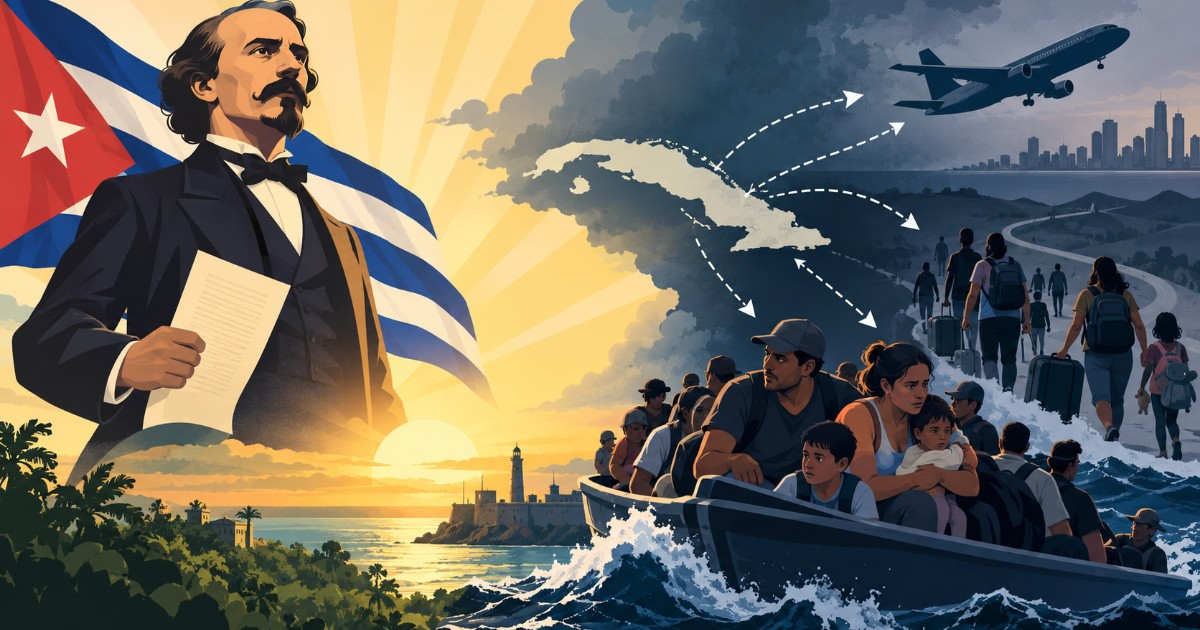
On October 10, Cuba marks the 158th anniversary of the Cry of Yara, yet the nation grapples with a declining population. Officially, the National Office of Statistics and Information (ONEI) estimates 9,434,593 people will reside on the island by the end of 2025. However, an independent demographic study suggests a vastly different number, with only 8,025,624 residents by the end of 2024—a discrepancy of nearly 1.72 million compared to official figures for that year.
This gap highlights a significant issue tied to the exodus: while many Cubans have established their lives and homes abroad, they maintain administrative ties to Cuba, such as documentation or family connections. This situation complicates the distinction between administrative residence and physical presence. Although ONEI claims to exclude individuals who spend most of the year outside the island, the debate over Cuba’s true population remains unresolved.
Challenges in Accurately Counting Cuba's Population
ONEI's projections for 2025 show a decrease of 313,414 people from the 9,748,007 reported at the end of 2024. In that year, Cuba recorded 68,064 births and 136,214 deaths, resulting in a natural decrease of 68,150 individuals. The net external migration was negative, with 317,320 emigrants compared to 72,056 immigrants. This balance reflects the difference in entry and exit movements rather than the total number of those leaving the country.
Juan Carlos Albizu-Campos, a demographer and economist, critiques the official statistics, arguing they fail to capture the full extent of emigration. In his research, "Cuba: Demographic or Systemic Crisis?" he presents two scenarios for the end of 2024, estimating populations of 8,893,483 and 8,025,624, depending on adjustments applied to initial population figures and migration balances. These estimates, significantly lower than ONEI's reports, underscore the potential underestimation of departures to destinations other than the United States.
Impacts of New Migration Laws
In 2024, Cuba's National Assembly approved a migration reform, published in the Official Gazette on May 5, 2026. This reform introduces a framework differentiating effective migratory residence from other legal statuses. Law 171 of Migration and Decree 136 stipulate that individuals with over 180 days of presence in Cuba during the preceding year will be recognized as residents. Starting November 1, 2026, these laws will replace the previous system tied to 24 months of absence, which had been suspended.
While the reforms may enhance administrative identification of residents, they do not immediately correct the population registry by one or two million. The changes aim to better distinguish between those truly residing in Cuba and those living abroad, yet a comprehensive and precise population count remains elusive.
The Legacy of Cuban Exodus Since 1959
Before Fidel Castro's rise in 1959, Cuban emigration was already a reality. However, the establishment of the socialist regime triggered successive waves of emigration, driven by political persecution, economic changes, family separations, and the pursuit of better living conditions. Key historical emigration phases to the United States include:
1959-1962: Approximately 248,100 Cubans fled during the early Castro years, including former Batista regime officials, businesspeople, and families opposed to political changes.
1965-1973: The Camarioca exodus and Freedom Flights facilitated around 260,600 departures. Family reunification was a primary motivator for these travelers.
1980: The Mariel Boatlift saw about 124,800 Cubans leaving after the Peruvian embassy crisis. This influx altered the social composition of Cuban émigrés.
1994: Amidst economic collapse, the balseros crisis resulted in around 30,900 Cubans attempting to reach Florida on makeshift rafts.
1995-2017: Emigration continued post-Special Period, with family reunifications, visas, and irregular routes. The "wet-foot, dry-foot" policy, abolished in 2017, facilitated these departures.
Recent Migration Trends and an Aging Population
The economic downturn post-pandemic and increased repression after the July 11, 2021 protests have spurred a new migration wave. The removal of Nicaraguan visa requirements for Cubans enabled travel routes through Central America to the U.S. Meanwhile, others have sought routes to Florida or moved to countries like Spain, Mexico, and Brazil. By September 2024, reports indicated over 850,000 new Cuban arrivals in the U.S. since 2022, a scale exceeding prior exodus events.
As of 2025, 26.7% of Cuba's population was aged 60 or older, according to the United Nations Population Fund. The working-age group has diminished by approximately 1.26 million in five years, with young adults emigrating and low birth rates shrinking the labor force supporting the economy and care systems. Families are increasingly dispersed, with elderly relatives left behind, children growing up apart from family members, and professionals leaving the island.
On October 10, 1868, Carlos Manuel de Céspedes initiated the Cuban War of Independence, aspiring to build a sovereign nation. Today, that nation extends beyond its borders due to waves of emigration, leaving Cuba with the fundamental demographic question: how many Cubans truly remain on the island?
Understanding Cuba's Population Dynamics
Why is there a discrepancy in Cuba's population figures?
The discrepancy arises because many Cubans live abroad but maintain administrative ties to Cuba. Official statistics may not fully account for those spending most of the year outside the island.
What impact do Cuba's new migration laws have?
The new laws, effective November 2026, aim to clarify who qualifies as a resident based on their presence in Cuba. However, these changes don’t immediately adjust the population registry.
What are the consequences of Cuba's demographic decline?
The demographic decline results in an aging population and a reduced labor force, impacting economic support and care systems. It also leads to families being spread across different countries.