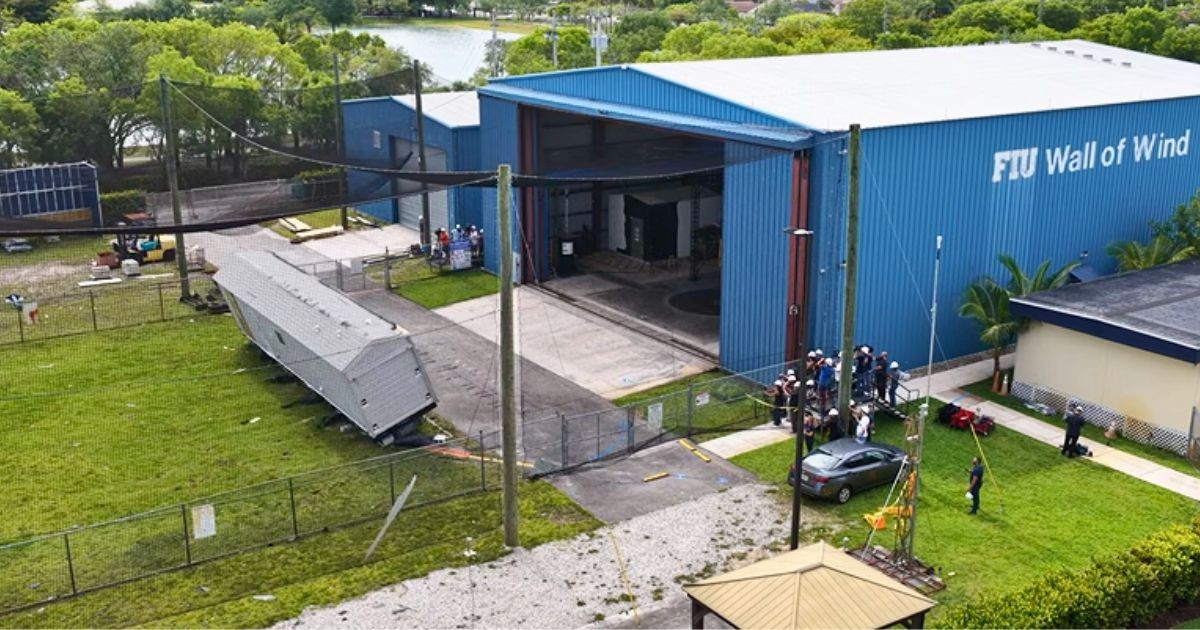
Florida International University (FIU) and the University of Kansas researchers have disclosed preliminary findings from a groundbreaking experiment: the first full-scale controlled test of manufactured homes exposed to hurricane-level winds. The findings reveal critical flaws in anchorage systems, threatening millions of Americans.
The experiments, overseen by researchers Elaina Sutley from the University of Kansas and Arindam Chowdhury from FIU, were conducted from May to June 2026 at FIU's Wall of Wind facility in Miami. These findings were made public this Friday.
This research is especially significant as Hurricane Isaías approaches the United States, making landfall near Destin, Florida, around 9:30 p.m. (Miami time) with sustained winds of 105 mph. Initially a Category 2 hurricane on the Saffir-Simpson scale, it quickly weakened to Category 1, yet it still poses risks to several regions over the weekend.
The FIU and University of Kansas team subjected three FEMA-provided manufactured homes to over 20 individual tests, with wind speeds ranging from 70 mph to 130 mph, altering anchorage systems, wind zones, elevation, and structure orientation.
The most striking moment occurred at 110 mph. As described by the researchers: "It's 9:15 a.m. The wind howls at 110 mph; the noise is deafening. Dust swirls in the air. We watch as a single-module manufactured home sways back and forth, battered by turbulent winds. Then, suddenly, the screws snap, and the entire unit topples backward, flipping over twice before coming to rest."
This scenario mimicked the minimum installation standard in states like Kansas, with approximately 40% of the anchors failing. In contrast, when the same structure was fitted with steel straps and the most robust anchorage system—akin to Wind Zone III requirements—it remained relatively stable even at higher speeds.
The preliminary conclusions are stark: "Our initial findings indicate that installation practices allowed by some states do not meet federal code minimums, and many commonly used installation systems in the U.S. fall short of modern wind engineering standards," wrote Sutley and Chowdhury.
The federal code governing these homes—HUD Code, Title 24 CFR Part 3280—features wind engineering standards from 1988, which have not seen a significant update in over three decades. Unlike site-built home codes, reviewed every three years, the prefabricated home regulations lack guidelines for earthquakes, wildfires, or tornadoes.
The tested homes were notably constructed to withstand three times the federal code's requirements. The researchers caution that the results are preliminary and should not be generalized as a safety guarantee for all mobile homes on the market.
The experiment also has acknowledged limitations: it isolated wind hazards without concurrently replicating flooding or storm surge. "If this home had been tested under flood, wind, and surge conditions, it might have failed sooner," noted Chowdhury.
More than 22 million Americans reside in manufactured homes, the most prevalent form of unsubsidized affordable housing in the country, with a high concentration in the hurricane-prone Southeast. The state's My Safe Florida Home program, which offers up to $10,000 for hurricane-proofing homes, explicitly excludes mobile and manufactured homes.
The team also devised a wind load reduction device that attaches to the roof gutter system to keep shingles intact under extreme conditions and partnered with the industry to test an optimized anchorage system.
The researchers conclude that the issue is not intrinsic to the construction type: "The results show that manufactured homes can be designed and built to be both affordable and resilient to strong winds. In fact, some already are; it's just not the standard."
Further detailed analyses will be announced in the coming months, and data will be shared with federal agencies responsible for updating safety codes.
Key Insights on Mobile Home Safety in Hurricanes
What did the FIU study reveal about mobile home anchors?
The study revealed significant weaknesses in the anchorage systems of mobile homes, highlighting that many do not meet federal and modern wind engineering standards, posing risks during hurricane conditions.
Why are the study's findings particularly significant now?
The findings are crucial as they coincide with Hurricane Isaías's approach to the U.S., underlining the potential danger to millions living in hurricane-prone areas with inadequate mobile home anchorage systems.
What are the limitations of the FIU experiment?
The experiment only tested wind hazards and did not simultaneously account for flooding or storm surge, which means the results might not fully represent real-world conditions.