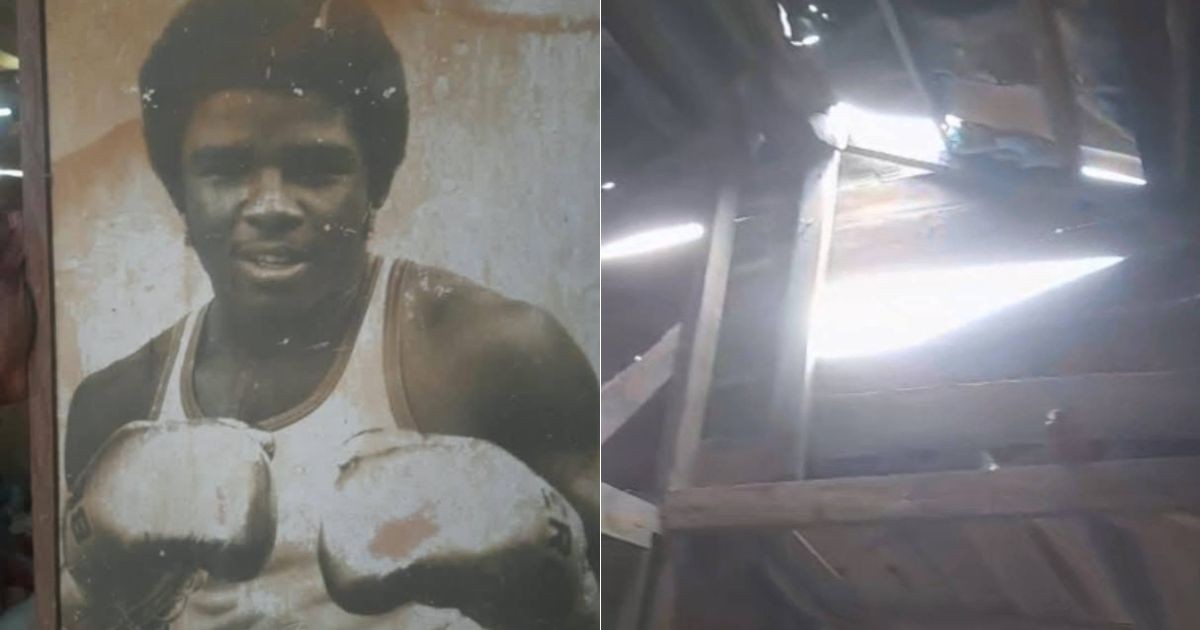
The Provincial Directorate of the National Institute of Sports, Physical Education, and Recreation (INDER) in Camagüey dismissed accusations on Thursday regarding the alleged neglect of Bernardo Comas Aguilera, a former world boxing champion. Despite issuing a statement, they did not provide concrete evidence or announce measures to address the athlete's current hardships, as reported by CubaNet.
Signed by provincial director Iosvanis Omar Urizarri Socarrás, the statement followed a day after CubaNet released an interview with Comas's mother, who described the dire living conditions of the family. The plight of Comas, 65 years old and suffering from senile dementia, has recently received public attention. He is celebrated as a "Gloria Deportiva" of Cuba.
According to the state entity's Facebook post, they have maintained ongoing support and recognition for the former athlete, claiming to have "records and evidence of their actions, which include visits, medical assistance, institutional support, and public honors."
However, INDER failed to present these records or address critical questions: Will the home's leaks be repaired? How will they ensure the availability of medication for Comas's dementia? What happened to the long-promised payments for his gold medals that the family has been awaiting?
The boxer's mother, his primary caregiver, portrayed a starkly different reality to CubaNet. "When it rains, I can't sleep. I have to rush," she explained, highlighting the need to rearrange furniture to find a dry spot for her son to rest. She was equally clear about the state of their appliances: "Nothing works here. Not the refrigerator, washing machine, fan, nothing."
The family survives on the ex-boxer’s 8,000 Cuban pesos monthly retirement and the mother's 3,000 pesos pension, which she considers insufficient: "How is anyone supposed to make ends meet? It's not enough for anyone to live on."
Regarding medication for her son's illness, she was blunt: "There is no medicine here for that kind of illness." She also criticized the unfulfilled promises of payments for his medals, stating they had been informed they were available, but "so far, nothing has been paid." As for the institutional visits claimed by INDER, the mother acknowledged they only began after the case gained public attention.
Social media reactions to the agency's statement were predominantly skeptical. One user directly questioned whether INDER would address the housing conditions. Another demanded clarity on the medal payments. A third user challenged whether the champion's mother was lying and expressed belief in her over the institution. Another comment pointed out that institutional attention seemed limited to inconsequential visits, while another user urged that at the very least, they should provide a meal for the champion and his mother.
Comas achieved the amateur world title in the 75-kilogram category in Munich 1982, knocking out Finland's Tarmo Uusivirta in the final round. In the semifinals, he defeated American Iran Barkley, who would later become a professional world champion. The Camagüeyan also secured gold at the Pan American Games in Caracas 1983 and reportedly amassed an amateur record of 203 wins in 234 bouts before retiring in 1987.
This case forms part of a documented pattern of neglect involving Cuban sports legends. At the end of September, the wife of Olympic champion Andrés Aldama—aged 70, suffering from dementia and diabetes—reported a similar situation in Matanzas. Earlier this year, ex-boxer Gaspar Casamayor was spotted begging for money in the streets of Santiago de Cuba, and in October 2025, former athlete Aleida Palomo was reported ill and begging in the same city.
Despite these accumulating cases, INDER's national commissioner for Athlete Support, Wilmer Lewis Calvo, denied in a February 2025 appearance on the television program "Mesa Redonda" that sports legends were being neglected, insisting that institutional support structures exist. Independent press reports consistently contradict this official narrative.
Key Questions About Bernardo Comas's Situation
What evidence did INDER provide to support their claims?
INDER claimed to have records and evidence of their support for Bernardo Comas but did not present these records publicly.
How does the family of Bernardo Comas survive financially?
The family relies on Comas's monthly retirement of 8,000 Cuban pesos and his mother's pension of 3,000 pesos, which they find insufficient for their needs.
What is the public's reaction to INDER's statement?
The public reaction on social media was largely skeptical, with users questioning INDER's claims and expressing belief in the mother's account over the official statement.