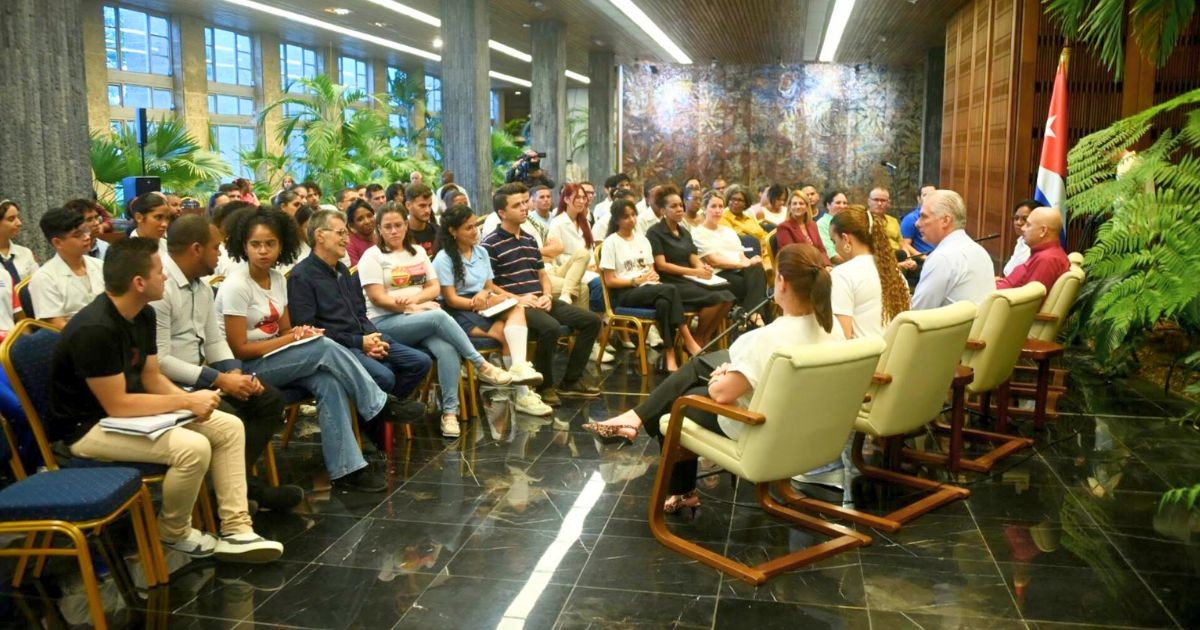
As Cuba endures eight complete electrical system failures so far in 2026, most of its population lacks adequate food access, and hundreds of essential medications are conspicuously absent from pharmacies. On Thursday, Miguel Díaz-Canel gathered with a group of young people in the Portocarrero Hall of the Palace of the Revolution. He spoke about Che Guevara, shed some tears, and boldly declared, in a Guevara-like spirit, "the present is a struggle; the future is ours."
This event, orchestrated by the regime to mark the 59th anniversary of Ernesto Guevara's combat death, was described by the state-run media as "moving," "stirring," and "beautiful." Attendees included Meyvis Estévez Echevarría, First Secretary of the Communist Youth Union (UJC); Roberto Morales Ojeda, a member of the Political Bureau; Vice Prime Minister Inés María Chapman Waugh; and economist and writer Carlos Tablada, among others.
Díaz-Canel did not hold back from making memorable statements: "Che has not died; Che has multiplied," he claimed, in a nation where hunger, power outages, and emigration have indeed multiplied. He also stated, "There are people who can't understand how we are resisting," a rhetorical question that, outside the Palace of the Revolution, has rather straightforward answers: resistance is due to lack of choice, or some choose not to resist and simply leave the country.
The Reality Behind the Rhetoric
Economist Tablada urged young people to always be "rebellious" and "dissatisfied," warning that "the day we lose our ethics, we lose everything." Of course, this rebellion and dissatisfaction are always directed at "the empire," never against the regime that has plunged Cuba into poverty. It's a conveniently selective ethics.
A highlight of the event was the introduction of the Farma Joven project, an initiative by the UJC that distributes donated medications from foreign organizations via WhatsApp and door-to-door visits. Díaz-Canel praised this as a "truly Guevara-like attitude." On Wednesday, the president admitted that the island faces a severe medication crisis, which, according to various reports, includes hundreds of basic drugs.
Leanet Proenza del Hoyo, coordinator of the project, described their efforts with unintentional starkness: "We have visited communities, delivering medicines to those without means, to that elderly person in great need. We have to knock on doors. We have reached nursing homes, children's homes, and maternity homes."
A Nation in Crisis
The backdrop to this event is a Cuba that scarcely fits the heroic narrative the regime meticulously constructs. Approximately 2.7 million Cubans experience total or partial water service disruptions. Over 30% of households reported at least one member went to bed hungry in the last month, based on recent data. It's estimated over 1.6 million Cubans have left the island since 2020, according to the Council on Foreign Relations, marking one of the largest mass exoduses in the hemisphere's recent history.
Díaz-Canel emphasized that the tribute to Che was doubly significant "because we are doing it in the year of the centenary of Commander in Chief Fidel Castro Ruz," as if accumulating revolutionary anniversaries could replace fuel, food, or antibiotics.
The president concluded his remarks by invoking the Guevarian "new man": "We cannot build a better world if there is no New Man," he proclaimed to an audience of young people who probably dream of building that better world in another country.
Understanding Cuba's Challenges and Leadership
What are the main issues currently facing Cuba?
Cuba is grappling with widespread power outages, inadequate food supplies, and a severe shortage of essential medications. Additionally, a significant portion of the population lacks reliable access to water, and there is a high rate of emigration as people leave the island in search of better opportunities.
How is the Cuban government addressing the medication crisis?
The government has initiated projects like Farma Joven, which distributes donated medications from foreign organizations through WhatsApp and door-to-door delivery. However, the severity of the crisis remains a significant challenge for the nation.
What is the significance of Díaz-Canel's remarks about Che Guevara?
Díaz-Canel's remarks about Che Guevara aim to inspire resilience and hope among the Cuban people, drawing on Guevara's legacy as a revolutionary figure. However, these statements contrast sharply with the everyday struggles faced by the population.