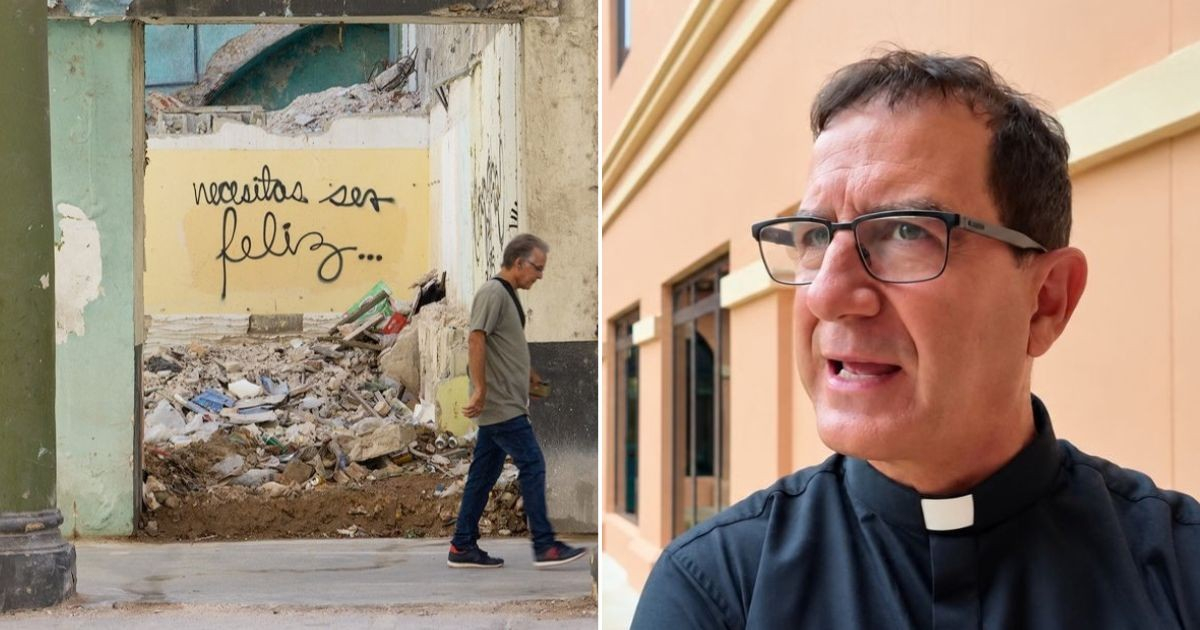
Cuban priest Alberto Reyes Pías declared on Friday that Cuba must transcend a life constrained by mere survival. He urged citizens to reject the normalization of scarcity, fear, and the loss of rights.
In a message he shared on his Facebook profile, the parish priest of Esmeralda, located in Camagüey, pondered the contrast between mere survival and leading a life filled with dignity, prosperity, freedom, and future prospects.
“We were not born just to survive. We were born to live with dignity, to prosper, to enjoy freedom without fear,” Reyes stated.
Daily Struggle for Survival
Reyes highlighted that survival has become the daily norm for many Cubans. The day begins with the quest to secure essential needs for tomorrow, standing in endless lines, scrambling for scarce medications, facing skyrocketing food prices, fuel shortages, and constant blackouts.
He added that this accumulation of hardships leads to a persistent uncertainty, prompting the question, “How long can this continue?”
The Danger of Acceptance
Reyes cautioned that a significant threat arises when these harsh realities cease to be seen as exceptional and start being accepted as inevitable.
“Surviving means becoming accustomed to this agonizing life to the point of considering it 'normal,' allowing necessity to convince us that such a life is our fate. But it is not, and it need not be,” he emphasized.
According to Reyes, when survival becomes the sole goal of a society, dreams fade, the ability to dream diminishes, and hope vanishes.
“We start celebrating what should be guaranteed, thanking as a privilege what should be a right, settling for crumbs because we've forgotten our worth, our dignity,” he wrote.
The Need for a New Vision
Reyes insisted that a dignified life must go beyond securing food, electricity, or medicine. It also demands freedom, security, opportunities, quality education, employment that meets living costs, and realistic chances to pursue personal projects.
In one of the more direct parts of his reflection, he asserted that “Cuba does not just need a change of system,” but also citizens who are convinced that the country can have a different future.
“Cuba needs children who deeply believe that this island is not doomed to remain as it is today,” he expressed.
Actions for Change
Reyes argued that change begins when society stops accepting harmful realities as normal and regains awareness of its rights.
He listed some actions that can be taken immediately: “Do not lie, do not applaud what chains us, do not abandon those who raise their voices, and do not leave behind those who suffer alongside us.”
Reyes concluded his reflection by linking the recovery of freedom with overcoming fear and defending individual rights.
“Perhaps we cannot change everything overnight, but we can start today, because a people begin to reclaim their freedom when they realize that no ideology, government, or power is above their rights, and they stop fearing to speak aloud what everyone whispers in silence,” he concluded.
Challenging Fear and Resignation
Fear, resignation, and the normalization of crisis have been recurring themes in the priest’s public messages in recent months.
In June, Reyes questioned whether living in “survival mode,” amidst exhaustion and perpetually postponed projects, could be considered normal.
He linked this reality to blackouts, economic hardship, and the deterioration of public services.
A month later, he delved into fear as a mechanism of control and considered the fear among Cubans of imagining a life “without chains,” noting that fear of change can become a pillar of the system.
At the end of July, Reyes shifted focus to those in power, asserting that those who “took over the country” also fear the people they have ignored for decades.
In August, he hardened his message, asserting that Cubans' demands should not be limited to meeting material needs but should aspire to a “radical change” and the “end of chains.”
Days later, he directed a reflection at military personnel, police, state security agents, and others involved in control mechanisms, reminding them that “a people cannot be chained forever.”
In September, on the occasion of the feast of Our Lady of Charity, he urged maintaining “the courage to speak the truth” amidst repression.
More recently, he described the Catholic Church in Cuba as an “uncomfortable neighbor” that the regime has failed to silence.
Understanding Cuba's Struggles and Hopes
What does Alberto Reyes believe Cuba needs to overcome?
Reyes believes Cuba must move beyond merely surviving and reject the normalization of scarcity, fear, and loss of rights in order to achieve a life of dignity, prosperity, and freedom.
How does Reyes suggest Cubans can initiate change?
Reyes suggests that change can start by not lying, not applauding oppressive systems, supporting those who speak out, and standing by those who suffer, thereby reclaiming individual rights and overcoming fear.
Why does Reyes emphasize the danger of accepting the status quo?
Reyes warns that accepting the harsh realities as normal leads to a loss of dreams, hope, and the ability to aspire for a better future, making it imperative to recognize and challenge these conditions.