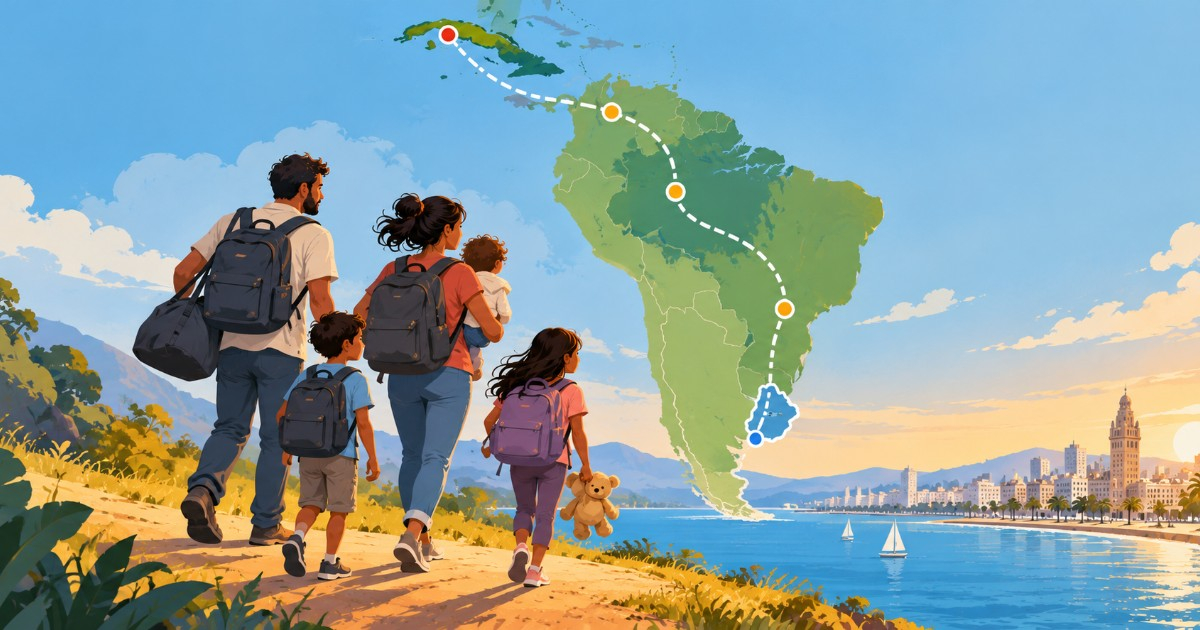
An extensive journey starting in Cuba, passing through Guyana, and traversing Brazil from north to south to reach the Uruguayan border has emerged as a new migration route for thousands of Cubans. This has become a viable option as other paths previously taken have become more challenging.
A report by BBC Mundo outlines this journey using official data and testimonies from several migrants, including Liudmila Medina, who traveled over 7,000 kilometers with her husband and children to settle in Uruguay.
The Unexpected Detour to Uruguay
Initially, the family aimed to reach the United States. Medina explained they planned to travel to Nicaragua to continue northward, but their plans were thwarted when they were denied boarding due to an expired passport.
Faced with a decision, they chose a new path. "What do we do?" Medina's husband asked. "Let's go to Uruguay," she replied.
Medina recounted how she used contacts and bribed officials to quickly obtain a new passport. Eventually, they paid nearly $13,000 to a network of smugglers from various nationalities who assisted them throughout the journey. The money, nearly all they had, included proceeds from selling her mother's home.
A Grueling Journey Across South America
In April 2024, the family flew to Guyana. From there, they spent about 17 hours on a minibus with dozens of other Cuban migrants, packed tightly together.
"We were all cramped, one on top of the other," Medina recalled. The journey was particularly arduous because it included traveling with Tristán, one of her children who has central nervous system issues and requires constant care. Accompanied by two other young children and being eight months pregnant, Medina faced significant challenges.
After crossing Guyana, they entered Brazil through Roraima, the country's northernmost state, and continued south via various land and air routes. A week after leaving Cuba, they finally crossed into Uruguay at the Santana do Livramento-Rivera border, where they sought asylum. "They said: 'Welcome to Uruguay,'" Medina remembered.
Growing Numbers and Pressures
This family's journey is not unique. An analysis by the Brazilian Intelligence Agency (ABIN) and the International Organization for Migration (IOM), cited by BBC Mundo, noted a significant increase in Cubans entering Uruguay from Brazil. Between January and October 2025, over 11,000 Cubans passed through the joint migration checkpoint, averaging about 30 daily.
Guyana plays a strategic role in this route as it is the only country in South America that does not require a visa for Cuban citizens. From there, many continue to Brazil and eventually Uruguay.
Smuggling networks charge between $1,200 and $10,000 per person, depending on the starting point and final destination. The analysis also documented cases of physical assaults and illegal detentions of migrants.
Impact on Uruguay's Asylum System
The increasing Cuban presence in Uruguay is putting pressure on the refugee system. By June, there were 30,715 pending asylum applications, with about 89% from Cuban citizens, according to the Refugees Commission (CORE). In the first half of 2026, the agency received approximately 1,300 applications monthly.
Uruguay's Deputy Foreign Minister and CORE President, Valeria Csukasi, attributed the backlog primarily to a "structural mismatch between the volume of applications and the institutional capacity to process them."
Delays in processing applications leave many in a state of uncertainty, affecting their ability to access bank credit, rent housing, or reunite with family members.
Life for Cubans in Uruguay
Despite challenges, Cubans currently lead in obtaining permanent residency in Uruguay. In 2025, they received 6,185, more than a third of all granted, and 4,665 more in the first seven months of 2026, according to migration data cited by BBC Mundo.
Madelyn del Río, president of the organization Manos Cubanas, estimates around 60,000 Cubans might now live in Uruguay, far exceeding the 11,826 recorded in the 2023 census.
While many Cubans report feeling welcomed, there are instances of discrimination and xenophobia. Cubans have integrated into various sectors, from medicine and commerce to delivery, security, and services.
Challenges and New Beginnings
For Medina, the decision to migrate was closely tied to her son Tristán's health condition. He had undergone surgery for brain tumors in Cuba in 2019 and suffered further nervous system damage due to medical complications.
Medina abandoned her career as a singer and actress, known as Mía Rosa, to focus on her son's rehabilitation. However, the lack of results, medications, and basic necessities in Cuba ultimately pushed the family to leave.
Arriving in Uruguay did not solve all their problems immediately. Medina had to borrow money, adjust to a new economic reality, and go alone to the public hospital Pereira Rossell to give birth to her son Kai. Later, her children accessed preschool through a government scholarship, and the family received housing assistance and financial support from a refugee foundation.
"When we arrived in Uruguay, we received a hug," Medina summarized.
The family's main disappointment was the impracticality of Tristán's rehabilitation through Teletón. Medina even considered moving to Spain for alternative medical options but ultimately dismissed the idea.
Currently, Tristán receives specialist care at the hospital Pereira Rossell, while Medina devotes her time to caring for him in their subsidized apartment in Montevideo, where they live with her husband and other children.
They have also reunited with Medina's mother in Uruguay and now dream of purchasing a car and their own home.
"It's incredible to see how we are now, with a certainty that we won't lack anything," she said. "Back there, we were very limited and fearful; here, we have no fear. Here, we have whatever we set our minds to."
The expansion of this migration route was already evident months ago. In June, an analysis of the Cuban exodus to South America documented that over 11,000 island citizens crossed from Brazil to Uruguay between January and October 2025, primarily through Santana do Livramento-Rivera.
However, the immigration status of those already in Uruguay remains marked by delays. Recently, a human rights advocate demanded answers from authorities regarding the prolonged wait in processing thousands of asylum applications.
Official recognition as refugees remains limited. Uruguay has acknowledged only 52 Cuban citizens as refugees, despite the large number of pending cases.
The increasing arrival of Cubans has sparked discussions about integration and employment. In September, young Cubans residing in Uruguay publicly responded to criticisms against immigrants and urged reflection on the circumstances driving so many to leave Cuba.
Frequently Asked Questions About Cuban Migration to Uruguay
Why are Cubans choosing Uruguay as a migration destination?
Cubans are opting for Uruguay due to its more accessible asylum process compared to other countries, the lack of a visa requirement in Guyana, and the opportunity for a fresh start amidst economic and social challenges back home.
What challenges do Cuban migrants face on their journey?
Cuban migrants face numerous challenges, including long and arduous journeys, financial strain from paying smugglers, and the risk of physical assaults or illegal detentions during their travels through South America.
How has the influx of Cuban migrants affected Uruguay?
The influx has placed pressure on Uruguay's asylum system with a backlog of applications and has sparked discussions on integration and employment, although many migrants have successfully integrated into various sectors of society.