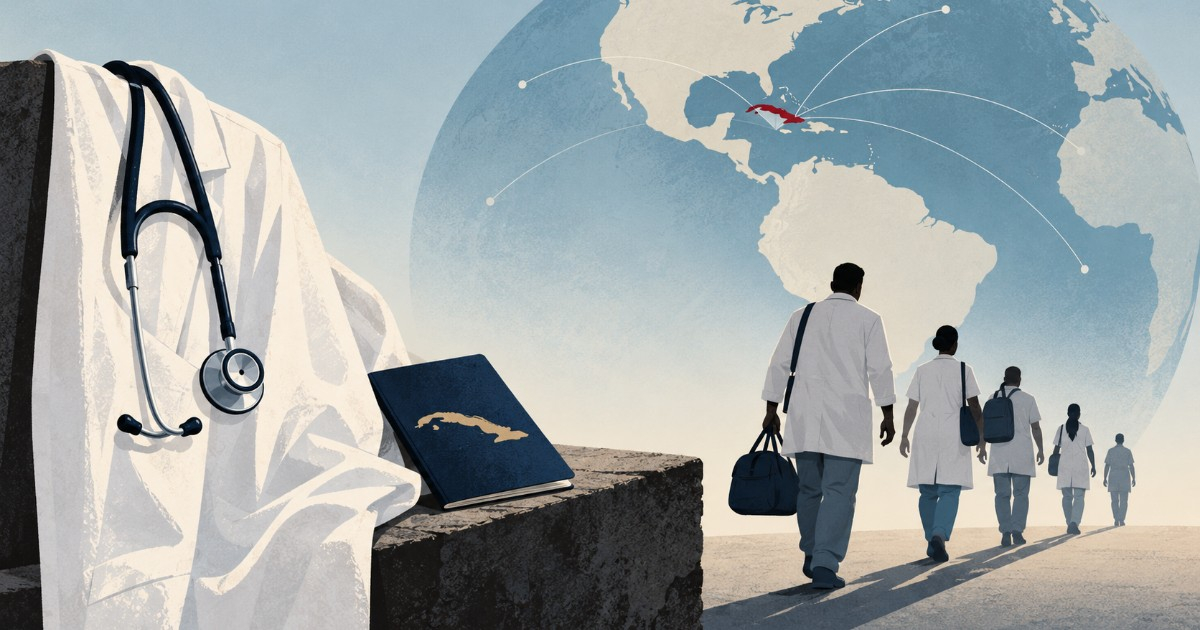
The Cuban regime's worker export program, which includes overseas medical missions, saw its numbers decrease from about 24,000 participants at the start of 2025 to between 15,000 and 18,000 by 2026, as revealed by the 2026 Trafficking in Persons Report from the United States Department of State.
This decline, representing a loss of 6,000 to 9,000 workers, is partially attributed by Washington to its diplomatic efforts against international agreements involving Cuban personnel and visa restrictions imposed on officials associated with this system.
Published on October 8, the report highlights that four countries terminated their bilateral agreements with the Cuban government in 2025, although it does not specify which countries these were.
The Remaining Workforce in 2026
Despite the setbacks, the State Department estimates that by 2026, there were still Cuban workers engaged in missions across 53 nations.
Comparing these figures suggests a decrease of roughly 25% to 37.5% from the original 24,000 workers counted at the beginning of 2025. It's crucial to note that the report encompasses the entire Cuban state civil worker export program, not just medical professionals. According to the State Department, healthcare workers constitute 75% of this workforce.
U.S. Campaign Targets Contracts and Salaries
Washington aims to reform the agreements that allow foreign governments to pay the Cuban state for the services of professionals sent to work abroad.
The U.S. report claims that the regime retains between 50% and 95% of the overseas workers' earnings, while these professionals receive significantly lower stipends compared to others performing similar roles.
The document also accuses the Cuban government of imposing travel restrictions, passport and credential control, surveillance, and threats against workers or their families.
Impact on a Key Financial Resource
The reduction in workers and review of agreements threatens an activity that has long provided substantial income to the Cuban regime. The State Department describes these health missions as a crucial financial resource for the government, generating foreign currency through contracts with other nations and entities.
However, the 2026 document does not offer a verifiable estimate of the financial loss incurred by Havana due to the reduced workforce. Therefore, it is impossible to calculate a specific economic loss from the decrease of 6,000 to 9,000 workers, as revenues also depend on contract values, contract durations, and payment methods.
Uruguay's Approach: Direct Payment
As an example, Uruguay has altered its agreements without halting its health cooperation. On October 7, CiberCuba reported that Uruguay began paying Cuban professionals at Montevideo's José Martí Eye Hospital directly, eliminating the previous fund transfer system to the Cuban brigade's structure. Despite this change, ophthalmological services continue uninterrupted.
This adjustment in payment method should not be confused with the four agreements reportedly ended in 2025 according to Washington.
In July 2026, the Trump administration announced sanctions against Cuba's Minister of Public Health and leaders of the medical missions system, including officials from the Central Unit for Medical Cooperation.
U.S. Push for Direct Hiring
The latest developments are part of a broader U.S. policy encouraging recipient countries to scrutinize conditions for Cuban workers and adopt transparent hiring mechanisms.
The State Department believes that removing mandatory Cuban government involvement would better protect salaries, freedom of movement, and professional rights.
The 2026 Trafficking in Persons Report continues to place Cuba at Tier 3, the lowest ranking in the U.S. assessment of government efforts to combat trafficking.
According to Washington, the decrease in overseas workers reflects the success of efforts targeting both the reported labor conditions and Havana's hiring model.
The challenge now for recipient nations is ensuring the continuation of necessary services for their populations without endorsing mechanisms that could violate the rights of Cuban professionals. For the regime, the reduction in workforce and contract reviews add pressure to a system combining international cooperation, state labor control, and foreign currency income.
Frequently Asked Questions About Cuban Worker Missions
Why has the number of Cuban workers abroad decreased?
The reduction is attributed to diplomatic efforts by the United States against international hiring agreements with Cuba and visa restrictions on officials associated with these agreements.
What role do healthcare professionals play in Cuba's worker export program?
Healthcare workers make up about 75% of the Cuban state worker export program, which also includes other civil workers.
How does the U.S. aim to protect Cuban workers' rights abroad?
The U.S. advocates for direct hiring by recipient countries, eliminating Cuban government mediation to better safeguard wages, movement freedom, and professional rights.