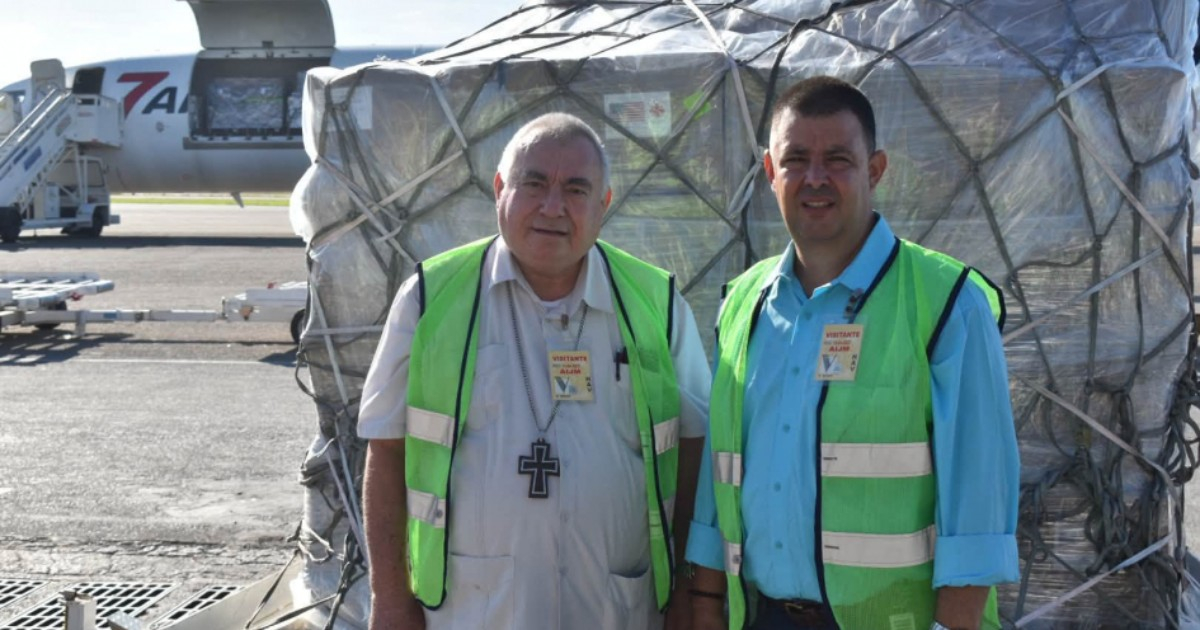
A shipment of 700 food kits and 700 hygiene packages from the United States touched down at Havana's José Martí International Airport on Thursday, intended for families facing severe hardship within the diocese of Pinar del Río, as shared by Caritas Pinar del Río on Facebook.
Bishop Juan de Dios Hernández Ruiz, S.J., and Abel Castillo López, the director of Caritas Pinar del Río, were present at the airport to receive the shipment alongside volunteers and airport personnel.
Distribution is set to begin promptly at two locations: the parish of Candelaria and the community of Quiebra Hacha, part of the Mariel parish. Both areas, while administratively part of the Artemisa province, fall under the ecclesiastical jurisdiction of the Pinar del Río diocese.
Beneficiaries of the aid were chosen based on stringent vulnerability criteria, including elderly people living alone, pregnant or nursing women identified as at-risk, children under five in precarious conditions, and individuals with disabilities or bedridden who are unable to care for themselves.
Caritas volunteers conducted home visits beforehand to identify the most needy families and coordinated the reception and distribution of aid adhering to principles of transparency, fairness, and social justice.
In a diocesan statement, Bishop Juan de Dios Hernández Ruiz acknowledged the limitations of the program: "As a Church, we are fully aware that we cannot reach everyone, and that reality pains us. Resources are limited, and priority is given to those in greatest need."
This shipment is part of a $100 million humanitarian program announced by the Trump administration in May 2026, with $60 million channeled through Caritas Cuba and Catholic Relief Services (CRS), and the remaining $40 million via other independent organizations.
The program's design explicitly excludes the Cuban regime as an intermediary: funds are managed by CRS, which purchases products in the United States, and Caritas Cuba distributes them on the island through its diocesan and parish networks.
The delivery to Pinar del Río is the latest in a territorial expansion that progresses weekly. After kicking off in July in Havana—with an initial flight of 18 tons from Miami—the program reached Villa Clara in September, followed by Cienfuegos, and more recently Camagüey on October 1 and Ciego de Ávila on October 6, where modules were distributed in the Gaspar parish.
The extension to five provinces—Camagüey, Ciego de Ávila, Cienfuegos, Matanzas, and Pinar del Río—was announced by the U.S. Embassy in Cuba on September 16, following a meeting between Chargé d'Affaires Mike Hammer and Carmen María Nodal Martínez, director of Caritas Cuba.
The overall goal of the program is to reach between 100,000 and 120,000 families across the country, although CRS has estimated that the Catholic component could benefit nearly 200,000 Cuban households.
Frequently Asked Questions about U.S. Aid to Pinar del Río
Who are the main beneficiaries of the aid sent to Pinar del Río?
The aid is primarily intended for vulnerable groups such as elderly people living alone, pregnant or lactating women at risk, young children in precarious conditions, and individuals with disabilities or who are bedridden.
How is the aid distributed in Cuba?
The aid is managed by Catholic Relief Services (CRS) in the U.S., with Caritas Cuba responsible for distributing it through diocesan and parish networks, ensuring the Cuban regime is not involved as an intermediary.
What is the overall goal of the U.S. humanitarian program in Cuba?
The program aims to reach between 100,000 and 120,000 families across Cuba, with estimations suggesting nearly 200,000 households could benefit from the Catholic initiative.