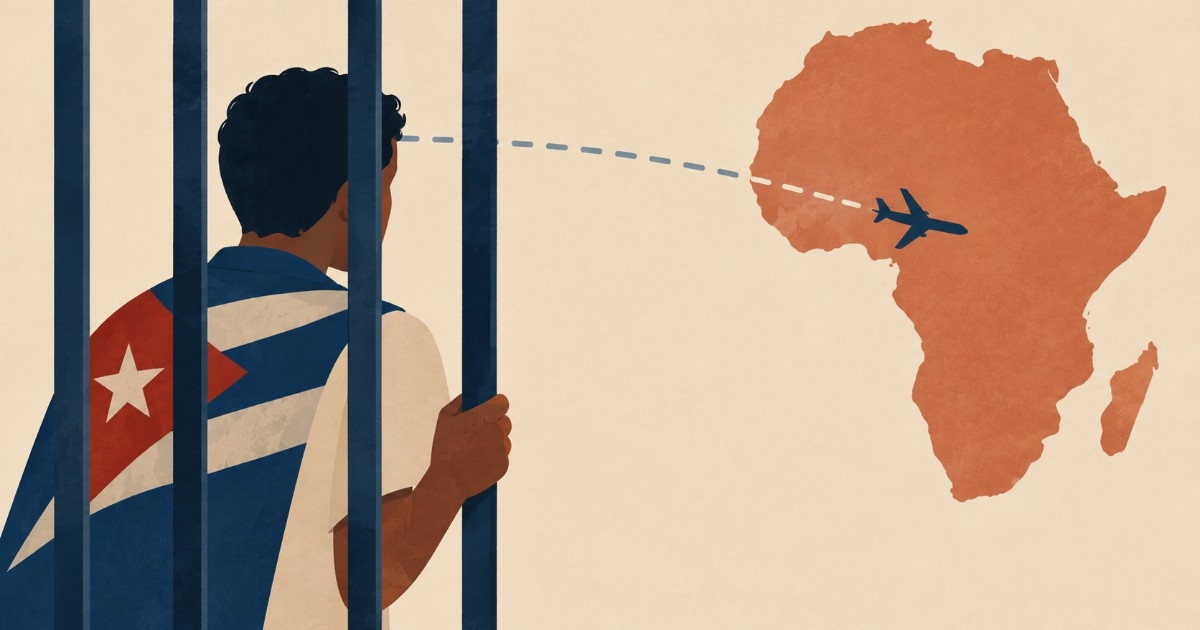
According to a report released Thursday by Human Rights Watch (HRW), Cubans deported from the United States to African nations have described enduring months of imprisonment, unexpected transfers, and challenges in securing legal representation. The organization has documented accounts from migrants sent to countries with which they had no prior connections, raising questions about the procedural guarantees offered.
Trump Administration's Deportation Practices Under Scrutiny
The detailed 125-page report, titled "To Scare People," delves into the deportations to African third countries carried out under the Trump administration. The report includes testimonials from Cuban men sent to Eswatini, where they found themselves in maximum-security prisons after serving criminal sentences in the U.S.
HRW's analysis of data from the U.S. Immigration and Customs Enforcement (ICE) revealed that between January 20, 2025, and August 5, 2026, 536 individuals of various nationalities were deported to African countries not their own. This number does not solely consist of Cubans. The report is based on interviews conducted from February to July 2026 with 24 people transferred to six African nations, as well as court documents and official records. HRW summarized its findings in a statement released Thursday.
Personal Accounts of Harsh Detention and Transfers
One account shared by HRW is that of Geraldo C., a pseudonym for a 59-year-old Cuban who arrived in the U.S. during the Mariel boatlift in 1980. He recounted being detained by immigration agents in June 2025 during a routine ICE check-in in Broward County, Florida.
Geraldo described his journey through the Krome detention center in Miami and facilities in El Paso, Texas, lamenting overcrowded conditions, people sleeping on floors, and poor sanitation. He was eventually relocated to Eswatini in southern Africa, where armed guards awaited him, leading him to a prison vehicle.
Another Cuban, Alberto C., aged 60, reported being detained for six months in Buffalo, New York, before his deportation to Eswatini in October 2025. His statement revealed multiple stops and detention centers without clarification of his final destination in Africa.
Concerns Over Detention Conditions and Legal Protections
The report also features the testimony of Alfredo C., another 60-year-old Cuban who had been detained in Eswatini for nine months by June. He claimed to have never consented to his transfer, describing the psychological impact of indefinite detention. "I feel kidnapped; I never agreed to come here," he stated, according to HRW's translated account.
Eswatini reportedly received 32 deportees of different nationalities in five groups by September 2026, including Cuban nationals. The deportees were sent to Matsapha prison complex, where human rights organizations have criticized the lack of effective mechanisms to challenge detention.
U.S.-Eswatini Agreement and Broader Implications
The agreement between Washington and Eswatini involves a $5.1 million U.S. contribution to enhance border management and immigration capabilities in the African nation, in exchange for accepting up to 160 deportees. This funding is part of a governmental agreement and is not meant as individual compensation for deportees.
CiberCuba previously covered cases like that of Juan Carlos Font Agüero, who sought to return to Cuba after months of detention in Eswatini. The new HRW report provides a broader investigation into these reported practices.
Deportations Beyond Eswatini: Additional Destinations
HRW's investigation notes that deportations extended beyond Eswatini. A flight to the Central African Republic on July 31 carried individuals from Cuba and other nationalities. Additionally, a group was sent to Equatorial Guinea in August after some deportees refused to disembark in Liberia.
CiberCuba had earlier reported on Yasmany Moreno de Armas, a Cuban deported to Bangui, who learned of his destination mid-flight. In September, he was involved in aiding other Latin Americans deported to the same country.
In a separate report, the Associated Press highlighted the story of Daniela Fuentes, a 32-year-old transgender Cuban deported to the Central African Republic from Miami on August 29. Fuentes detailed the difficulties of living safely and freely in a country where she has no personal ties. Her account should not be confused with HRW's interviews, though it underscores another human consequence of the same immigration policy.
U.S. Government's Defense and Judicial Developments
The U.S. Government justifies deportations to third countries as a tool to enforce immigration orders, especially when the origin country does not accept the return of certain citizens. They claim to secure assurances from receiving governments regarding the treatment of transferred individuals. HRW argues that these assurances have not prevented arbitrary detention and risks for those fearing return to their home countries.
Backgrounds of deported individuals vary. The initial group sent to Eswatini included men convicted of serious offenses in the U.S.; the report acknowledges these backgrounds but notes they had served their sentences. Other Cubans deported to African countries assert they have no criminal history, though their claims require independent verification. Completing a sentence does not alone address concerns about detention conditions and guarantees against further deportation.
On September 29, 2026, the Supreme Court temporarily allowed the Trump administration to continue these deportations while it considers the legal requirements of the policy. CiberCuba analyzed the implications of this decision for Cuban migrants. The interim ruling is not a final decision on the policy's legality.
Human Rights Watch calls for procedures that enable individuals to know and challenge their destination, access legal assistance, and secure effective protections against persecution or torture. The investigation raises a crucial question for Cubans deported to Africa: what real resources do they have to contest their transfer and avoid indefinite detention in countries where they lack family, residency, or clear protection avenues?
Frequently Asked Questions about Cuban Deportations to Africa
Why are Cubans being deported to African countries?
Cubans, along with individuals from other nationalities, are being deported to African countries as part of a U.S. policy to enforce immigration orders, particularly when their home countries refuse to accept them back. This policy was notably implemented during the Trump administration.
What challenges do deported Cubans face in Africa?
Deported Cubans often face challenges such as indefinite detention, lack of legal representation, and poor living conditions in prisons. They also struggle with the psychological impact of being in a foreign country with no personal connections or clear legal recourse.
What is the U.S. government’s stance on these deportations?
The U.S. government defends these deportations as necessary for carrying out immigration orders and claims to secure assurances from receiving countries about the treatment of deportees. However, Human Rights Watch and other organizations criticize the effectiveness of these assurances.