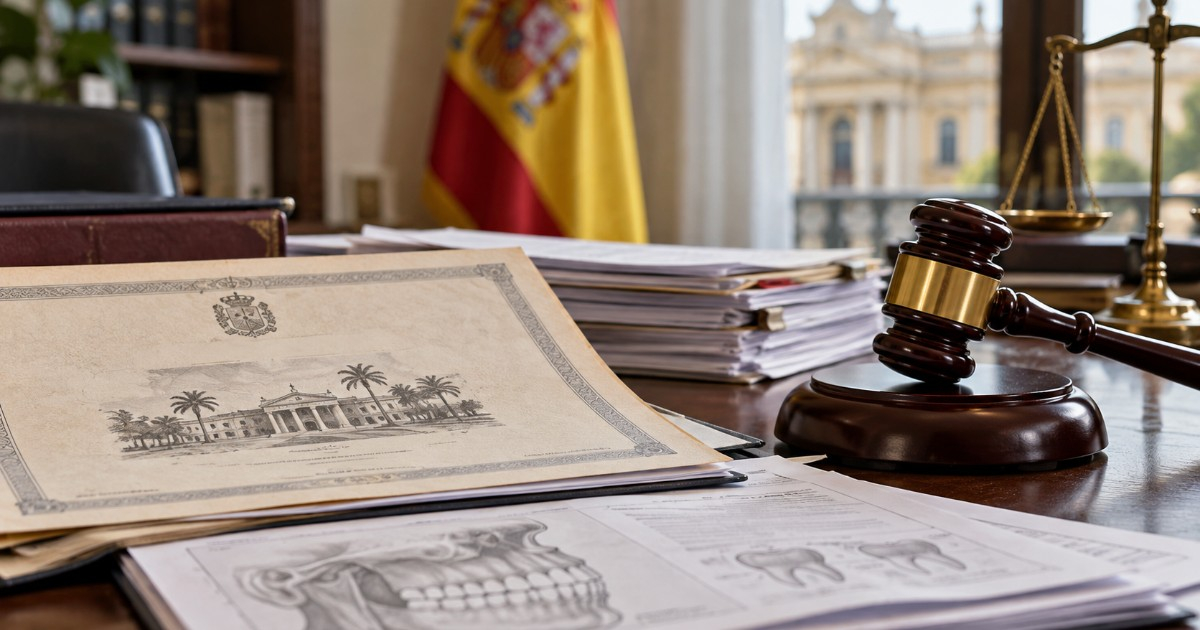
A dentist who earned her degree in Cuba has finally achieved a victory in Spain as the National Court nullified the administrative silence that hindered the recognition of her qualifications. This decision comes after nearly five years of inaction on her application for equivalency.
On March 5, 2026, the Sixth Section of the Contentious-Administrative Chamber issued a ruling compelling the Spanish administration to proceed with processing the application, requiring a mandatory technical report, and delivering a well-reasoned decision regarding the degree's validation.
The Bureaucratic Struggle for Cuban Professionals
This case highlights the significant bureaucratic challenges faced by many Cuban-trained professionals attempting to practice in Spain, particularly in health sectors like Medicine, Nursing, and Dentistry.
Five-Year Wait for Degree Recognition
According to ruling 95/2026 by the National Court, the applicant submitted her request on March 17, 2021, to the General Secretariat of Universities, seeking recognition of her Doctor of Stomatology degree from Havana's Higher Institute of Medical Sciences, to qualify for practicing as a dentist in Spain.
Despite providing documentation proving her studies, including the curriculum hours from Cuba, she met the legal requirements, yet received no official response within the legal timeframe, prompting her to pursue a judicial appeal for recognition.
Administrative Oversight and Legal Battle
Registered under case number 759/2022, the legal proceedings concluded with a ruling on March 5, 2026, nearly five years after her initial application.
A key aspect of the court's decision was the finding that the Spanish administration had failed to undertake the necessary steps to evaluate the degree for recognition. The administrative file contained only the initial request and the supporting documents from the applicant, lacking the required technical report from the National Agency for Quality Assessment and Accreditation (ANECA).
The State Attorney argued that this missing report prevented granting the equivalency. However, the court ruled that this omission did not justify the administrative silence, and the administration must complete the process before making a determination on the degree's recognition.
Does the Ruling Allow the Dentist to Practice?
No, while the National Court partially upheld the applicant's appeal, it did not directly grant equivalency. It annulled the presumed denial of her application and ordered the administrative process to be revisited so ANECA can issue the necessary technical report.
Once this report is obtained, the administration must issue a clear and reasoned decision, which may be favorable, unfavorable, or contingent upon meeting additional educational requirements. Thus, the ruling marks a judicial victory against administrative inactivity but does not equate to automatic recognition of the Cuban qualifications.
Understanding Spain's Equivalency Regulations
The procedure began in 2021 under Royal Decree 967/2014. Although this was later replaced, the transitional provision of Royal Decree 889/2022 allows processes initiated before its implementation to proceed under previous regulations, except for specific transition options.
For procedures under the 2022 regulations, the general timeframe to issue and notify decisions is six months from when the application is submitted electronically, barring legally permitted suspensions. If no response is received within this period, the application may be considered denied due to administrative silence. However, this does not relieve the administration of its duty to provide an explicit resolution.
Article 21 of Law 39/2015 on Common Administrative Procedure also mandates issuing and notifying decisions in administrative proceedings. The ruling concerning the degree from Havana underscores that lack of response does not waive the obligation of evaluation and justification of decisions.
Guidance for Cubans Seeking Degree Recognition in Spain
Odontology is a regulated profession in Spain, requiring foreign-trained professionals to obtain the necessary recognition before practicing as dentists. The Ministry of Science, Innovation and Universities provides a specific guide for recognizing foreign dental degrees.
Required documents include proof of identity and nationality, university degree, academic certification with subjects and study hours, legalized documents when necessary, and proof of fee payment. Evaluation also considers academic criteria set by ANECA, including study duration, professional skills, and clinical training.
New equivalency applications are now submitted via the Ministry's electronic platform, where applicants can also check their application status. Those experiencing prolonged delays should verify official communications, retain submission receipts, and check for any pending documentation requests.
In cases where delays exceed applicable timeframes, applicants may consider administrative or judicial claims with specialized legal advice. This dentist's court victory highlights the potential to contest certain administrative actions or omissions, although each case must be individually assessed.
Cuban Professionals Seeking Opportunities in Spain
This situation unfolds amid a backdrop of increasing Cuban emigration to Spain, where many doctors, nurses, dentists, and other graduates aim to continue their careers. In 2025, Spain resolved 85,564 foreign degree equivalency cases, yet by mid-March 2026, 72,337 applications were still pending.
Previously, CiberCuba reported Cuba as one of the top countries in terms of foreign university degree recognition applications in Spain. The hurdles in obtaining equivalency directly impact the professional lives of emigrants.
In September, we shared the story of a Cuban doctor working as a waitress in Spain while trying to rebuild her professional path after leaving the island. Some professionals manage to navigate the process successfully. In January, a Cuban doctor celebrated resuming her practice in Spain after a four-year wait.
The National Court's ruling does not guarantee a favorable outcome for all applicants seeking degree recognition, but it sets a crucial precedent: the administration cannot indefinitely replace evaluation with its own inaction.
For those who have spent years training and seek to legally practice in Spain, obtaining a reasoned decision is essential to determine whether they can continue their career or what additional requirements they must fulfill.
Key Questions on Degree Recognition for Cuban Professionals in Spain
What steps must Cuban-trained dentists take to practice in Spain?
Cuban-trained dentists must apply for degree recognition through the Ministry of Science, Innovation, and Universities, providing necessary documentation such as proof of identity, degree certification, and academic records. ANECA evaluates the application based on duration, competencies, and clinical training.
What happens if there's no response to a degree recognition application?
If no response is received within the legal timeframe, the application may be considered denied via administrative silence. However, the administration is still obligated to issue a formal decision. Applicants can pursue legal action to challenge this inaction if necessary.
Does a court ruling automatically grant degree recognition?
No, a court ruling that orders the processing of a degree recognition application does not automatically grant it. The administration must still complete the evaluation process and issue a decision, which may require additional steps or conditions.