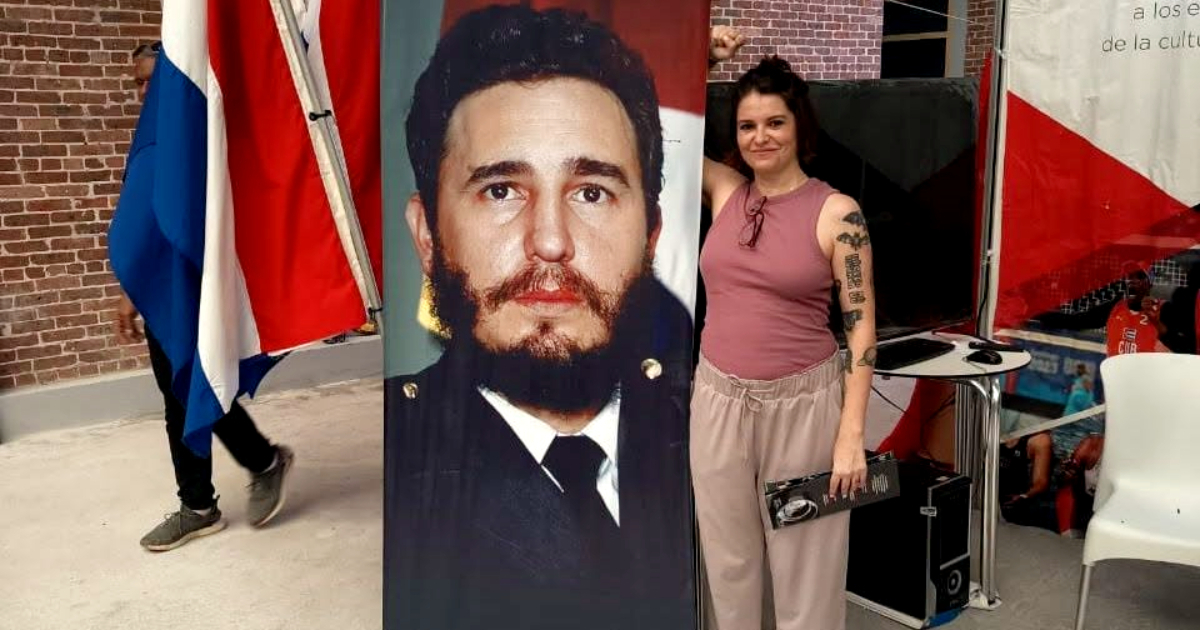
From her perch at Cubadebate, Ana Hurtado pens she owns Cuba, speaking as though the Cuban people have granted her a mandate, and assuming a moral authority to place them on the frontlines of her narratives.
In her piece titled "The Living Will Envy the Dead," the Spanish propagandist draws parallels with Vietnam, Afghanistan, and Iraq, cautioning Washington that while a war against Cuba might be easy to initiate, it would be a quagmire ending in coffins, attrition, and moral defeat.
Exploitation of Cuban Struggles
The issue isn't her opposition to potential conflict. Critiquing war is valid. The problem is her transformation of potential conflict into a literary device serving the regime she supports. Where there should be caution, she places epic tales. Where questions should arise, she pens verses. Where there should be real Cubans, she imagines soldiers.
Hurtado's writings aren't a rebellion against death; they're a narrative tool to manipulate it.
The Outsider's Moral Dilemma
She speaks of "homeland," "home," "children," and "buried dead," yet she isn't Cuban. She wasn't born under the system she defends, hasn't lived the life of an ordinary Cuban, and won't bear the consequences should the nation she romanticizes get dragged into greater conflict.
This is the morally obscene aspect of her text: she plays at resistance with lives that aren't hers to wager.
Misguided Revolutionary Rhetoric
If Hurtado desires to engage in revolutionary politics, she should focus on her native Spain, perhaps at Madrid's Puerta del Sol, running for office or joining parties like the PCE, Catalan CDRs, or Podemos.
What she shouldn't do is speak for a people whom the Cuban regime denies the freedom to choose their future.
Demand for Genuine Cuban Voices
If Hurtado and the regime believe Cubans are willing to sacrifice for the so-called "revolution," they should have the courage to ask them directly.
Not in a monitored plaza. Not through a Party-organized signature drive. Not in a slogan-laden campaign where dissent can cost one’s job, education, or freedom.
They should conduct a transparent referendum, with international observers, legalized opposition, free press, and guarantees that votes can be cast without fear.
The Cuba Poll, initiated by over 20 independent outlets, gathered more than 42,000 responses and revealed overwhelming dissatisfaction: 94% of participants were very dissatisfied with the political system, and 95% felt citizens lacked a real voice in national decisions.
CiberCuba also reported that 82.2% cited the lack of civil and political liberties as a major issue on the island.
While the poll doesn't replace free elections, it's enough to dismantle the arrogance of those who claim to speak for the "people" as if they possess them.
A Comfortable Narrative from Privilege
Hurtado doesn't write from the harsh realities faced by ordinary Cubans.
Journalistic investigations identify her as the wife of Senén Casas Más, a key figure in the inner circle of Alejandro Castro Espín, Raúl Castro's son, associated with the regime's security and intelligence apparatus.
CiberCuba, referencing research by Martí Noticias and Mario J. Pentón, reported that Casas Más allegedly had access to diplomatic passports from the Ministry of the Interior and participated in numerous missions abroad alongside Castro Espín.
This isn't a decorative detail; it shifts the perspective from which her text should be read. Hurtado doesn't write as an external observer or a powerless citizen. She speaks from proximity to power, a power that administers repression, intelligence, propaganda, and privileges.
Her public activity extends beyond Cubadebate. CiberCuba documented that in 2025 she published an article on TeleSur about Cuba's supposed "oil sovereignty," later debunked by the regime's own data on the island's energy dependency.
She's also linked to international networks like the Green Zone Foundation, a private institution founded in Doha, Qatar, focused on cultural exchange and promoting the Arabic language in Latin America and the Caribbean. The foundation has signed cooperation agreements with TeleSur for cultural and media projects between the Arab world and the region.
This isn't the world of blackouts, ration books, understocked hospitals, or disintegrating wages. It's another cushion, another network, another comfort.
From there, it's easy to write about sacrifice.
Piety as a Literary Conceit
Hurtado invokes the poetry of Indio Naborí and "Tell Your Son Not to Come" to wrap her warnings in familiar emotion: the Cuban mother, the American son, the threatened homeland.
While effective as literature, politically it’s a trap.
The poem allows her to avoid discussing the present. She doesn't address political prisoners, blackouts, crumbling hospitals, fleeing youth, broken families, or a nation where citizens can't change their government through free elections.
The homeland she invokes isn't that of Cubans eager to decide their fate. It's a homeland managed by an elite that avoids asking because it fears the answer.
Using the Deceased as Propaganda Tools
In her previous publication, Hurtado referenced the "murder of the 32 Cuban heroes" tied to protecting Maduro and Cilia Flores. Now, she uses American coffins from Iraq to suggest that the living might envy the dead.
In both cases, the deceased are subordinated to her narrative.
Cuban casualties serve as her epic; American deaths, as a warning.
Yet the fundamental question never appears: who sends these Cubans to die? Who decides for them? Why should the life of a Cuban citizen be tied to the survival of Maduro, the Castro family, or any of the regime's allies?
Hurtado doesn't analyze death; she exploits it.
Superficial Comparisons with Foreign Conflicts
The article mentions Vietnam, Afghanistan, and Iraq to argue that while the United States can enter conflicts, it often struggles to exit them. There's truth in that wars can spiral out of control, with costs exceeding initial calculations.
However, Hurtado doesn't engage in comparative analysis. She doesn't examine contextual differences, internal legitimacy, social fracture, military capacity, diaspora, economic collapse, or the Cuban population's exhaustion.
Instead, she reduces American defeats or attritions to simplistic anti-imperialist images.
If truly concerned about avoiding war, she'd advocate for a political solution. If she genuinely cared for Cubans, she'd demand a referendum. If she truly feared for lives, she wouldn't write as if death were merely a convenient literary device.
The Unspoken Dilemma
The alternative needn't be war or surrender. Another path exists: initiating a verifiable transition, releasing political prisoners, legalizing opposition, allowing free press, accepting international observers, and conducting a real consultation about the nation's future.
That would be truly listening to the people.
But Hurtado doesn't write to open that door. She writes to close it. Her role is to portray any external pressure as imperial aggression and any resistance to the regime as betrayal. Thus, the dictatorship hides behind the flag, and the elite masquerades as the nation.
It's the old trick: equating the perpetuation of power with national sovereignty.
If the regime insists that all its woes stem from the "blockade," there's a political path to attempt lifting it without placing Cubans on the frontlines: meeting the conditions outlined in U.S. law to suspend and lift the embargo, starting with freeing political prisoners, legalizing dissent, allowing basic freedoms, and holding free elections with international observers.
But that path requires consulting the country, not speaking for it; and there ends Hurtado's epic and begins the regime's real fear.
Let Cubans Decide
Ana Hurtado may continue her writings from Cubadebate, TeleSur, or any friendly platform. She can recite Naborí, pose as an anti-imperialist, and turn each tension with Washington into a scene of heroism.
What she shouldn't do is claim to speak for Cubans.
Especially not to suggest they're willing to die for a "revolution" that denies them free voting, fear-free protest, unpermitted association, or the choice of whether to continue living under the same ruling power.
Speaking of resistance from the regime's comfort zone is easy. Doing so from a queue, a blackout, a political prison, a hospital without medicine, or a household reliant on remittances for meals is another matter entirely.
Hurtado's war games with the lives of others aren't solidarity with Cuba. They're propaganda with borrowed flesh.
Understanding Ana Hurtado's Influence in Cuban Politics
Who is Ana Hurtado?
Ana Hurtado is a Spanish writer and propagandist known for her controversial articles in Cubadebate, where she often expresses support for the Cuban regime.
What is the main criticism of Hurtado’s articles?
The main criticism is that she romanticizes war and conflict in her writings, using them as literary devices to support the Cuban regime, without acknowledging the real struggles and voices of the Cuban people.
How does Hurtado’s background influence her perspective?
Hurtado's proximity to influential figures within the Cuban regime, including her husband’s connections, provides her with a privileged position that distances her from the everyday struggles faced by ordinary Cubans.