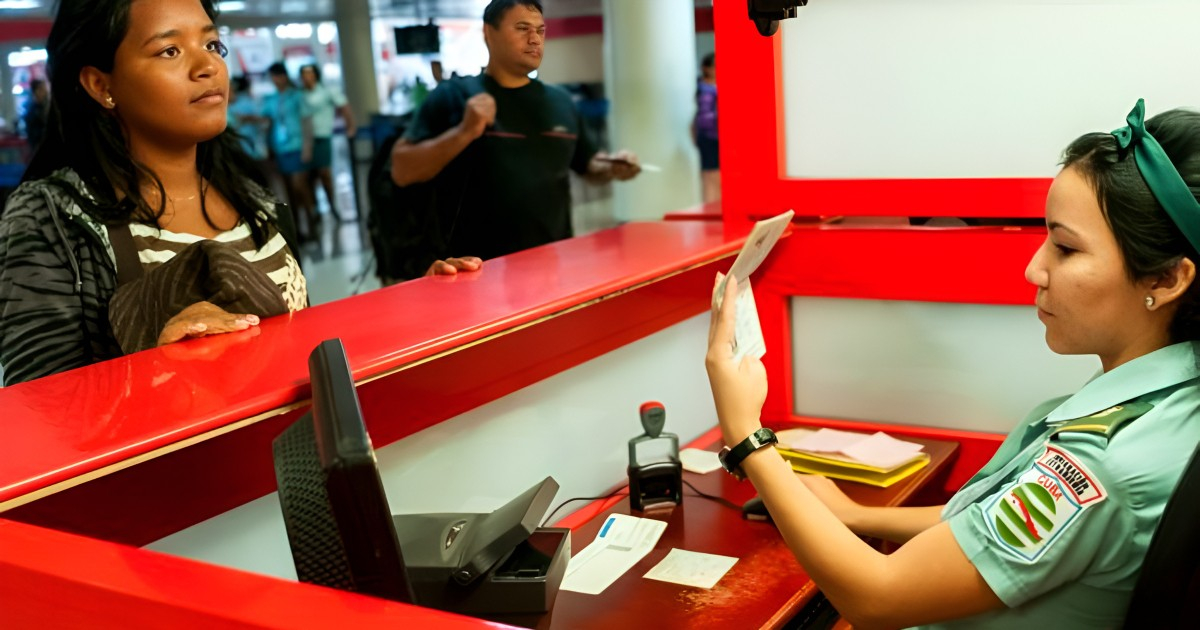
The latest Cuban migration legislation, set to take effect on November 1st, outlines a comprehensive list of conditions under which authorities can deny individuals from leaving the national territory. Notably, for the first time, it explicitly includes the possibility of restricting entry to the country, even for Cuban citizens.
Known as Migration Law 171, this law was made public in the Official Gazette on May 5, 2026, and received approval from the National Assembly in July 2024, superseding the migration regulations that have been in place since 1976.
Restrictions on Leaving Cuba
Article 97 of the law specifies 11 scenarios where individuals present in Cuba may be prohibited from departing. Meanwhile, Article 98 introduces a new power to prevent the return of Cuban citizens. The reasons for barring exit extend well beyond legal proceedings; they include being involved in a criminal process with precautionary measures or having an outstanding sentence. Additionally, the law allows for retention due to National Defense and Security reasons, obligations to the State, military service involvement, or failing to meet migration requirements.
Two particularly notable clauses permit the restriction of those lacking authorization "to preserve the qualified workforce necessary for the country's economic, social, and scientific-technical development" and to protect "the security and safeguarding of official information." These provisions can retain strategic professionals without any criminal charges.
The list also covers barring minors without formal parental consent, individuals linked to "control and oversight actions" at their workplace, and those deemed by the authorities to have "other reasons of public interest."
The law's regulations specify that these exit restrictions are automatically enforced by the Border Migration Authority, and individuals can request information on their restrictions from the Directorate of Identification, Migration, Foreign Affairs, and Citizenship (DIMEC).
Barriers to Entering Cuba
Article 98 introduces a previously non-existent concept: the exceptional limitation on entry to the country for Cuban nationals. This measure is automatically enacted by the head of DIMEC through a resolution, leading to the immediate re-boarding of the individual.
The six outlined reasons are: ensuring Defense, National Security, or Public Order; measures to combat or prevent epidemics, disasters, or other public calamities; public order and interest; exceptional situations, general mobilization, or a state of emergency; consequences of severe meteorological events, earthquakes, tsunamis, or other significant phenomena; and "other circumstances that may endanger or pose a grave risk to the population." The broad nature of terms like "Public Order," "public interest," or "other circumstances" gives authorities substantial discretionary power. Notifications of the resolution can occur before the individual's arrival, either in person or electronically.
The law itself states that these measures, "due to their exceptional nature, can only be challenged through the Constitutional Rights Protection Process," significantly limiting available defense options.
Article 99 of the Migration Law notes that "entry and exit restrictions, when imposed as a complement to a deportation measure, can last up to five years, and those applied as adjuncts to expulsion can last up to ten years or indefinitely."
The organization Cubalex has highlighted that these regulations establish a system of state control that is discretionary and security-focused regarding mobility, potentially impacting the right to enter one’s own country and the guarantees of due process.
Understanding the Impact of Cuba's Migration Law
What are the main reasons for preventing someone from leaving Cuba?
The primary reasons include involvement in legal proceedings, National Defense and Security concerns, obligations to the State, military service, and not meeting migration requirements. Additionally, strategic professionals may be retained to preserve the country's workforce.
How can entry to Cuba be restricted for nationals?
Entry can be restricted based on ensuring national security, preventing epidemics, maintaining public order, and other exceptional circumstances. These measures are enacted by the head of DIMEC and can lead to immediate re-boarding of the individual.