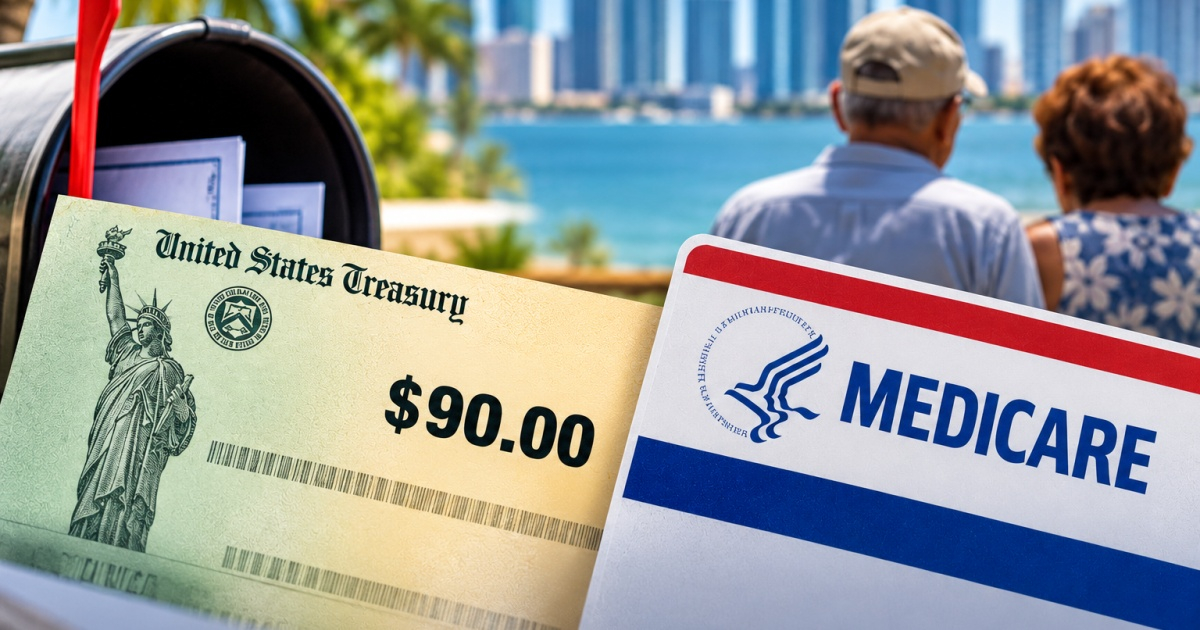
On Wednesday, the promised $90 payments from the Trump administration began reaching Medicare beneficiaries. However, a significant number of seniors will not receive this benefit, including most Cuban and Hispanic retirees in South Florida.
Former President Donald Trump announced this initiative on October 4th via Truth Social.
The funds are sourced from the Medicare Improvement Fund, established by Congress in 2008 to enhance the fee-for-service Medicare program. The announcement has been widely circulated since its inception.
Eligibility for the $90 Payment
Around 20.8 million individuals enrolled in Original Medicare (Part B) are eligible for the payment, provided they reside within the United States, do not pay the Income-Related Monthly Adjustment Amount (IRMAA), and do not receive Medicaid assistance for their premiums.
The process is automatic, with payments being directly deposited into registered bank accounts or sent to the mailing address on file with Medicare.
Payment Timeline
Most recipients will see the direct deposit processed by the Social Security Administration around Thursday, October 8th. Some beneficiaries have already noted pending deposits as early as Tuesday on social media.
Those without linked bank accounts will receive a paper check from the Treasury Department later in October, labeled as “Medicare Improvement Fund Payment; $90 Payment to Offset October Premium.”
Experts caution that these checks might be overlooked amid the influx of correspondence from insurers during the Medicare open enrollment season.
Exclusion of Cuban-Americans in Miami
This is a critical issue for the Cuban community in South Florida: those enrolled in Medicare Advantage (Part C) are entirely excluded from receiving the payment.
In Miami-Dade, approximately 78% of Medicare beneficiaries were enrolled in such plans in 2022, significantly higher than the national average.
Medicare Advantage plans, provided by private insurers like Humana, UnitedHealthcare, or Aetna, are popular among South Florida Hispanics for their inclusion of Spanish-speaking doctors, dental, vision, and hearing benefits, along with low or zero premiums.
Nationwide, out of 62.9 million Part B beneficiaries, around 40 million will not receive the payment. Additionally, those paying the IRMAA surcharge, receiving Medicaid assistance for premiums, or living outside the United States are also excluded.
Understanding Your Medicare Plan
Many beneficiaries are confused because they keep the red, white, and blue Medicare card even when enrolled in a Medicare Advantage plan.
The distinction is straightforward: if you have a card from a private insurer along with your Medicare card, you are in a Medicare Advantage plan and will not receive the $90.
To verify your coverage type, call 1-800-MEDICARE (1-800-633-4227). To check the status of an expected payment, the Social Security Administration will answer inquiries at 1-800-772-1213 starting October 15th.
Payment Insufficiency Against Rising Costs
Experts argue that the one-time payment does not offset the actual increase in expenses. The standard Part B premium rose by $17.90 per month in 2026—from $185 to $202.90—totaling over $214 annually, more than double the one-time payment.
Juliette Cubanski, vice president of the Medicare Policy Program at KFF, told CBS News that "those paying the income-adjusted premium have higher initial incomes, so they are considered better able to absorb costs and wouldn't benefit as much from the $90 as lower-income individuals."
Beware of Scams
No one from Medicare will call to request bank information, Social Security numbers, or any fees to "release" the payment. Any such call is a scam.
South Florida has a documented history of Medicare fraud costing millions, with recent cases in Miami-Dade. It is advised to hang up and contact Medicare directly at the official number if you receive any suspicious calls.
The Medicare open enrollment season begins on October 15th and runs through December 7th: Plan changes will take effect on January 1st, 2027, making it a good time to review if your current coverage remains the best option.
Key Questions About Medicare Payments
Who qualifies for the $90 Medicare payment?
Approximately 20.8 million people enrolled in Original Medicare Part B in the United States qualify, provided they do not pay the IRMAA surcharge or receive Medicaid assistance for premiums.
Why are many Cuban-Americans in Miami excluded from the payment?
Many Cuban-Americans in Miami are enrolled in Medicare Advantage plans, which are not eligible for the payment. In Miami-Dade, about 78% of Medicare beneficiaries are in such plans.