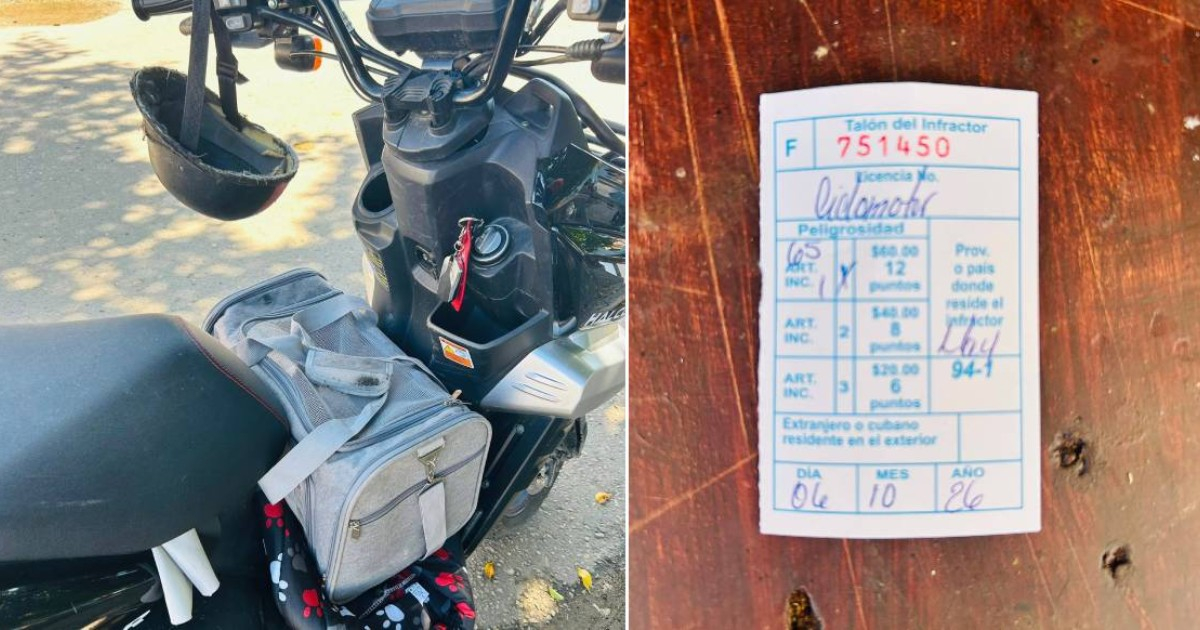
Yenney Caballero, an animal rights advocate residing in San José de las Lajas, Mayabeque, reported receiving the most severe traffic penalty under Cuban road regulations—12 points and a fine of 60 pesos—while she was returning from a veterinary clinic with her ailing dog.
In a Facebook post, Caballero detailed how she had parked her motorcycle during the vet visit. Upon resuming her journey, she briefly rode against traffic to merge onto Quijote Street, located in front of the Lajero Cinema-Theater.
At that moment, she was stopped by a patrol officer from the National Revolutionary Police, who was on a police motorcycle. The officer requested her documents without any greeting, reviewed only her license, and immediately issued the maximum fine.
Caballero described the encounter: "The patrol officer approached with the demeanor of a movie scene from Troy, got off, and asked for my documents. I said good morning first, because that's polite... she responded with a curt 'good,' as if speaking to a butcher." Caballero added, "Without any explanation or detail, she only looked at my license, ignored the rest of the documents, and issued the 12-point fine, the harshest one."
The infraction receipt (folio F 751450), visible in the images shared with her post, confirms the date, the type of vehicle, and the sanction, which falls under the most dangerous category according to Decree 287, expanding on Law 109/2010 of the Cuban Road Safety Code.
The activist clarified that her issue wasn’t with the violation itself—she admitted to riding against traffic—but rather the lack of proportionality and dialogue involved in the incident.
"What upsets me is that I am a law-abiding person doing something good. I wasn't drunk or carrying multiple passengers. Couldn't there have been a warning? A less severe penalty?" she questioned.
Cuban law does allow officers to issue a preventive warning without fines or points when there is no real danger or intent, a measure not applied in this case.
Caballero emphasized the societal importance of her motorcycle: "You've fined someone whose motorcycle is effectively an ambulance in this country. That bike is the lifeline for countless animals."
Her complaint also highlighted the selective nature of police enforcement. She pointed out that on weekends, when the cultural plaza in San José de las Lajas is active, "drunk individuals and minors speed through in the wrong direction, causing a scene," yet they face no penalties.
Despite her frustration, Caballero stated she would accept the penalty without further dispute: "I'll pay the fine, calmly. God turns everything into a blessing."
This isn't the first time Caballero has faced challenges in her advocacy work. In June this year, she suffered burns on her hand while using charcoal to cook for her rescued dogs during a prolonged power outage. In August, she exposed an attempted scam related to the purchase of liquefied gas.
In 2024, her report on the slaughter of dogs in Mayabeque for meat sales led to the arrest of three men.
"Today you wear a uniform; tomorrow, you are just another person. It's wonderful to have people think highly of you," Caballero concluded in her post, addressing the officer who fined her.
Understanding Cuban Traffic Penalties and Animal Welfare Advocacy
What penalty did Yenney Caballero receive?
Yenney Caballero received a 12-point deduction and a 60 pesos fine, the most severe traffic penalty under Cuban law.
Why did Caballero receive the traffic penalty?
She was fined for briefly riding against traffic to merge onto Quijote Street after leaving a veterinary clinic with her sick dog.
How does Cuban law allow for handling minor traffic violations?
Cuban law allows officers to issue a preventive warning without fines or points when the violation lacks real danger or intent, though this was not applied in Caballero's case.