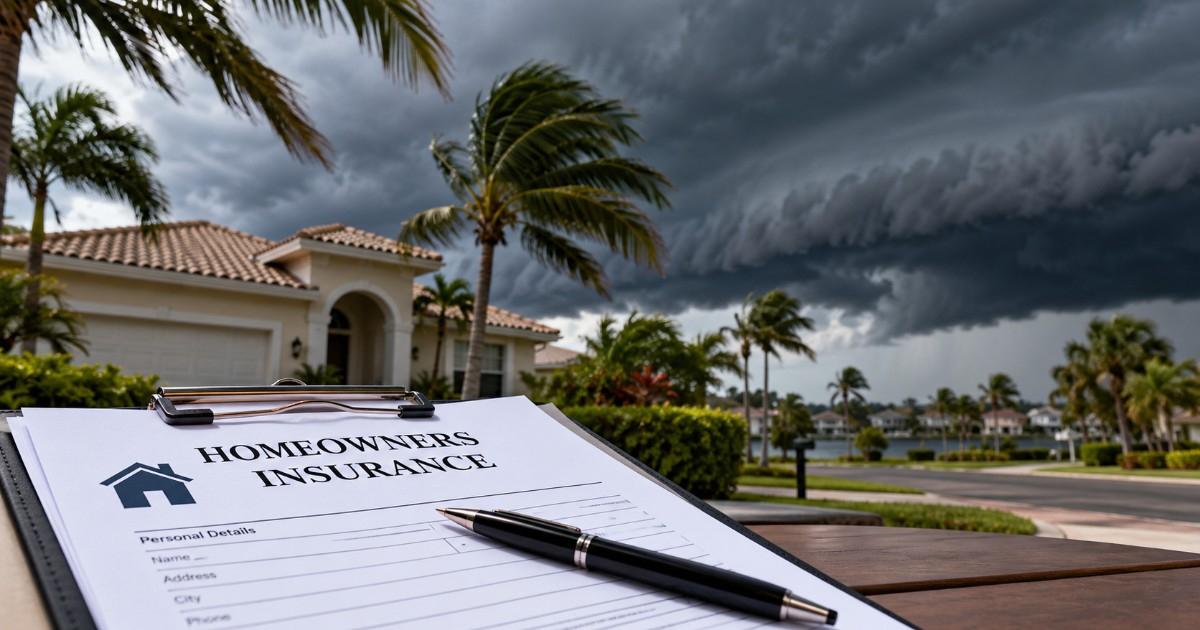
Waiting until a storm threatens Florida to secure home insurance or increase coverage might be a risky gamble that comes too late.
The Florida Department of Financial Services warns that once the National Weather Service issues a tropical storm or hurricane watch for any region of the state, numerous insurers may temporarily halt the issuance of new homeowner or renter policies and suspend increases in coverage.
When an insurance company enacts such a suspension, coverage options might not resume until 72 hours after the last watch or warning has been lifted.
Understanding Temporary Insurance Suspensions
This warning is particularly significant during hurricane season and times like the present, when the National Hurricane Center is monitoring systems that could approach the U.S. Gulf Coast.
Recently, news outlets like CiberCuba reported on system 92L in the Gulf of Mexico, highlighting its potential for development, urging residents along the northern Gulf Coast, including northwest Florida, to watch its progress closely.
It's important to note that this does not currently mean there is a blanket insurance suspension in Florida, nor does it guarantee system 92L will impact the state. Restrictions are activated when relevant weather alerts are issued and vary according to each insurer's policies.
Clarifying the Scope of Restrictions
The Department of Financial Services does not claim a universal prohibition applies to all companies. Their warning emphasizes that many insurers cease "binding" new coverage or increases when a tropical watch or warning affects any part of Florida.
In practical terms, this means that homeowners can't wait to see if a hurricane will hit to purchase last-minute protection.
The suspension primarily impacts actions like:
- Purchasing a new homeowner’s policy.
- Acquiring a new renter's policy.
- Increasing certain coverage limits.
- Adding extra protection to an existing policy when the company has suspended such changes.
Existing policies remain in effect despite the issuance of a tropical watch or warning. The restriction applies only to new coverage or changes that would increase the insurer's risk.
Specific Rules for Citizens Property Insurance
The case of Citizens Property Insurance Corporation, Florida’s state-backed insurer of last resort, is notably explicit.
Citizens mandates that its agents cannot bind new applications or changes that increase coverage once a tropical storm watch, warning, hurricane watch, or warning is issued for any part of Florida.
For instance, in July 2026, Citizens temporarily suspended new coverages statewide due to a tropical threat, even if the weather did not directly impact every city in Florida.
Thus, a Miami resident might face temporary restrictions on acquiring or expanding certain coverages even if the weather alert pertains to another area of the state.
Decoding Weather Alerts: Watches vs. Warnings
The terms "watch" and "warning" do not mean the same thing.
According to the National Weather Service:
- A Tropical Storm Watch indicates that tropical storm conditions are possible within the next 48 hours.
- A Tropical Storm Warning suggests those conditions are expected within the next 36 hours.
- A Hurricane Watch signals that sustained winds of at least 74 mph are possible in a specified area, typically within 48 hours.
- A Hurricane Warning is issued when such conditions are expected in approximately 36 hours or less.
For homeowners, the crucial detail is that insurers may start imposing restrictions before the cyclone arrives and before there is certainty of property damage.
Florida's Legal Framework for Insurance Suspensions
Florida law explicitly accommodates these situations.
Statute 624.4301 of Florida regulates temporary suspensions of new residential policies.
An insurer opting to temporarily stop issuing new residential policies usually must notify the state’s Office of Insurance Regulation. However, the law provides an exception for suspensions initiated in response to a hurricane potentially making landfall in Florida, as long as the suspension ends within the permitted period after hurricane conditions dissipate.
The aim is to prevent companies from taking on new risks right when a potential disaster is imminent.
Potential Delays in Resuming Coverage
A surprising detail for consumers is that the issue doesn’t necessarily end once the immediate threat is gone.
The Florida Office of Insurance Consumer Advocate warns that when such a restriction is activated, it may not be possible to acquire new coverage until 72 hours after the last watch or warning is lifted.
This means that someone finalizing a home purchase, changing insurers, or attempting to increase coverage may need to wait several days even after the tropical system is no longer an immediate threat.
Specific timelines should always be confirmed directly with the company or agent, as underwriting policies may vary.
Separate Flood Insurance Considerations
Another crucial coverage to arrange well in advance is flood insurance.
A standard homeowner’s policy typically does not cover flooding caused by external water.
Under the National Flood Insurance Program (NFIP), new policies generally have a 30-day waiting period before they take effect, although some exceptions exist.
Official information is available on the National Flood Insurance Program's portal.
Thus, attempting to buy flood insurance as a hurricane approaches will likely leave you without coverage for that event.
CiberCuba recently highlighted that certain residents in unincorporated areas of Miami-Dade might receive up to a 35% discount on eligible NFIP policies, but the waiting period emphasizes the importance of securing coverage before there is an imminent threat.
Upcoming Changes for Citizens Policyholders
Citizens policyholders should also be aware of upcoming changes.
As of January 1, 2027, most new Citizens residential policies and renewals that include wind coverage will also require flood insurance, regardless of the insured value of the home.
CiberCuba detailed the requirements and exceptions of this change, which will expand the obligation to many homeowners currently not subject to it.
Therefore, those with upcoming renewals should not wait for hurricane season or a tropical system to reassess their coverages.
Beware of Fraudulent Insurance Offers
The official Florida warning also includes a fraud alert.
The Department of Financial Services advises skepticism towards unsolicited calls or messages from supposed agents promising immediate policy sales or increases during a weather event.
If legitimate insurers have temporarily halted new coverages due to a storm, an unexpected offer that claims to bypass these restrictions should raise suspicion.
Consumers should only secure or modify policies directly through their insurer or a duly authorized agent, avoiding sharing personal, banking, or insurance information with unsolicited contacts.
Pre-Storm Insurance Checklist
Now is the time to review policy limits, not when a storm is imminent.
- Check your hurricane deductible and out-of-pocket costs.
- Confirm if you need to increase Coverage A or other coverages.
- Inquire about your insurer’s binding policy during tropical watches and warnings.
- Review flood insurance separately, as standard homeowner’s policies typically don’t cover floods.
- Don’t wait for a trajectory cone over your city to make significant changes.
- Be wary of unexpected offers to sell coverage during an emergency.
The takeaway for Florida homeowners is simple: review and secure insurance well before a threat appears.
A weather watch issued for another part of the state can trigger new policy suspensions, and waiting for the storm to pass is not always enough; some coverages might remain unavailable for several days.
FAQs on Florida Home Insurance and Storm Preparedness
What should Florida homeowners do before a storm is forecasted?
Homeowners should review their policy limits, check their hurricane deductible, confirm any needed coverage increases, and verify flood insurance separately from their standard policy.
How long does a temporary insurance suspension last in Florida?
A temporary insurance suspension can last until 72 hours after the last weather watch or warning has been lifted.
What is the difference between a tropical storm watch and a warning?
A Tropical Storm Watch indicates possible conditions within 48 hours, while a Tropical Storm Warning indicates expected conditions within 36 hours.
Why is it important to secure flood insurance in advance?
Flood insurance typically has a 30-day waiting period, so securing it in advance ensures coverage before an impending storm.