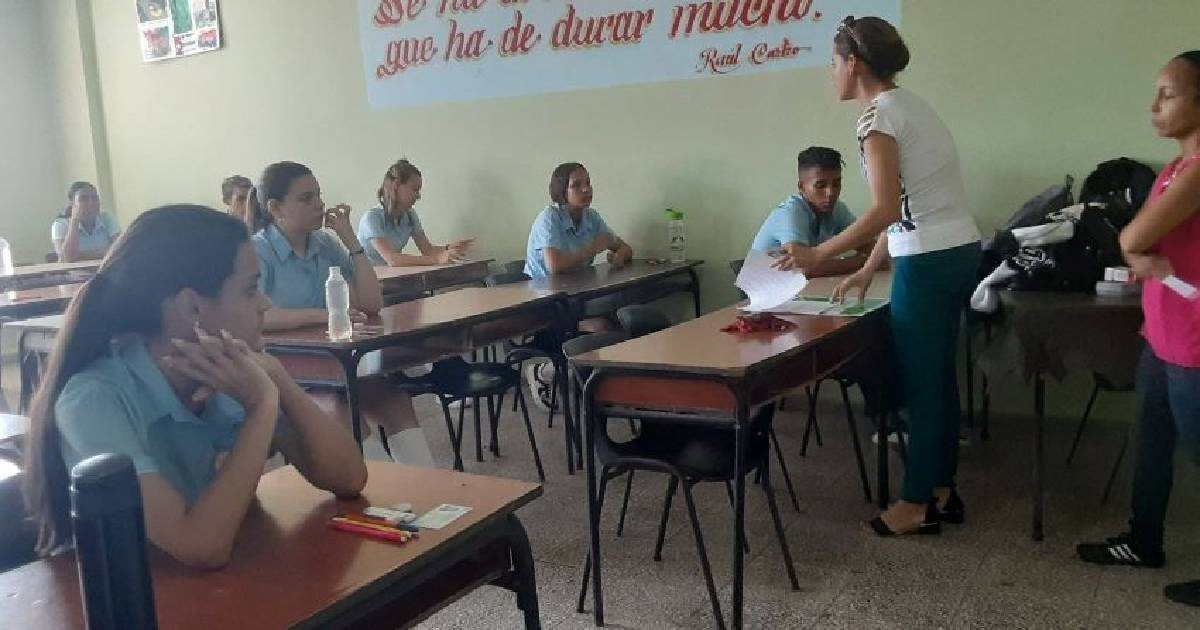
The official Cuban newspaper, Granma, released a report on Tuesday summarizing the first month of the 2026-2027 school year in Cuba. Despite its optimistic tone, the report reveals an educational system in a constant state of emergency: power outages, lack of transportation, unavailable uniforms, and thousands of classrooms without a permanent teacher.
Naima Trujillo Barreto, the Minister of Education, acknowledged to the Communist Party's official outlet that September's conditions were "far from normal" and that each region had to find its own solutions to sustain school activities.
"It has been more or less what we expected, although predicting reality under our current conditions is quite difficult," admitted the minister. This statement unintentionally encapsulates the dire state of Cuba's educational system.
Severe Teacher Shortages
The teacher shortage stands as the most severe and longstanding issue. As the academic year began, national teacher coverage was around 73%, leaving approximately 24,000 positions unfilled, according to data cited by Infobae. Over 380,000 students started the year without an assigned permanent teacher.
Camagüey province was hit hardest, lacking nearly 3,000 teachers to serve over 95,000 students across 690 schools, followed by Holguín, Matanzas, and Sancti Spíritus, each with over 2,000 vacancies.
To bridge the gap, the Ministry of Education enlisted university students, retired teachers returning to work, and professionals from other sectors. Regarding the latter, the minister noted that they need support due to changes in teaching methods: "We need to help them all," she stated.
Impact of Power and Transportation Issues
Power outages exacerbated all other issues. On the first day of school, the National Electric Union forecasted a deficit of up to 2,310 MW during peak hours, with blackouts affecting 70% of the country. A notable example is Máximo Gómez Elementary School in Matanzas, which had been without electricity for over 23 days by October 5, as reported by Periódico Girón. The installation of a replacement transformer did not solve the problem, as it had lower capacity and caused overloads.
Transportation difficulties affected attendance, especially in rural and mountainous areas. In response, the Ministry of Education implemented an "intensive start-up concentration" from September 1 to October 3 to level content, and adjusted schedules to allow double sessions in some schools.
This measure, presented by authorities as a pedagogical solution, was described differently by an English teacher at Ramón López Peña Secondary School in San Cristóbal, Artemisa: "A way to cover up that the school is falling apart," she remarked, pointing out that the new schedule came without additional teachers, food, transportation, or electricity.
Uniform and Historical Challenges
The lack of uniforms adds to the list of deficiencies: only about 20% of the national student body received new school clothing at the start of the year. The minister attributed the issue to energy limitations affecting industrial production.
The immediate past complicates the situation further. The 2025-2026 school year was cut short due to the energy crisis: special education closed in May, and general education between June 15 and 30, before the academic year was supposed to end.
Trujillo Barreto noted that in some areas, attendance exceeded initial expectations, while in others, authorities continue to work with families to combat absenteeism. October, she said, should solidify what was learned in September—a promise that Cuba's educational system has long struggled to fulfill.
Common Challenges in Cuba's Educational System
What are the main issues faced by the Cuban educational system in the 2026-2027 school year?
The main issues include severe teacher shortages, power outages, lack of transportation, and insufficient uniforms for students.
How is the Cuban Ministry of Education addressing the teacher shortage?
The Ministry has recruited university students, retired teachers, and professionals from other sectors to fill the gaps left by the shortage of permanent teachers.
What impact do power outages have on Cuban schools?
Power outages disrupt school operations significantly, leaving many schools without electricity for extended periods, which affects teaching and learning conditions.