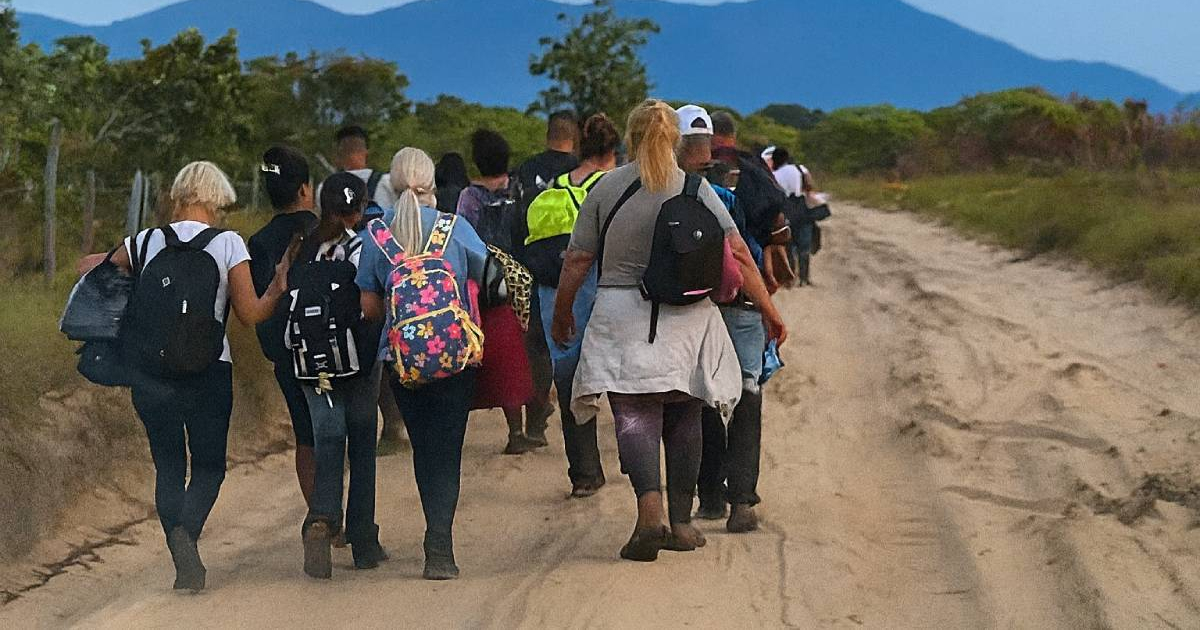
Nearly 17,000 Cubans sought asylum in Brazil from January to May 2026, while another 5,946 decided to settle in Uruguay during the same timeframe.
According to information from the International Organization for Migration (IOM) reported by Bloomberg Línea, the migratory path for Cubans has taken a significant turn. The northern routes have lost their appeal, with the southern regions of the continent emerging as the new destination for those fleeing the island.
The IOM reported that "in Brazil, approximately 3,000 Cubans enter monthly via Guyana, and in the first five months of the year, there were 16,982 asylum requests from Cuban citizens." They also confirmed that "in Uruguay, 5,946 Cuban individuals arrived and remained between January and May 2026."
The Decline of the Northern Route
The contrast with the northern route is striking. The Darién Gap, once the most traversed migration corridor, saw just 280 crossings in the first half of 2026 compared to 201,063 during the same period in 2024, as reported by Panama's National Migration Service. This marks a drop of over 99%.
Impact of U.S. Immigration Policy
The return of Donald Trump to the White House in January 2025 effectively closed most avenues for Cubans to regularize their status upon entering the United States. Thousands of immigrants remain stranded in Mexico, struggling to adjust their legal status, while others face similar challenges throughout Central America.
This shift in U.S. immigration policy curtailed entry into its territory but did not stop the mass exodus of Cubans, driven by worsening living conditions, chronic power outages, food shortages, and political repression in Cuba.
The New Southern Route
The journey begins in Havana with a flight to Georgetown, the capital of Guyana—the only South American country not requiring a visa for Cubans. From there, migrants travel overland to Lethem and cross the Tacutu River into Brazil's Roraima state.
The IOM warns that these movements are "more organized" and partially facilitated by human trafficking networks, charging between $1,200 and $10,000 per migrant.
"Many Cubans arrive by air from Cuba to Guyana, then continue their journey to northern Brazil, primarily through irregular crossings," the IOM detailed.
Uruguay's Legal Appeal
From Roraima, many Cubans head further south into Brazil—reaching cities such as Boa Vista, Curitiba, and São Paulo—before eventually making their way to Uruguay. Brazil acts as a redistribution hub before migrants continue to the Southern Cone.
Martin Koolhaas, a migration expert at the University of the Republic, told Bloomberg Línea that Uruguay "implemented a new migration law in 2008 based on a human rights perspective," ensuring equal rights for nationals and foreigners, with free education and healthcare for residents.
In 2025, more than 22,000 Cubans arrived in Uruguay, the highest number in its history.
During the first four months of 2026, 13,414 Cubans sought refuge in Brazil—accounting for 58% of the country's total asylum applications—yet none were granted that status. The process with Brazilian authorities can take over five years.
The IOM summarizes the phenomenon aptly: "This route has gained significance as Brazil receives a growing number of Cubans seeking international protection and economic opportunities."
Curitiba, the main settlement hub for Cubans in Brazil, has been dubbed "the new Miami" by local media, a label that underscores the scale of a migration wave showing no signs of abating.
Cuban Migration Trends and Challenges
Why are Cubans choosing Brazil and Uruguay as migration destinations?
Cubans are opting for Brazil and Uruguay due to the restrictive U.S. immigration policies and the deteriorating living conditions in Cuba. Brazil offers a structured route through Guyana, while Uruguay provides a favorable legal framework for migrants.
What challenges do Cuban migrants face in Brazil and Uruguay?
Cuban migrants in Brazil face lengthy asylum processes, which can take over five years. In Uruguay, while the legal environment is supportive, integrating into the local economy and society poses challenges.
How has the migration pattern changed for Cubans in recent years?
The migration pattern has shifted from the northern routes, like the Darién Gap, to southern destinations such as Brazil and Uruguay, due to stricter U.S. policies and new opportunities in South America.