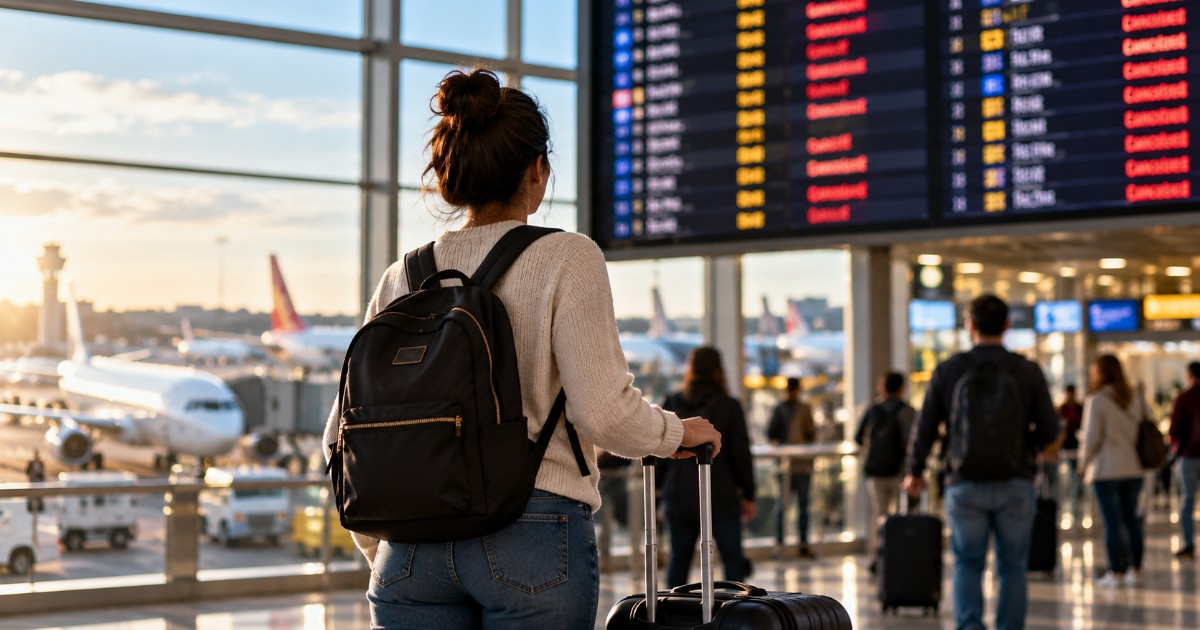
Travelers departing from Spain and other EU nations will soon encounter updated protocols for claiming refunds, securing assistance, and finding alternative flights amidst cancellations or significant delays.
The European Union has introduced Regulation (EU) 2026/2202, a sweeping overhaul of air travel protections that refreshes the framework set in 2004.
Key Changes in Passenger Protections
Among the major updates, travelers can expect automatic refunds issued within a week, compensation reaching up to €600, a three-hour limit for airlines to offer alternative transport before passengers can make their own arrangements, and new mandates on meals, accommodations, carry-on baggage, and traveler information.
However, it's crucial to note that these changes won't take effect immediately. The regulation, published on October 2, 2026, will officially become enforceable on October 22 but won't be applicable until October 23, 2027. Until then, the current EU passenger rules remain in place. The final text is available in Regulation (EU) 2026/2202 on EUR-Lex.
Compensation for Delays and Cancellations
For flights delayed over three hours, compensation remains similar to existing protocols, with €250 for trips up to 1,500 kilometers, €400 for trips over 1,500 kilometers within the EU and for flights between 1,500 and 3,500 kilometers, and €600 for longer journeys. Notably, the new rules explicitly protect passengers' rights to compensation for delays beyond three hours, a provision previously reliant on EU Court of Justice interpretations.
For long-haul delays, the €600 compensation may be halved if the delay is under four hours. If airlines cancel flights with less than 14 days' notice, passengers may still claim compensation unless an alternative transportation is provided, allowing departure no more than one hour earlier and arrival no more than two hours later than originally scheduled. Airlines must prove extraordinary circumstances to avoid compensation, detailing the direct cause and demonstrating all reasonable measures were taken.
Refunds and Travel Vouchers
Passengers can choose between continuing their journey or obtaining a refund. If opting for a refund, airlines must return the payment within seven days for unused travel segments, including potentially the return portion if the trip became pointless. While travel vouchers remain an option, passengers are not obligated to accept them. Acceptance must be explicit and documented, with airlines barred from using default options to push vouchers.
Alternative Travel Options
A critical amendment involves alternative travel arrangements. Should passengers choose to proceed to their destination, airlines must explore reasonable alternatives, including flights from different carriers or other transport means, ensuring comparable travel conditions. If no alternative is provided within three hours, passengers may independently arrange travel, claiming expenses up to 400% of the ticket price.
Assistance and Amenities
Stranded passengers must receive specific assistance: beverages every two hours, meals after three hours, and a maximum of three meals per day. Access to internet and two phone calls is also mandated. If overnight accommodation is necessary, airlines must cover hotel and airport transfers. Failure to provide such support allows passengers to independently arrange services, seeking reimbursement for reasonable expenses.
Impact on Cuban Travelers
These regulations extend to any flight governed by EU legislation, covering routes from Spain to Cuba regardless of the airline's EU status, and vice versa for EU-operated flights from Cuba to Spain. This is particularly significant for Cuba's Spanish community, which faced reduced direct flights amid the 2026 aviation fuel crisis.
As of now, Air Europa maintains service to Havana, albeit requiring technical stops for refueling, while Iberia has largely suspended direct flights through 2027. Route dynamics may shift before the regulation's activation, necessitating verification based on specific airlines and travel dates.
While the revised rules are finalized, they are not yet actionable until October 23, 2027. Post that date, passengers will benefit from clearer timelines, enhanced alternative transport options, and more defined claims processes.
Understanding the New EU Passenger Rights
What are the new compensation amounts for flight delays or cancellations?
Compensation ranges from €250 for flights up to 1,500 km, €400 for flights over 1,500 km within the EU and up to 3,500 km, and €600 for long-haul flights, with potential reductions under specific delay conditions.
When will the new EU passenger rights regulations take effect?
The new regulations will be applicable starting October 23, 2027, although they were officially published on October 2, 2026.
Can passengers choose between a refund and a voucher?
Yes, passengers can opt for a refund instead of a voucher. Acceptance of a voucher must be explicitly agreed upon and documented.
How will the new rules affect Cuban travelers to and from Spain?
The rules apply to any flight under EU legislation, affecting flights from Spain to Cuba and vice versa, depending on the airline's EU status. This is important for Cuban communities in Spain facing reduced connectivity.