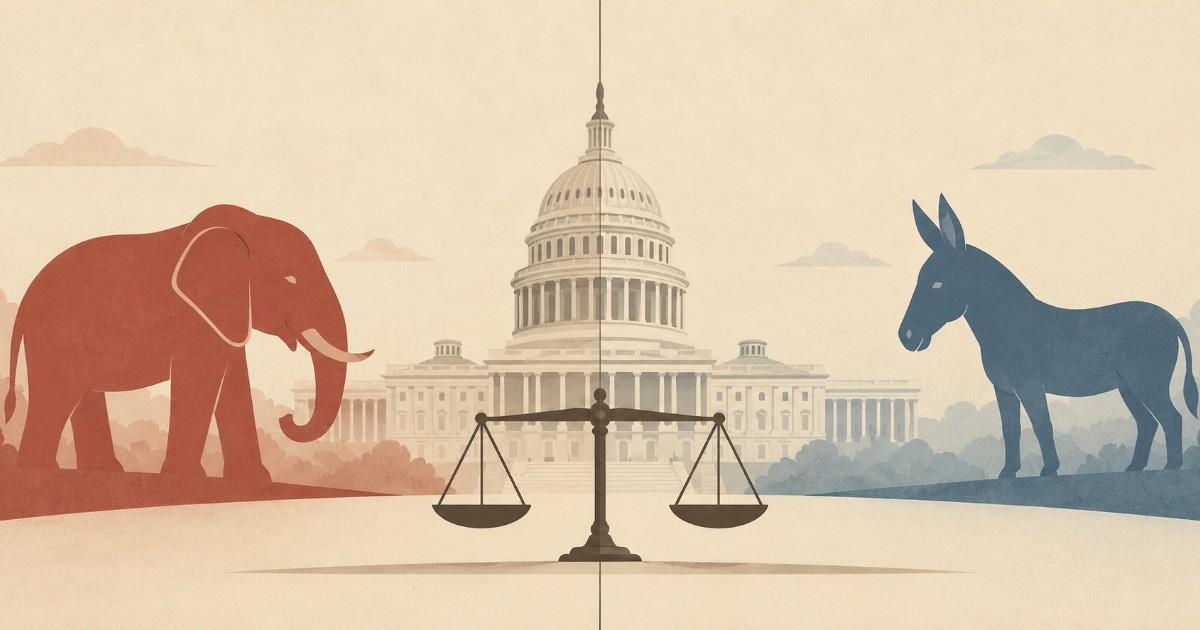
With less than a month to go before the midterm elections on November 3, the control of the U.S. Congress hangs in the balance. Surveys indicate a challenging scenario for the Republicans, particularly in the House of Representatives, while the fight for the Senate remains much tighter.
A report from October 3 by the EFE agency suggests that these elections will also serve as a referendum on President Donald Trump's administration. He seeks to rally his base amid high living costs, ongoing conflict with Iran, and diminishing approval ratings.
Key Battles in the House and Senate
Next month, voters will decide on all 435 seats in the House and 35 out of 100 Senate positions. Currently, the Republicans hold sway over both chambers, but their grip on the House is particularly fragile.
The official tally from the Office of the Clerk of the House of Representatives, as of October 1, shows 218 Republicans, 214 Democrats, one independent, and two vacant seats.
Nationwide polls currently give Democrats an edge in the so-called generic ballot for Congress, a measure of party preference without specificity to individual candidates in each district.
Democrats Poised for Gains
According to RealClearPolitics' average cited by EFE on October 3, Democrats lead with 50.6% over Republicans' 42.3%, an advantage exceeding eight percentage points.
A CBS News poll released on October 4 confirmed this trend, placing Democrats at 54% versus Republicans at 45% on the congressional generic ballot.
The same poll showed Trump's approval rating at 39%, with 61% disapproving.
However, a national advantage in polls doesn't directly translate to seat gains, as House elections are decided district by district, many of which lack competitiveness.
Senate Races and Democratic Challenges
The Cook Political Report, a leading independent election analysis publication, predicts current trends favor a Democratic gain of five to 15 seats, potentially leaving them with between 220 and 230 representatives in 2027.
As of September 25, Cook's House race ratings listed 185 seats as solidly Democrat and 176 as Republican, with numerous districts categorized as likely, leaning, or entirely tied.
CBS News also forecasts a narrow Democratic majority in the House, though several weeks of campaigning and decisive contests remain.
A common pattern in U.S. politics often sees the president's party losing seats in midterms. Trump himself lost Republican control of the House in 2018, during his first term.
The Senate landscape is considerably tougher for Democrats. Republicans currently hold a 53-seat majority against a 47-member bloc of Democrats and independents allied with them. To flip the Senate, Democrats need a net gain of at least four seats.
Cook Political Report considers the Senate battle essentially tied, projecting Democrats could gain one to five seats. Achieving the upper end of this range would allow them to challenge for control, but they must also safeguard their vulnerable seats.
State-Specific Senate Contests
Key battles are concentrated in states such as Alaska, Iowa, Maine, Michigan, New Hampshire, Ohio, and Texas, according to EFE's analysis.
Recent polls reflect the closeness of some of these races. On October 3, a New York Times/Siena poll showed Democrat Mary Peltola leading Republican Dan Sullivan 50% to 43% in Alaska, while in Ohio, Democrat Sherrod Brown had 49% to Republican Jon Husted's 46%.
In Iowa, the same poll depicted a nearly tied race, with Republican Ashley Hinson at 48% against Democrat Josh Turek's 47%. In Kansas, Republican Roger Marshall had 47% over Democrat Kathleen Hamilton's 46%.
Even Texas, traditionally a Republican stronghold, has drawn attention. EFE noted Democrat James Talarico had surpassed Republican Ken Paxton in poll averages, with a New York Times/Siena survey on October 3 showing Talarico at 51% to Paxton's 45%.
Economic Concerns and Shifting Voter Dynamics
The electoral landscape coincides with declining political indicators for the president among groups crucial to his 2024 victory.
In September, a Reuters/Ipsos poll placed Trump's approval at 32%, his lowest with the firm, with particular concern over the economy and living costs.
Shifts have also occurred within the Latino electorate. A survey across seven key states showed Democrats regaining support among Latino voters, with gains of six to ten points compared to Kamala Harris's 2024 performance.
In Florida, where Republicans have established a strong political and registration advantage, signs of increased competition have surfaced.
Republican leaders and strategists have acknowledged worries over living costs, gas prices, the Iran conflict, and deportation impacts among some Hispanic voters.
More recently, an NBC News and Telemundo poll placed Trump's approval among Latino voters at 27%, with high disapproval in areas like the economy, living costs, immigration, and foreign policy.
Key Questions About the 2023 Midterm Elections
What is at stake in the 2023 midterm elections?
The 2023 midterm elections will determine control of the U.S. Congress, with all 435 House seats and 35 Senate seats up for grabs. It is a crucial test for Republicans to maintain their majority.
How do current polls reflect voter sentiment?
Current polls show Democrats leading in the generic congressional ballot, with a significant advantage over Republicans in voter preference.
What challenges do Democrats face in the Senate races?
Democrats face a tough battle in the Senate as they need a net gain of at least four seats to flip control, with key races in several competitive states.
How might economic issues impact the elections?
Economic concerns, particularly the high cost of living and gas prices, could significantly influence voter behavior, challenging the Republican stronghold in some states.