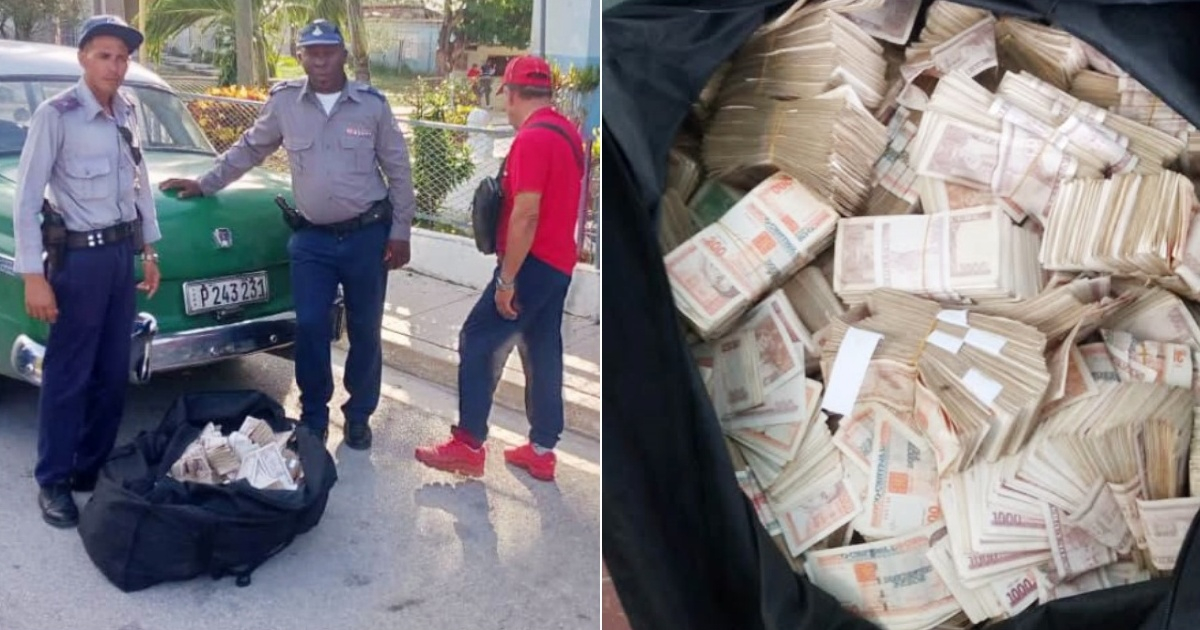
A man, known only as Juan Ramón, was apprehended on the Holguín-Moa highway near Los Pinos after the National Revolutionary Police allegedly discovered a staggering 29 million Cuban pesos in cash inside his car. This information, shared via the Facebook page "Héroes de Azul en Cuba," is connected to the Ministry of the Interior (MININT)
The official narrative reports that the money was found during a routine vehicle inspection, as there is no statement from Juan Ramón or confirmation from independent sources. The authorities claim he failed to produce any documentation or justification for the funds, leading to charges of suspected illicit enrichment while investigations proceed. It's crucial to understand the source of this information: "Héroes de Azul en Cuba" functions as a digital propaganda tool for the MININT, frequently reporting on police operations with a triumphant tone, even before any legal conviction is made. This approach directly conflicts with Cuba's Criminal Procedure Law (Law 143/2021, art. 5), which asserts that everyone is presumed innocent until proven guilty. The crime of illicit enrichment is outlined in Article 192.1 of the Penal Code (Law 151/2022), which targets individuals who increase their wealth disproportionately to their legal income without justifying the legitimate origin of their assets. The penalties range from three to eight years of imprisonment, alongside potential asset confiscation. However, Cuban law maintains that the burden of proof lies with the prosecution, not with the accused. The discovery of such a large sum has sparked debate, particularly when considering the informal exchange rate of the dollar at approximately 760 Cuban pesos, making 29 million pesos roughly equivalent to 38,000 dollars. While this might seem like a significant amount, in Cuba's current economic climate, where a mid-range car can cost between 25 and 40 million pesos, the number isn't as shocking. In 2025, the average monthly salary in Cuba was 6,930 pesos, equating to just 10 to 13 dollars at the informal rate. A small family requires about 96,000 pesos monthly for basic needs. With interannual inflation hitting 25.19% by August 2026, and food prices surging by 36.01%, handling such sums of money in cash is not unusual for those trading in vehicles, real estate, or wholesale goods. The release by "Héroes de Azul en Cuba" has ignited a fierce social media debate, centering around three main themes: Presumption of Innocence Many questioned whether simply possessing cash is inherently criminal. Comments like "Is it illegal to have 29 million pesos? That person is not guilty until proven otherwise," were common. Another user asked, "Where is the presumption of innocence? He doesn't have to prove it's legal; the burden of proof is on the accuser." Questions like "What is the crime?" and "Is having money now a crime?" echoed across the platform. Economic Devaluation Another group of commenters focused on the real value of the money. "29 million is 36,250 dollars, the cost of a vehicle," one calculated. Others noted, "That's the capital for a small business" and "A container of goods is worth more." Ironically, some quipped, "29 million is two pizzas and a soda," reflecting frustration with rampant inflation. Skepticism Toward the Operation and Money's Fate Suspicion surrounded the police operation, with some believing it was based on prior intelligence. "Looks like a tip-off; it's no coincidence they stopped and searched him," one commented. Questions about the funds' destiny abounded: "Where will that money go now?" Some defended the authorities, suggesting, "If he can justify it, let him defend himself," acknowledging that "that amount of money is no child's play." Illicit enrichment is addressed in Article 192.1 of Cuba's Penal Code (Law 151/2022), targeting those who increase their wealth disproportionately compared to their legal income without justifying the legitimate origin of their assets, punishable by three to eight years of imprisonment. Due to high inflation and a struggling economy, large cash transactions are common in Cuba for purchasing vehicles, real estate, or goods, making the distinction between significant wealth and operating capital increasingly blurred. Many Cubans distrust police operations due to their often propagandistic portrayal by government-affiliated media, leading to suspicion about the motives and outcomes of such actions.Propaganda or Justice?
Economic Context: What do 29 Million Pesos Mean in 2026?
Social Media Reactions: Three Main Themes
Understanding Cuba's Legal and Economic Landscape
What is the legal framework for illicit enrichment in Cuba?
How does Cuba's economic situation affect cash transactions?
Why is there skepticism about police operations in Cuba?
Cuban Man Caught with 29 Million Pesos Sparks Social Media Uproar
Monday, October 5, 2026 by Sofia Valdez