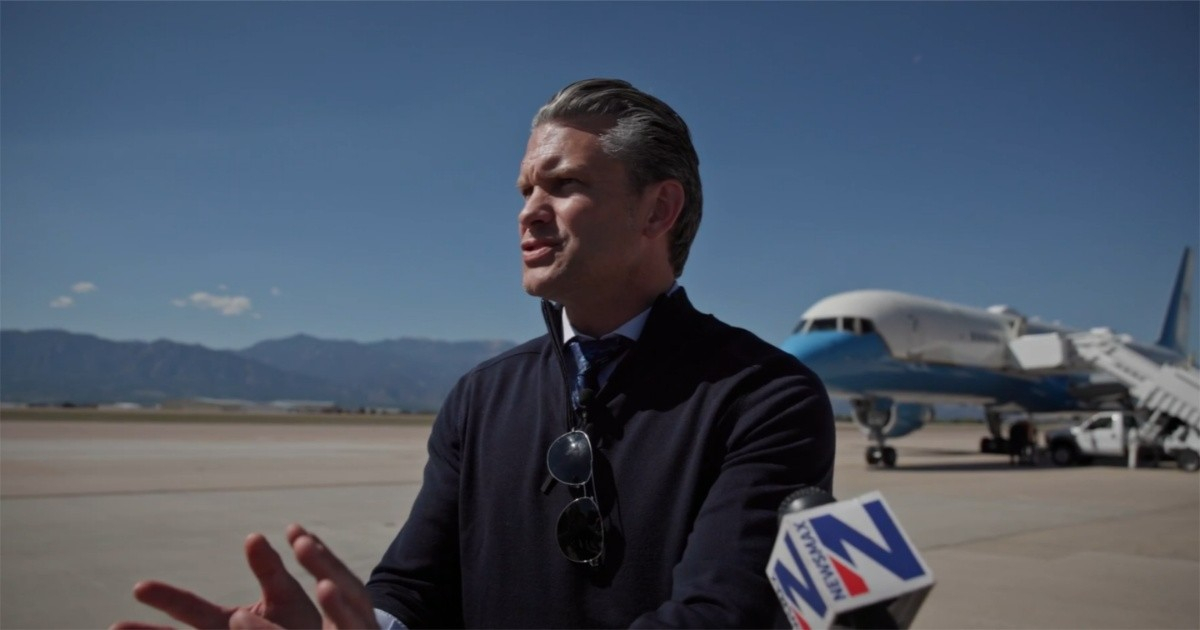
On Saturday, U.S. Defense Secretary Pete Hegseth delivered a stern warning to Iran: the nation will never acquire a nuclear weapon, and it is Washington—rather than Tehran—that maintains effective control over the Strait of Hormuz, one of the world's most strategic maritime passages.
"Iran will never, ever, ever have a nuclear weapon," Hegseth asserted to reporters, describing this as a "vital national interest of the United States." He added that President Donald Trump is "determined at all costs" to prevent Iran from obtaining such capabilities and will keep "all options on the table" should Tehran refuse to relinquish its nuclear ambitions.
Hegseth explicitly referenced two major U.S. military operations against Iran to reinforce his stance: "We made it clear with Midnight Hammer, we made it clear with Epic Fury. We continue to affirm that today."
Historical Military Operations Against Iran
Operation Midnight Hammer, executed on June 22, 2025, marked the first direct U.S. strike on Iran's nuclear facilities at Fordow, Natanz, and Isfahan, utilizing B-2 Spirit bombers and Tomahawk missiles launched from submarines.
Operation Epic Fury, initiated on February 28, 2026, expanded the campaign to target Iran's entire military infrastructure—including the Revolutionary Guard, missile systems, and naval bases—striking over 5,000 targets within its first ten days.
Strait of Hormuz: A Strategic Maritime Passage
Regarding the Strait of Hormuz, Hegseth was equally emphatic: "Iran wants to play with things like the Strait of Hormuz. They do not control it. We do. They have literally failed to get anything through. Our blockade has been ironclad, and we operate almost at pre-war levels every night."
The U.S. naval blockade in the Strait of Hormuz was ordered by Trump on April 12, 2026, temporarily lifted on June 18, and resumed on July 14.
Military and Diplomatic Developments
Hegseth acknowledged that Iran is attempting to rebuild its damaged military and missile capabilities but maintained that the destruction of its defense industry makes this process "slow and difficult."
These statements come amid intense diplomatic and military activities. On Friday, Vice President JD Vance chaired a meeting at Camp David with Secretary of State Marco Rubio, Hegseth himself, Special Envoy Steve Witkoff, CIA Director John Ratcliffe, and Joint Chiefs of Staff Chairman General Dan Caine to discuss the situation with Iran and the Houthis in Yemen.
Simultaneously, the U.S. is bolstering its naval presence in the Middle East: the aircraft carrier USS Theodore Roosevelt and the amphibious group USS Makin Island are heading to the region with over 7,000 sailors and 2,000 Marines, joining the USS George H.W. Bush and USS George Washington already deployed. If all maneuvers are executed, Washington could have three carrier groups in the area by the end of October.
Hegseth declined to confirm if the USS Theodore Roosevelt would be deployed specifically to the Persian Gulf but emphasized that its mission is to maximize the president's "decision space."
Economic Sanctions and Military Reinforcements
Alongside military pressure, the Treasury Department expanded its "Operation Economic Outcast" sanctions campaign this week to include Iran's automotive and railway industries, while additional Patriot missile systems are being deployed to protect energy infrastructure in Saudi Arabia and Qatar.
When asked about his next steps with Iran, Trump responded succinctly: "You'll see." Just the day before, he warned that the decision regarding Iran would be resolved "the easy way or the hard way."
U.S. Strategy and Impact in the Middle East
What is the U.S. stance on Iran's nuclear ambitions?
The United States is committed to preventing Iran from acquiring a nuclear weapon, considering it a crucial national interest. All options remain available to deter Tehran's nuclear ambitions.
How does the U.S. maintain control over the Strait of Hormuz?
The U.S. enforces a naval blockade in the Strait of Hormuz, ensuring that Iran cannot exert control. This blockade is described as ironclad, allowing the U.S. to operate at nearly pre-war levels.
What military operations has the U.S. conducted against Iran?
The U.S. has executed operations such as Midnight Hammer and Epic Fury, targeting Iran's nuclear and military infrastructure with significant force to deter its capabilities.