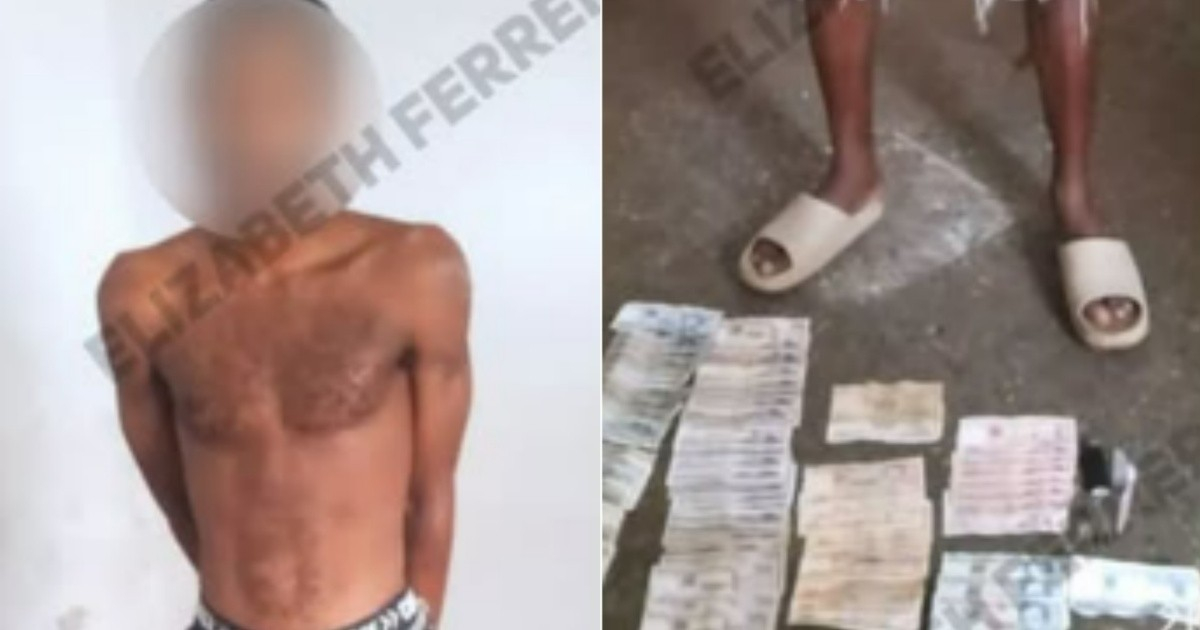
In a police operation conducted on October 1 in the Playa municipality of Havana, authorities apprehended an individual known by the nickname "Ardilla." The suspect was found in possession of 131 doses of synthetic cannabinoids—commonly referred to in Cuba as "the chemical"—along with cash believed to be the proceeds of drug trafficking.
Details of the arrest were shared by Elizabeth Ferrer's Facebook profile, which is linked to the Cuban Ministry of the Interior (MININT), and were further disseminated by state-run media outlets like Cuban Television. The social media post described the arrested individual as someone who "had set up his drug-selling operation right in the neighborhood, causing distress to multiple families."
Accompanying images showed the suspect shirtless, wearing camouflage shorts and white sandals, with currency scattered on the ground in front of him. A subsequent photo revealed numerous small folded papers—typical packaging for the drug—next to a banknote.
The Public Reaction and Community Relief
The official report noted community support for the arrest. "Neighbors have long demanded his incarceration," Ferrer remarked, adding, "No one sells with impunity here."
Understanding "The Chemical"
In Cuba, "the chemical" is a street term for synthetic cannabinoids, also known as "papelito" due to their paper strip form. Experts warn these substances are 50 to 100 times more potent than marijuana, posing risks of seizures, psychosis, and severe intoxications. The danger is amplified when mixed with fentanyl, formaldehyde, or benzodiazepines, increasing the overdose potential.
With a price of approximately 250 Cuban pesos per dose (about $0.50), it remains one of the most affordable and accessible drugs on Cuba's illegal market, particularly among the youth aged 14 to 25. According to official data cited by the Associated Press, emergency medical cases related to this drug nearly doubled in Havana—from 467 incidents in 2024 to 886 in 2025.
Escalating Police Efforts Against Drug Trafficking
The case involving "Ardilla" is part of a broader crackdown by MININT in Havana throughout 2026. In mid-September, an operation in Central Havana resulted in 13 arrests and the seizure of cocaine and 184 strips of synthetic cannabinoids. Shortly thereafter, operations in Guantánamo led to additional arrests related to marijuana and "the chemical."
Cuban authorities have identified no fewer than 46 variants of synthetic cannabinoids circulating within the country. They assert that most are smuggled from the United States through air and parcel services. In July 2026, Cuban Customs intercepted shipments of the drug concealed in food packages at José Martí International Airport.
Rising Social Concerns Over Drug Use
The social concern regarding the proliferation of "the chemical" extends beyond police reports. On October 2, Cuban intellectual Rodolfo Alpízar Castillo publicly highlighted the growing consumption in the Santos Suárez neighborhood, depicting scenes of young people visibly affected in public spaces and questioning, "How much longer must we wait?"
FAQ About Synthetic Cannabinoids in Cuba
What are synthetic cannabinoids known as in Cuba?
In Cuba, synthetic cannabinoids are often referred to as "the chemical" or "papelito," due to their form of paper strips impregnated with the substance.
What are the potential risks associated with "the chemical"?
The risks include seizures, psychosis, and severe intoxication, which are further heightened when the drug is mixed with substances like fentanyl, formaldehyde, or benzodiazepines, increasing the chance of overdose.
How has the Cuban government responded to the drug trade?
The Cuban government has intensified police operations, resulting in numerous arrests and seizures of drugs throughout Havana and other regions, as part of a broader effort to combat the illegal drug trade.